
The Energy Storage Boom Powering the Future of Clean Electricity
How falling battery costs and rising demand are reshaping global energy systems

The way the world produces and uses electricity is changing fast. Renewable energy sources like wind and solar are expanding at record pace, but they come with one major challenge — they don’t produce power all the time. The sun doesn’t always shine, and the wind doesn’t always blow. This is where energy storage systems are becoming essential.
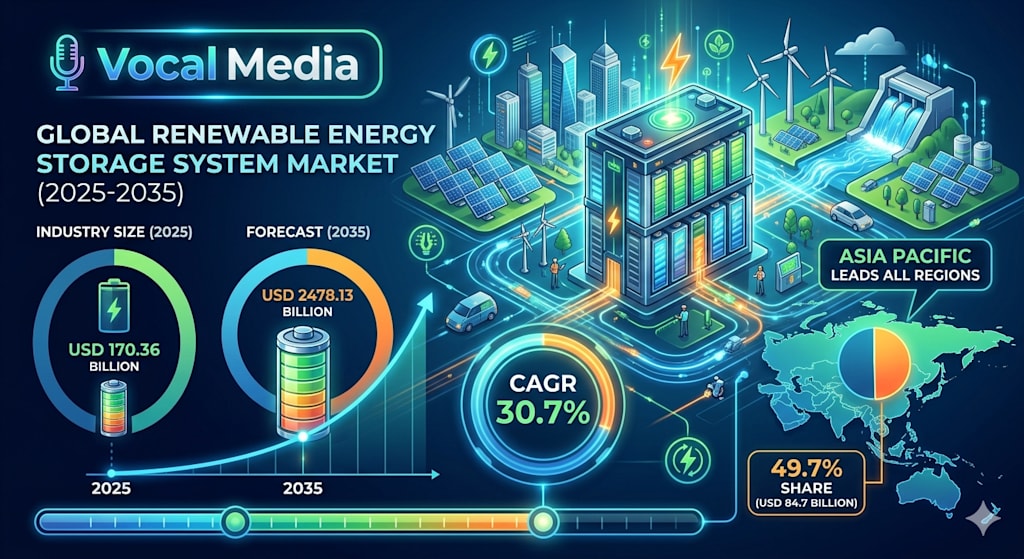
The global renewable energy storage system market is growing rapidly. It is expected to jump from about USD 170 billion in 2025 to nearly USD 2.5 trillion by 2035. That kind of growth signals a major shift. Energy storage is no longer a side technology — it is becoming a core part of modern energy infrastructure.
Why Energy Storage Matters More Than Ever
For years, power grids relied heavily on fossil fuels because they could produce electricity on demand. But as countries move toward cleaner energy, that reliability gap needs to be filled. Storage systems solve this problem by saving excess energy when supply is high and releasing it when demand rises.
Think of it like a battery for the entire grid. When solar panels generate more electricity than needed during the day, storage systems keep that energy for later use — like in the evening when demand peaks. Without storage, much of that clean energy would simply go to waste.
This shift is not optional anymore. Utilities and governments are now building storage directly into new energy projects. In many cases, renewable projects cannot even get approval unless they include storage.
Market Highlights
- The Global Renewable Energy Storage System Market valued at USD 170.36 Billion in 2025, reaching USD 2,478.13 Billion by 2035 at a CAGR of 30.7%.
- Asia Pacific leads all regions with a 49.7% share, valued at USD 84.7 Billion.
- Wind Power dominates the By Type segment with a 48.6% share.
- Pumped Hydro leads the By Technology segment with a 43.6% share.
- Residential end users hold the largest share at 54.8% in the By End User segment.
What’s Driving This Rapid Growth?
Several strong forces are pushing the market forward.
First, electricity demand is rising quickly. Data centers, especially those supporting artificial intelligence, consume huge amounts of power. At the same time, more people are switching to electric vehicles and electric heating. All of this puts pressure on existing grids.
Second, battery costs have dropped sharply. Over the past decade, prices have fallen dramatically, making storage systems more affordable for utilities, businesses, and even homeowners. This price drop has opened the door for wider adoption.
Third, governments are stepping in with policies and funding. Many countries now require energy providers to include storage in their plans. Others are offering financial support to speed up adoption. These policies are turning storage from a long-term idea into an immediate priority.
The Technologies Behind Energy Storage
Not all storage systems are the same. Different technologies serve different needs.
Pumped hydro storage remains the most widely used system. It works by moving water between two reservoirs at different heights. When electricity is needed, the water flows down to generate power. This method has been around for decades and is still very effective for large-scale storage.
Battery storage, especially lithium-ion systems, is the fastest-growing segment. These batteries are flexible, quick to install, and can respond instantly to changes in demand. They are now being used in everything from large power plants to residential homes.
Other technologies are also gaining attention. Hydrogen storage can store energy for longer periods, making it useful for seasonal energy needs. Flywheel systems are used for very fast response times, helping to keep the grid stable. Thermal storage, which stores energy as heat or cold, is becoming popular in buildings.
Each of these technologies plays a role in building a more balanced and reliable energy system.
Who Is Using Energy Storage?
One of the most interesting trends is how widely storage is being adopted.
Homeowners are installing solar panels paired with batteries to reduce their electricity bills and gain more control over their energy use. In many regions, this combination already makes financial sense.
Businesses are using storage to manage energy costs and avoid peak charges. For industries, even a short power outage can be very expensive, so storage provides a reliable backup.
Utilities, however, remain the biggest users. They deploy large-scale storage systems to manage entire power networks. These projects often involve huge investments and long-term planning, but they are essential for maintaining grid stability.
Regional Growth Patterns
Different parts of the world are moving at different speeds, but the overall trend is clear.
Asia Pacific leads the market, driven by large-scale investments and strong government support. Countries in this region are building storage at an unmatched pace, making it the center of global growth.
North America is also expanding quickly, especially as grid reliability becomes a bigger concern. Europe is focusing on storage to support its renewable energy targets and reduce dependence on fossil fuels.
Emerging markets in Latin America and Africa are starting to adopt storage as well, particularly in areas where reliable electricity access is still a challenge.
Challenges That Could Slow Things Down
Despite strong growth, the market faces some real challenges.
Supply chains remain a concern. Key materials like lithium, cobalt, and nickel are essential for battery production, and shortages or price swings can delay projects. Many of these materials are concentrated in a few regions, which adds geopolitical risk.
Another issue is policy uncertainty. Changes in government regulations or incentives can affect project timelines. When rules shift unexpectedly, companies may delay investments.
There is also the challenge of scale. Building storage systems at the level needed to support global energy demand requires massive investment and coordination.
What the Future Looks Like
The future of energy storage looks strong, but it is also evolving quickly.
As technology improves, systems will become more efficient and cost-effective. New business models are emerging, where storage operators can earn revenue by helping balance the grid in real time.
Competition is increasing. As prices fall, companies will need to focus more on performance, reliability, and service rather than just cost.
Most importantly, storage is becoming a permanent part of the energy landscape. It is no longer a backup solution — it is a central piece of how electricity systems operate.
Final Thoughts
The rapid rise of renewable energy storage systems reflects a deeper change in how the world thinks about power. Energy is no longer just about generation; it is about management, flexibility, and control.
As demand grows and clean energy expands, storage will play a critical role in keeping everything balanced. The next decade will likely see even faster growth, new technologies, and broader adoption across industries.
In simple terms, energy storage is turning renewable power from an unpredictable resource into a reliable one — and that changes everything.
About the Creator
Yash Mule
SEO Specialist with 10+ years of experience at Evolvance Market Research. Expert in technical SEO, content strategy, and data-driven optimization, with a proven track record of significantly increasing organic traffic and search rankings.
Enjoyed the story? Support the Creator.
Subscribe for free to receive all their stories in your feed.
Comments
There are no comments for this story
Be the first to respond and start the conversation.