
The End of Search? How AI Agents Could Replace Google Searches
From Search Results to Intelligent Decisions

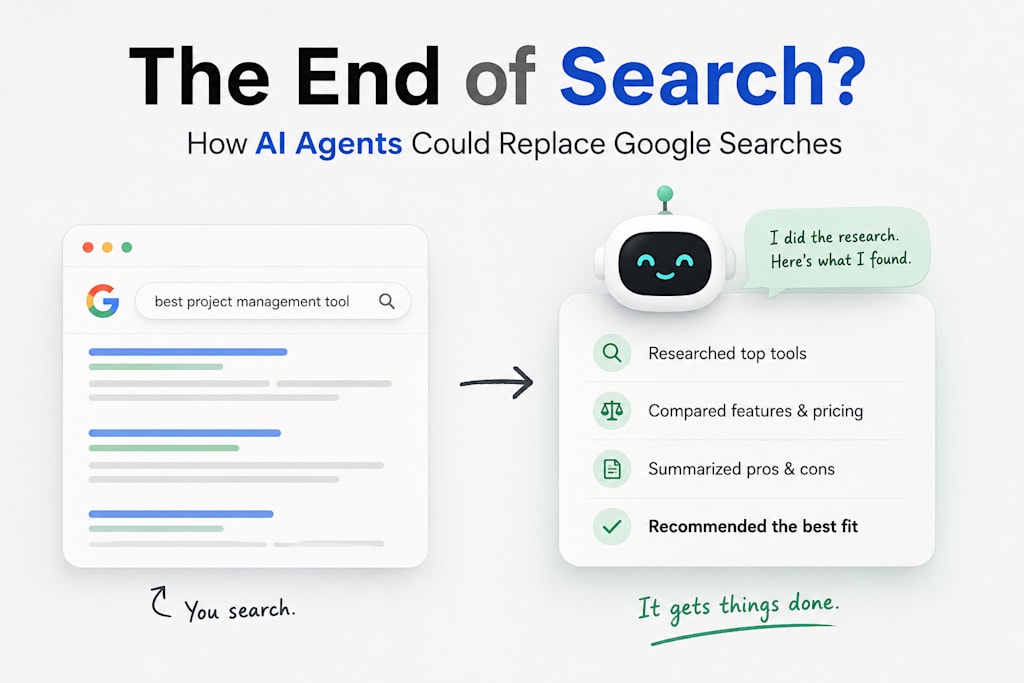
For decades, finding information online meant opening Google, typing a question, and scrolling through pages of results.
Today, a new generation of AI agents is starting to challenge that habit.
Instead of helping users find information, these systems can research topics, compare options, summarize findings, and even take action on users' behalf. The shift may seem subtle, but it represents one of the biggest changes in how we interact with the internet.
As businesses accelerate digital transformation initiatives and invest in agentic AI development services, the role of search itself is beginning to evolve.
The question is no longer whether AI will change search.
The question is whether search, as we know it today, will still be necessary in the future.
The Real Problem With Search Today
Search engines were designed to help us find information.
The problem is that information is no longer hard to find.
Today, a single search can produce millions of results in less than a second. Yet many people still spend more time comparing sources, opening tabs, and filtering content than actually finding the answer they need.
In other words, search solved the information problem years ago. Now we're facing a decision problem.
Now we're facing a decision problem.
People don't want ten possible answers.
They want the most useful one.
That's why the future of search may not be about finding more information. It may be about helping people make better decisions with the information that's already available.
AI Agents Don't Just Find Information
Traditional search engines are designed to answer questions.
AI agents are designed to achieve outcomes.
That distinction may seem small, but it fundamentally changes how people interact with information online.
Instead of simply providing links, the future of search won't be about finding information faster. It will be about turning information into action.
An AI agent can:
- Research multiple sources
- Compare information
- Summarize findings
- Create recommendations
- Take action on your behalf
Imagine planning a trip, researching software, or comparing products. Rather than opening ten browser tabs and piecing everything together yourself, an AI agent can do much of the heavy lifting and present a clear result.
That's why many experts believe the future of search won't be about finding information faster. It will be about turning information into action.
Why This Matters for Businesses
The rise of AI agents isn't just changing how people search.
It's changing how businesses operate.
For years, companies have invested in digital transformation initiatives to improve efficiency, reduce manual work, and make faster decisions. AI agents represent the next stage of that evolution.
Instead of simply helping employees find information, these systems can research options, analyze data, support decision-making, and automate repetitive tasks. That's one reason demand for agentic AI development services continues to grow. Organizations are increasingly looking beyond traditional search tools and investing in intelligent systems that can actively help get work done.
The goal isn't simply to search faster.
It's to work smarter.
Maybe Google Isn't the One Being Replaced
Most discussions about AI agents focus on solutions to what happens to Google.
That makes sense. Google has been the gateway to information for more than two decades.
But focusing on Google may distract us from a much bigger shift.
The real change is happening in user behavior.
People are gradually moving away from the idea of searching for information and moving toward the idea of delegating tasks. The more capable AI becomes, the less interested users may be in finding answers themselves.
They'll simply want the outcome.
The Future of Search May Not Be Search
When most people open a search engine, they're rarely looking for information alone. They're usually trying to solve a problem, make a decision, or figure out what to do next.
For years, search engines have been the fastest way to get there. They helped us find websites, compare options, and gather the information we needed to make informed choices. But the process still requires us to do most of the work ourselves.
AI agents introduce a different approach. Instead of simply pointing us toward information, they can help organize it, analyze it, and present it in a way that's easier to act on. That's a subtle shift, but it has the potential to change how people interact with the web.
The future may not be about replacing search engines altogether. It may be about reducing the number of times we need to search in the first place.
And if an AI agent could handle the research, comparison, and decision-support process for you, would searching the internet still feel like the most efficient option?
Conclusion
A few years ago, the idea of asking AI to write an email, plan a trip, or summarize hours of research sounded futuristic.
Today, many people do it without a second thought.
That's what makes the conversation around AI agents so interesting. The technology itself is evolving quickly, but our habits may be changing even faster.
For decades, searching for information has been the default way we interact with the internet. It's hard to imagine a different approach because search has been part of our online lives for so long.
But if AI agents continue to improve, future users may not think in terms of searches at all.
They may simply describe what they want to achieve and let the technology handle the rest.
Whether that future arrives in five years or twenty, it's becoming increasingly difficult to imagine that the next generation will use the web exactly the way we do today.
About the Creator
Encodedots Technolabs
Encodedots Technolabs is a diversified IT outsourcing company. We help our clients reach their business goals with our IT solutions to add real value to your business.
Visit: https://www.encodedots.com
Enjoyed the story? Support the Creator.
Subscribe for free to receive all their stories in your feed.
Comments
There are no comments for this story
Be the first to respond and start the conversation.