
The Emerging Trust Crisis in AI Driven Wealth Management Systems
The overlooked challenge shaping the future of AI-powered investing

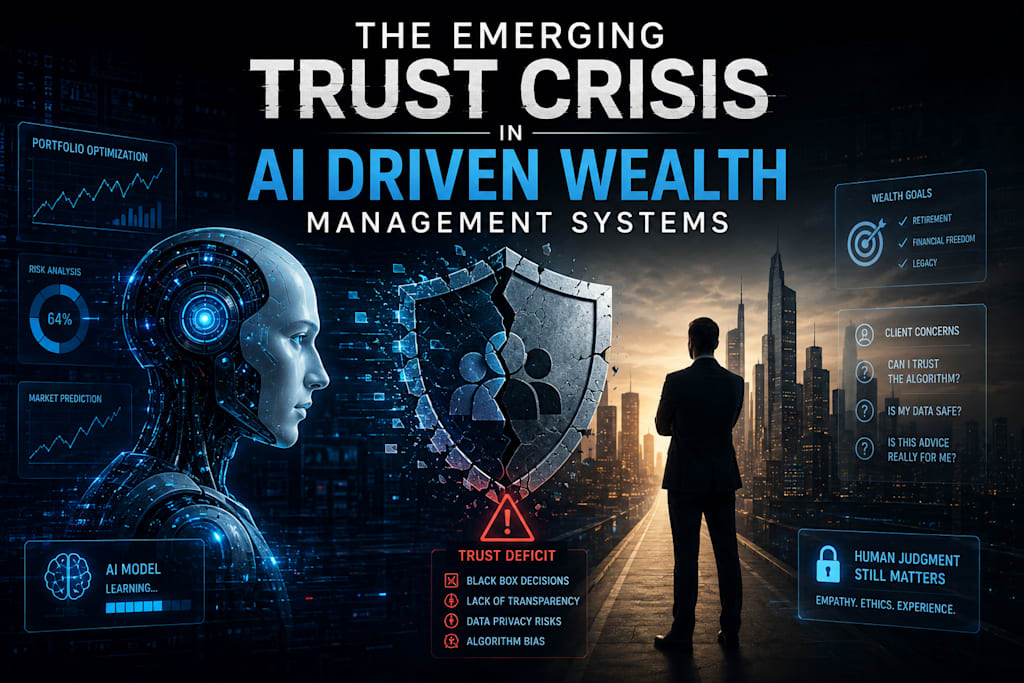
Artificial intelligence is transforming wealth management faster than many expected.
Investment firms are exploring AI-powered research tools, portfolio analysis systems, automated recommendations, and predictive insights designed to help investors make better decisions. The technology promises greater efficiency, faster analysis, and a level of personalization that would have been difficult to deliver just a few years ago.
Yet despite the enthusiasm surrounding AI, many organizations are discovering that building an intelligent investment platform is only part of the challenge.
The harder task is earning trust.
A platform can generate recommendations in seconds, analyze thousands of market signals simultaneously, and surface opportunities that might otherwise go unnoticed. None of those capabilities matter if investors and advisors do not feel confident relying on the results.
That reality is shaping the next phase of AI adoption across wealth management.
The Real Test Begins After the Demo
Building a prototype has never been easier.
Modern development teams can connect financial datasets, integrate AI models, and create sophisticated dashboards in a relatively short amount of time. Demonstrations often showcase impressive capabilities that capture the attention of stakeholders and decision-makers.
The real test begins when a platform moves beyond controlled environments and starts supporting actual investment decisions.
At that point, expectations change.
Performance alone is no longer enough. Reliability, consistency, transparency, and governance become equally important.
Questions that rarely appear during product demonstrations suddenly become central to the discussion. How are recommendations generated? What happens during periods of market volatility? How are risks monitored? Can advisors explain the reasoning behind an AI-generated suggestion?
The answers to those questions often determine whether a platform becomes a trusted financial tool or remains an interesting technology experiment.
The Most Important Competitive Advantage May Be Invisible
Conversations about AI frequently revolve around models.
A new benchmark appears. A new capability makes headlines. A new platform claims better performance than its competitors.
While those developments attract attention, they can distract from a less visible factor that often has a greater impact on outcomes.
Data quality.
Every recommendation produced by a wealth management platform depends on information flowing through the system. Market activity, economic conditions, portfolio history, investor objectives, and risk profiles all influence the final output.
When that information is incomplete, inconsistent, or outdated, the quality of recommendations can decline regardless of how advanced the underlying technology may be.
This is why many financial technology teams spend significant resources improving data infrastructure. The reliability of an AI system often depends less on the model itself and more on the quality of the information supporting it.
Investors Want Understanding, Not Just Answers
Financial decisions are deeply personal.
Whether someone is saving for retirement, managing generational wealth, or planning for long-term goals, investment choices carry consequences that extend far beyond a dashboard.
Because of that, recommendations without explanations rarely inspire confidence.
If a platform suggests adjusting a portfolio or reducing exposure to a particular asset class, investors naturally want to understand why.
Transparency has become one of the most valuable qualities an AI-powered platform can offer.
People are generally more willing to trust recommendations when they can see the reasoning behind them. Advisors benefit as well because clear explanations make it easier to communicate decisions and build confidence with clients.
In many ways, explainability is becoming just as important as prediction accuracy.
Automation Has Limits
Automation is often presented as one of AI's greatest advantages.
In wealth management, portfolio rebalancing is frequently highlighted as a process that can benefit from intelligent automation. The concept sounds straightforward: analyze conditions, identify opportunities, and adjust allocations accordingly.
Real investing is rarely that simple.
Every portfolio exists within a broader financial context that includes risk tolerance, tax considerations, liquidity requirements, investment horizons, and personal objectives.
A recommendation that appears optimal from a purely analytical perspective may not be the right decision for a particular investor.
This is why many organizations are focusing on decision support rather than full automation. AI can accelerate analysis and surface valuable insights, but context remains essential.
The strongest platforms recognize that investing involves both data and judgment.
Security Is Becoming a Differentiator
Trust is impossible without security.
Wealth management platforms handle some of the most sensitive information people own, including financial records, portfolio details, transaction histories, and long-term investment plans.
As AI systems gain access to larger volumes of financial data, expectations around security continue to rise.
Investors want assurance that their information is protected. Advisors want confidence that systems operate responsibly. Organizations want to meet regulatory obligations while maintaining operational efficiency.
For many firms, security is no longer simply a technical requirement operating behind the scenes.
It is becoming a competitive advantage.
The platforms that can combine intelligence with strong governance and protection measures are likely to earn greater confidence from both clients and institutions.
Faster Insights Are Reshaping Expectations
Investor expectations continue to evolve.
People are accustomed to receiving information instantly in nearly every part of their digital lives, and financial services are no exception.
Market conditions can change rapidly. New risks can emerge unexpectedly. Opportunities can appear and disappear within hours.
As a result, wealth management platforms are under increasing pressure to deliver insights in real time.
Achieving that goal requires more than sophisticated algorithms. It requires scalable infrastructure, efficient data pipelines, and systems capable of processing information continuously without sacrificing accuracy or reliability.
The organizations that succeed will be those that balance intelligence with speed.
Neither capability is enough on its own.
Human Expertise Remains Essential
Predictions about AI replacing financial advisors have become increasingly common.
The reality is more nuanced.
Investing is not simply a data challenge. It is also a human one.
People make financial decisions based on personal priorities, future goals, family circumstances, and emotional factors that cannot always be captured through data alone.
AI excels at identifying patterns and processing information at scale. Advisors excel at understanding context and helping clients navigate uncertainty.
Rather than replacing human expertise, the most successful platforms are likely to enhance it.
The future of wealth management will belong to organizations that combine technological capability with human insight.
Trust Will Define the Next Generation
The wealth management industry will continue embracing AI.
Platforms will become more intelligent. Recommendations will become more personalized. Analytical capabilities will continue to improve.
But intelligence alone will not determine which solutions succeed.
The organizations that create lasting value will be the ones that build systems people trust.
That trust will depend on transparency, security, reliability, governance, and strong data foundations.
Building AI for wealth management is becoming increasingly achievable.
Building confidence in those systems may be the challenge that ultimately matters most.
About the Creator
Jane
Exploring the intersection of technology, AI, software engineering, and digital innovation. I write about emerging trends, product development, fintech, startup growth, and the real-world challenges of building scalable technology.
Enjoyed the story? Support the Creator.
Subscribe for free to receive all their stories in your feed.
Comments
There are no comments for this story
Be the first to respond and start the conversation.