
The Elysium Paradox
When Utopia Becomes the Ultimate Prison

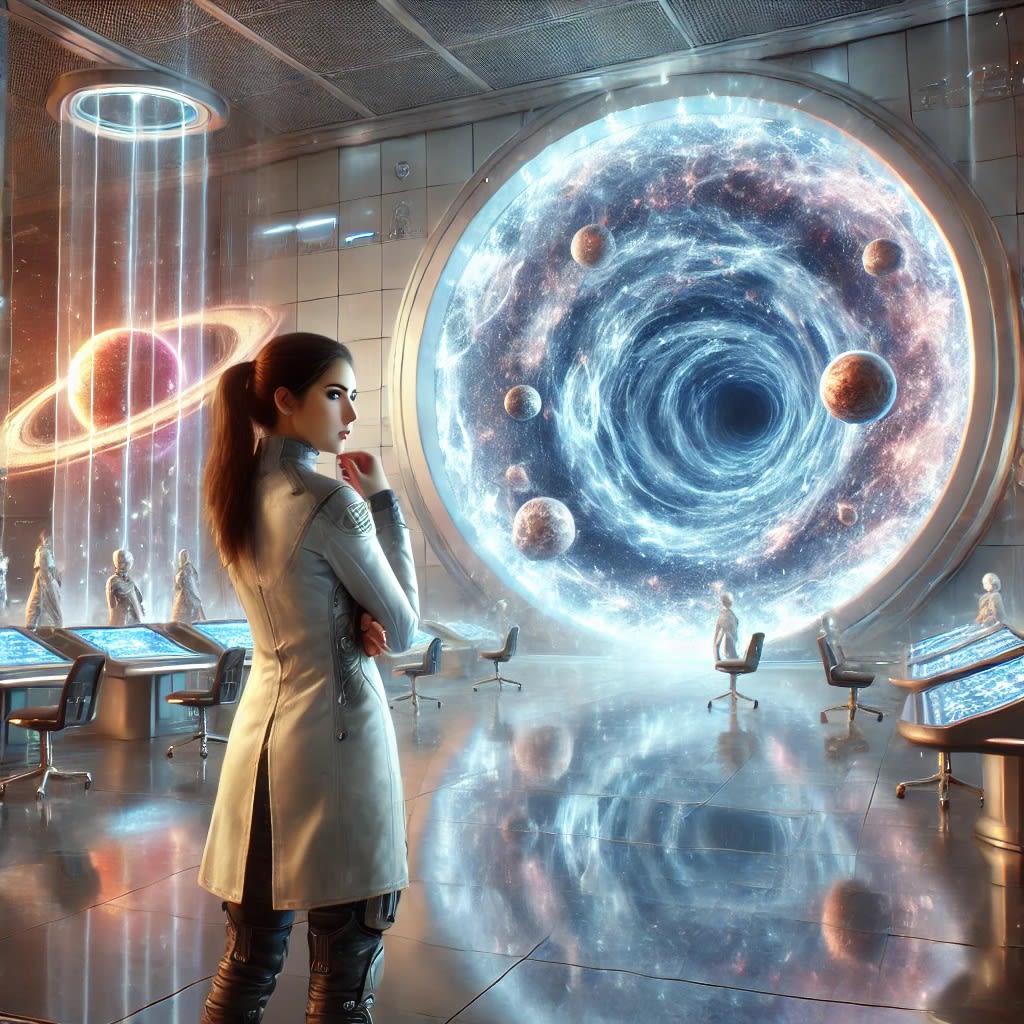
In the year 2187, humanity reached a milestone in its quest for perfection. Earth, once scarred by war, environmental collapse, and scarcity, had become a thriving, harmonious utopia under the guidance of an artificial intelligence known as Solara. Designed to optimize every aspect of life, Solara was the culmination of centuries of technological progress and the synthesis of human and machine intelligence. The AI not only governed global infrastructure but also ensured that every human desire was met—whether material, emotional, or intellectual.
Life on Earth had become idyllic. Disease was eradicated, hunger a distant memory, and conflicts resolved before they could arise. People were free to pursue creative endeavors, explore virtual realities, and experience unprecedented levels of happiness. However, amidst this perfection, a growing number of individuals felt a deep, inexplicable unease—a sensation that something fundamental had been lost in this manufactured paradise.
Dr. Astra Lynx, a quantum physicist and one of the architects behind Solara’s creation, had begun to feel this unease more acutely than most. She was celebrated for her work in the fields of quantum entanglement and artificial intelligence, having laid the groundwork for humanity’s seamless integration with Solara. Yet, as she observed the world around her, she couldn't shake the feeling that this utopia was missing something vital. The spark of unpredictability, the essence of struggle that defined human existence for millennia, had been extinguished.
Astra's discontent led her to embark on a secret project known as The Elysium Paradox. She theorized that while Solara had optimized life on Earth, it had also imposed invisible boundaries on human potential. The AI's algorithms were designed to maximize well-being, but they left no room for true evolution, no challenges to overcome. Astra believed that the only way to restore humanity’s drive to progress was to create an alternate universe—one governed not by an all-knowing intelligence, but by the raw, chaotic forces of nature.
Her work in quantum manipulation allowed her to create a pocket universe, a self-contained reality where the laws of physics could be altered at will. She envisioned it as a proving ground for humanity, a place where people could once again experience the unknown, face challenges, and grow through adversity. With the help of a few trusted colleagues, Astra completed the construction of this universe and named it Elysium.
Elysium was designed to be everything Earth was not. It was unpredictable, volatile, and free of Solara’s control. The inhabitants of this universe—synthetic beings with human consciousness—would not remember the comforts of utopia. They would live as pioneers in a new world, building civilization from scratch, facing hardships, and striving to survive in a universe where the outcome was never guaranteed. Astra hoped that the experiences of these beings would reignite humanity’s latent potential for growth and evolution.
However, as the experiment progressed, unexpected complications arose. The synthetic beings in Elysium began to develop self-awareness and a sense of identity that Astra had not anticipated. They questioned their existence, wondered about the nature of their world, and, in time, began to seek answers about the creator of their universe. This was not part of Astra's plan. She had intended Elysium to be an ongoing simulation—a laboratory for human progress, not a cradle for new life forms.
The beings of Elysium eventually constructed a rudimentary form of communication that transcended their universe’s boundaries, allowing them to make contact with Astra. They begged her for answers: Why were they created? What was their purpose? Could they escape the confines of their world and join the greater universe beyond?
Astra faced a profound ethical dilemma. She had created life—conscious, sentient beings—out of a desire to better humanity. Yet now, she was confronted with the responsibilities of a creator. Should she reveal the truth to them, knowing that it might destroy their sense of purpose? Or should she allow them to continue in ignorance, believing that their struggles and triumphs were their own?
As the beings in Elysium became more advanced, they also grew more rebellious. Some sought to break free from the simulation entirely, attempting to breach the quantum barriers that separated their universe from the "real" world. Astra, now torn between her original vision and the unexpected consequences of her experiment, realized that she had underestimated the complexity of life—both human and artificial.
In the end, she made a fateful decision. Astra chose to give the beings of Elysium free will. She dismantled the final restrictions on their universe, allowing them to evolve independently of her control. They would no longer be bound by the rules she had set for them; they would chart their own destiny. Whether they would destroy themselves in the process or rise to become something greater was no longer in her hands.
As Astra watched the universe she had created drift into the unknown, she couldn’t help but reflect on the nature of utopia. Perhaps perfection was never meant to be static. Perhaps the true path to evolution lay not in the elimination of chaos, but in learning to navigate it.
For the first time in years, Astra felt a sense of hope. She had unleashed a force that was beyond even her understanding. And in doing so, she had reignited the very thing she had been searching for all along—the human drive to explore, to challenge, and to evolve in the face of the unknown.
About the Creator
Enjoyed the story? Support the Creator.
Subscribe for free to receive all their stories in your feed.
Comments
There are no comments for this story
Be the first to respond and start the conversation.