
The Death of Traditional SEO: What Google’s AI Overviews Mean for Writers
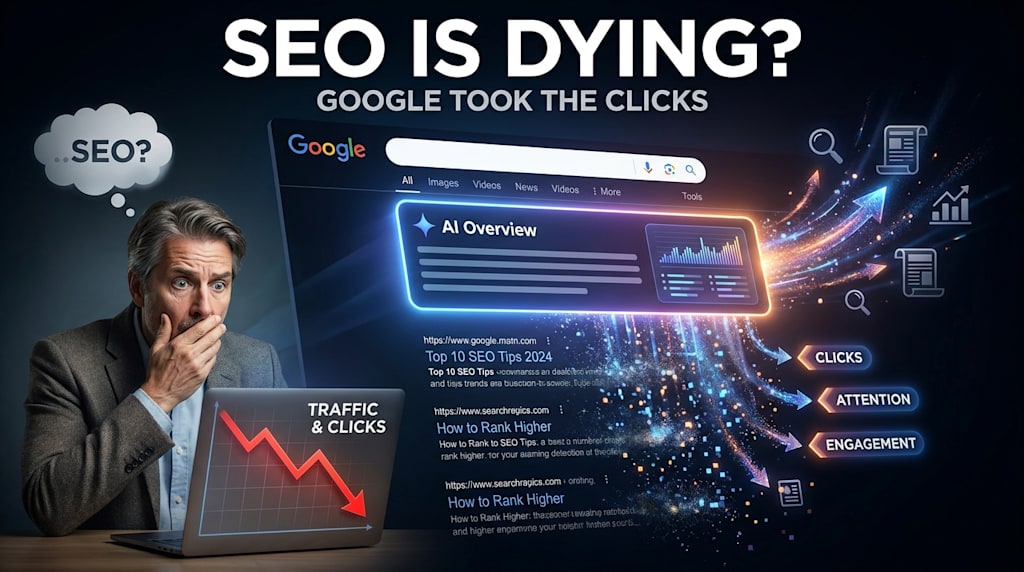
The biggest change to search in two decades isn't another Google update. It's the possibility that users may never click your article at all.

For years, the relationship between writers and Google was relatively simple.
You created useful content, optimized it around relevant keywords, earned backlinks, and hoped your article would rank high enough to attract clicks. The system was never perfect, but the basic rules were widely understood.
Today, those rules are changing.
When Google introduced AI Overviews, many writers viewed the feature as just another update. Over time, however, it became clear that this was something much bigger. AI Overviews are not simply reorganizing search results. They are changing the role of search itself.
For the first time, Google can answer many questions directly on the results page without requiring users to visit the websites that provided the information.
That shift has sparked an uncomfortable question across the publishing industry:
What happens when readers get the answer before they reach the article?
The concern is understandable. Traditional SEO was built around clicks. Writers, publishers, and businesses invested countless hours creating content designed to attract search traffic. If AI-generated summaries satisfy users immediately, fewer people may feel the need to explore the original source.
In some cases, that is already happening.
Search is gradually evolving from a destination engine into an answer engine.
The difference may sound subtle, but the implications are enormous.
A few years ago, ranking first on Google often meant winning a large share of traffic. Today, even a top-ranking article can appear beneath an AI-generated response that addresses the user's question before they see any organic results.
For writers, this creates both a challenge and an opportunity.
The challenge is obvious. Generic content is becoming easier to replace. Articles that simply repeat information found elsewhere are increasingly vulnerable because AI systems can summarize that information in seconds.
The opportunity lies in creating something AI struggles to replicate.
Original reporting, personal experience, expert analysis, unique opinions, interviews, case studies, and firsthand observations have become significantly more valuable. These elements do not merely provide information. They provide perspective.
And perspective is much harder to automate.
This may explain why some publishers are shifting their focus away from producing large volumes of search-driven content and toward creating material that demonstrates genuine expertise.
The goal is no longer just to rank.
The goal is to be worth citing.
That distinction could define the next era of online publishing.
Writers who built their careers around keyword optimization alone may find the transition uncomfortable. But those who understand audiences, tell compelling stories, and offer insights unavailable elsewhere may discover new opportunities.
Ironically, AI may push content creators back toward something that many had forgotten.
Good writing.
For years, the internet rewarded content that was optimized for algorithms. Increasingly, success may depend on content that serves humans first and algorithms second.
That does not mean SEO is disappearing completely. Search engines still need high-quality sources to train, reference, and surface information. Visibility will continue to matter.
What is changing is the nature of that visibility.
Being discovered is no longer enough. Writers must also be memorable.
As AI overviews become more common, the websites that thrive are likely to be those that offer something beyond easily summarized facts. Readers may visit fewer pages, but they may spend more time with sources they genuinely trust.
The phrase "the death of SEO" makes for a dramatic headline, but it may not be entirely accurate.
Traditional SEO is not dying.
It is evolving into something broader.
The future belongs to writers who can combine expertise, originality, credibility, and human insight in ways that AI summaries cannot fully capture.
In the end, Google’s AI Overviews may not eliminate the need for writers.
They may simply force writers to become more valuable
About the Creator
Future Lens
Exploring AI, technology, and the future of work through research-driven insights.
Enjoyed the story? Support the Creator.
Subscribe for free to receive all their stories in your feed.
Comments
There are no comments for this story
Be the first to respond and start the conversation.