
The Death of Autocomplete: Why 2026 is the Year of the Agentic IDE
From simple autocomplete to autonomous system orchestration: How Llama 3.1, Windsurf, and DeepSeek are redefining the engineering economics of 2026.

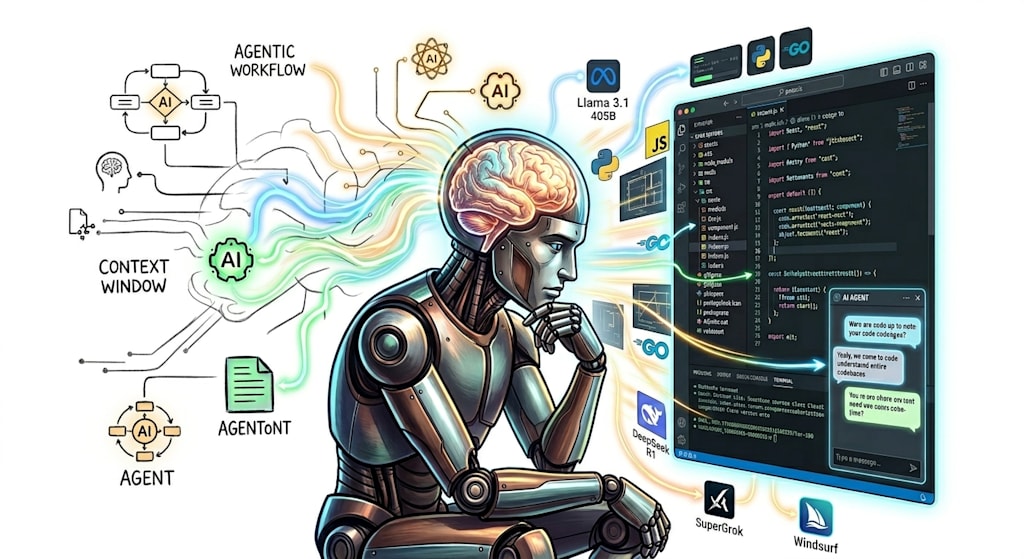
The shift in how we build software over the last year hasn't just been about having a chat window open next to our code. For those of us spending eight hours a day in a terminal, the transition from simple autocomplete to what we now call agentic workflows is the most significant change in productivity we've seen in a decade. We are no longer just asking an AI to "write a function"; we are asking it to understand why that function exists within our specific architecture.
The Core IDE Architecture: Beyond Text Editing
To understand where we are going, we have to look at the core IDE architecture. For years, the editor was a passive tool a place where syntax highlighting was the peak of intelligence. Today, the integration is native. Tools like Visual Studio Code have evolved from being mere shells to hosting environments for complex reasoning engines.
The reality of native AI integration means the IDE is now an active participant. By indexing the local codebase using RAG (Retrieval-Augmented Generation), these tools allow the model to provide suggestions that actually follow the project's established patterns. If you use a specific error-handling wrapper in 90% of your project, a modern agent won't suggest a generic block; it will use your custom implementation.
Visual Studio Code and the Rise of Windsurf Agent Mode
While many started with basic extensions, the market has moved toward deeper integration. Windsurf agent mode has changed the game by allowing the assistant to treat the entire codebase as a single, searchable, and indexable entity. This isn't just about speed; it's about the reduction of cognitive load.
When your environment understands that a change in a database schema requires a corresponding update in three different frontend components, it changes the way you approach refactoring. This level of autonomy is what separates a simple plugin from a true "agent."
Llama 3.1 405B vs. The Lightweight Contenders
Model selection is no longer a "one size fits all" decision. When we look at llama model details and specifications, the divergence in performance is staggering. For massive, high-logic tasks, llama 3.1 405b provides a level of reasoning that was previously reserved for closed-source giants. However, for local execution and rapid-fire iterations, the llama 3 8b cpu tokens per second benchmark is often the more critical metric for a smooth dev experience.
If your local machine can't push enough tokens per second, the "flow state" of programming is broken. This is why understanding the hardware-to-model ratio is now a core skill for the modern engineer.
DeepSeek-V3.1 and DeepSeek R1: The New Efficiency Kings
We are seeing a massive shift toward efficiency with models like DeepSeek-V3.1 and the reasoning-heavy DeepSeek R1. These models have shown that you don't need trillion-parameter architectures to solve complex, legacy C++ logic or modern TypeScript boilerplate.
The technical architecture of these models, specifically how they handle long-context debugging, is a primary reason why they are being integrated into the newest agentic workflows. If you are working on a monolithic repository with half a million lines of code, a model with poor retrieval logic will fail you, regardless of how good the IDE interface looks.
SuperGrok Heavy 16 Agents and High-Stakes Orchestration
For teams operating at the absolute frontier, supergrok heavy 16 agents represent the pinnacle of multi-agent orchestration. The ability to have 16 specialized agents working in parallel one on testing, one on documentation, and others on core logic moves us from "coding" to "system orchestration."
This level of autonomy requires a new kind of discipline. We have to become better at reviewing code than we are at writing it. The "writing" part is becoming cheap; the "validation" part is where the seniority of an engineer now resides.
Navigating the Engineering Economics of 2026
One risk we must address is the speed at which AI can generate technical debt. If an agent can churn out 500 lines of code in ten seconds, the review process must be equally robust. The best developers in 2026 are those who use AI to simplify their systems, not just to build them faster.
To truly understand which model fits your specific stack whether you are optimizing for local speed or cloud-based reasoning you need to look at the hard data. We recommend checking out this comprehensive frontier model technical breakdown and agentic performance benchmark to see how these tools hold up under the pressure of a production environment.
About the Creator
AIToolLand Research Team
Comprehensive reviews, data-driven research, and expert guides on popular AI tools. Empowering professionals and creators with independent insights on generative technology. Visit us at: www.aitoolland.com
Enjoyed the story? Support the Creator.
Subscribe for free to receive all their stories in your feed.
Comments
There are no comments for this story
Be the first to respond and start the conversation.