
The Day the World Went Silent
When every smartphone on Earth suddenly stops working, humanity faces chaos—and discovers the forgotten value of real human connection in a world without screens.

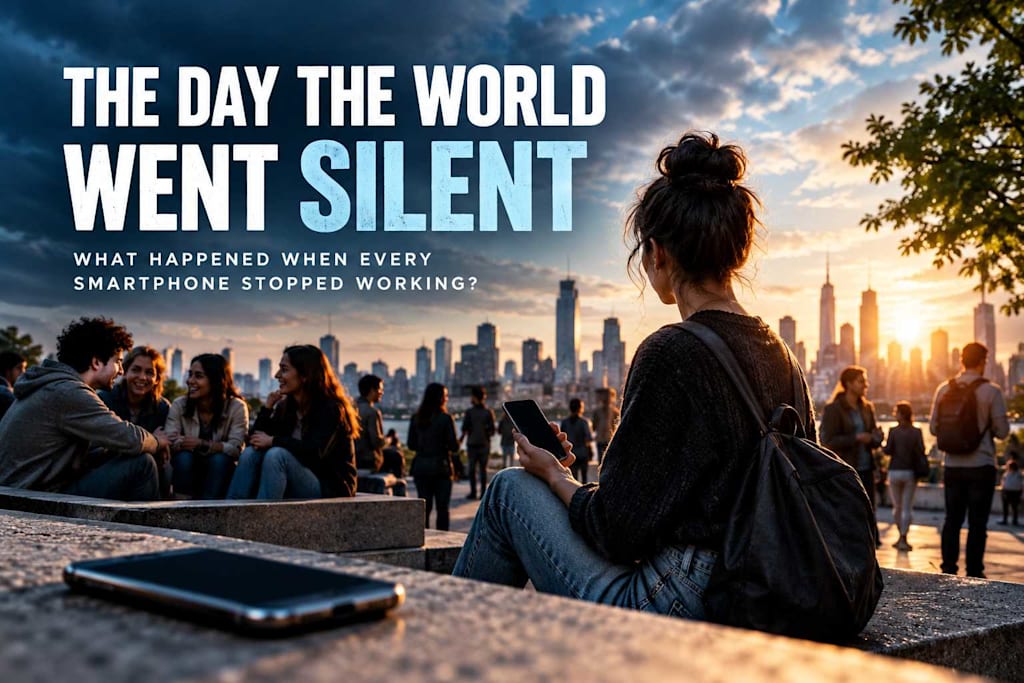
The Day the World Went Silent: A Haunting Reflection
When every smartphone on Earth stopped working, humanity discovered that the greatest connection it had lost was the one to itself.
At exactly 9:17 on a Tuesday morning, the world stopped looking down.
It happened everywhere at once.
In New York, a woman holding a coffee cup watched her phone turn black. In Tokyo, thousands of commuters stared at frozen screens. In London, a delivery driver pulled over because his navigation system had disappeared. In Istanbul, a teenager repeatedly pressed the power button, convinced the problem was his battery.
At first, nobody panicked.
People assumed it was a network outage. Perhaps a global software update had gone wrong. Maybe the biggest technology companies were experiencing some unprecedented technical failure.
They restarted their devices. They checked chargers. They held their phones toward the sky, searching for a signal that no longer existed.
But there was no signal.
Every smartphone on the planet had become a useless piece of glass and metal.
And nobody knew why.
The First Hour: A World Without Answers
By 10:00 a.m., confusion had turned into frustration.
People couldn't access banking applications, digital wallets, social media, email, or messaging services. Online payments failed. Ride-sharing services disappeared. Food deliveries stopped arriving. Millions of people suddenly realized they didn't know their friends' phone numbers because they had never needed to memorize them.
At airports, passengers crowded around information desks. Travelers who depended on digital boarding passes found themselves searching through luggage for printed documents.
Traffic became chaotic as navigation systems failed. Drivers stopped in unfamiliar neighborhoods, while others wandered through city streets trying to remember routes they had once traveled without assistance.
In offices, employees gathered around computers, only to discover that many authentication systems depended on smartphone verification.
The modern world had built an extraordinary infrastructure around a device that could fit inside a pocket.
Now that device was gone.
And the most frightening part wasn't that people couldn't communicate.
It was that they couldn't understand what was happening.
Without social media, there were no instant explanations, viral theories, or reassuring updates. Television stations struggled to gather information. Radio stations became unexpectedly important again.
For the first time in years, millions of people turned on their radios simply to hear another human voice.
The Second Day: The Things We Forgot
By the following morning, the consequences were impossible to ignore.
Supermarkets struggled with payment systems. Banks opened their physical branches to enormous queues. Businesses that had moved almost entirely online discovered how difficult it was to operate without mobile authentication.
People who had relied on smartphones for everything suddenly needed to remember how to do ordinary things.
They had to read physical maps, ask strangers for directions, carry cash, write down appointments, and remember important telephone numbers.
Some adapted quickly.
Others didn't.
A generation that had grown up with instant answers found itself facing questions it couldn't solve with a search bar.
But something unexpected began happening.
People started talking.
Not commenting. Not messaging. Actually talking.
Neighbors who had lived in the same apartment buildings for years introduced themselves for the first time. Strangers helped tourists find their hotels. Shopkeepers wrote prices on cardboard signs. Restaurants accepted cash and handwritten orders.
In parks, people gathered around benches and exchanged stories about what they had experienced.
A man who had spent years communicating with his brother through short messages finally visited him.
Two elderly women began meeting every afternoon to play chess.
Children played outside because their usual entertainment had disappeared.
The world was still struggling, but its streets were becoming strangely alive.
The Seventh Day: The Silence Between Us
One week passed.
Governments announced emergency measures. Traditional communication networks became essential. Landlines, radio transmitters, television broadcasts, and printed newspapers experienced a remarkable revival.
Scientists investigated the phenomenon, but nobody could explain it.
The failure appeared to be universal. Every smartphone, regardless of manufacturer, operating system, age, or location, had stopped functioning simultaneously.
There was no evidence of a cyberattack. No indication of a natural electromagnetic event. No explanation that made sense.
Theories multiplied, but without social media, they spread through conversations, newspapers, and broadcast programs.
Some people believed humanity had been punished for becoming dependent on technology.
Others thought it was an elaborate experiment.
A few insisted that the phones would eventually turn back on.
Most people simply wanted their old lives back.
But not everyone.
In a small neighborhood bookstore, a young woman named Clara noticed something unusual.
Sales of notebooks had increased dramatically. People were buying pens, journals, physical calendars, and printed maps.
One afternoon, a customer asked her for a notebook.
"What will you use it for?" Clara asked.
"Everything," the woman replied. "I used to keep my entire life in that little device. Apparently, I don't know how to remember things anymore."
Clara smiled.
"Perhaps it's time to start again."
That evening, Clara wrote something in her own notebook:
We didn't lose the ability to communicate. We lost the habit of being present.
She closed the notebook and looked outside.
A group of children were playing football in the street. A couple was sitting on a nearby bench, talking without interruption. Two neighbors were helping an elderly man carry groceries.
It wasn't a perfect world.
But it was a world she hadn't seen in a long time.
The Thirtieth Day: A Different Kind of Connection
After a month, humanity had begun to reorganize itself.
Businesses developed alternatives to mobile payments. Schools introduced more traditional learning methods. Cities installed public information boards. People began carrying printed emergency contacts and physical identification.
Restaurants returned to paper menus. Libraries became gathering places again. Public noticeboards appeared in neighborhoods, displaying everything from community events to missing pets.
Some industries suffered enormous losses, while others unexpectedly flourished.
Photography studios, bookstores, travel agencies, repair shops, and local newspapers experienced renewed interest.
People rediscovered hobbies that didn't require a screen.
They cooked together, learned instruments, visited relatives, explored their neighborhoods, and spent evenings outside.
Of course, there were serious problems.
Medical professionals faced difficulties accessing digital patient information. Families struggled to locate relatives across borders. Emergency services had to rebuild communication procedures. Many people experienced financial hardship.
The loss of smartphones had exposed just how vulnerable modern society had become.
Yet something fundamental was changing.
People were learning to distinguish between being connected and being close.
A thousand online followers couldn't replace one dependable friend. A hundred messages couldn't replace a conversation over dinner. Endless photographs couldn't replace the experience of actually watching a sunset.
The world was discovering that convenience and happiness weren't necessarily the same thing.
The Unexpected Return
On the forty-fifth day, Clara was closing the bookstore when she heard a familiar sound.
A notification.
She froze.
It came from somewhere outside.
Then another sound followed.
And another.
People began running into the streets.
In their hands, screens were lighting up.
Smartphones were working again.
Messages flooded in. Missed calls appeared. Social media applications refreshed. Banking services returned. Navigation systems began speaking.
The world had its favorite companion back.
People cheered, cried, and immediately started calling relatives.
Within minutes, the streets were filled with the familiar glow of screens.
But Clara noticed something strange.
The woman who had bought the notebook was standing outside the bookstore, holding her phone.
She looked at the screen for a moment, then slipped it into her handbag.
"You're not going to use it?" Clara asked.
"Of course I will," the woman replied. "But I don't think I need to use it every minute."
Clara laughed.
Across the street, a father was taking photographs of his children. A group of teenagers were sharing videos. A businessman was already answering emails.
Everything was returning to normal.
Or perhaps it wasn't.
Because something had changed during those forty-five days.
People had remembered their neighbors' names. They had discovered local businesses. They had learned to navigate their cities without digital assistance. Some had repaired broken relationships. Others had developed friendships they never would have made while staring at screens.
The smartphones had returned, but the world had been given an opportunity to reconsider its relationship with them.
That night, Clara opened her notebook and wrote one final sentence:
Technology gave us the world at our fingertips, but somewhere along the way, we stopped reaching for the people beside us.
She closed the notebook.
Then she walked home without checking her phone.
For once, she didn't need to know what everyone else was doing.
She was finally paying attention to what was happening around her.
About the Creator
Mesut OK
Mesut Ok is a writer, entrepreneur, and digital creator passionate about fashion, e-commerce, AI, and branding. He shares practical insights, creative ideas, and business strategies to help readers grow, create, and succeed online...
Enjoyed the story? Support the Creator.
Subscribe for free to receive all their stories in your feed. You could also become a paid subscriber, letting them know you appreciate their work.
Comments
There are no comments for this story
Be the first to respond and start the conversation.