
THE DAY THE SCREENS WENT BLACK
When Every Phone on Earth Went Dark, Civilization Began to Fall Apart.

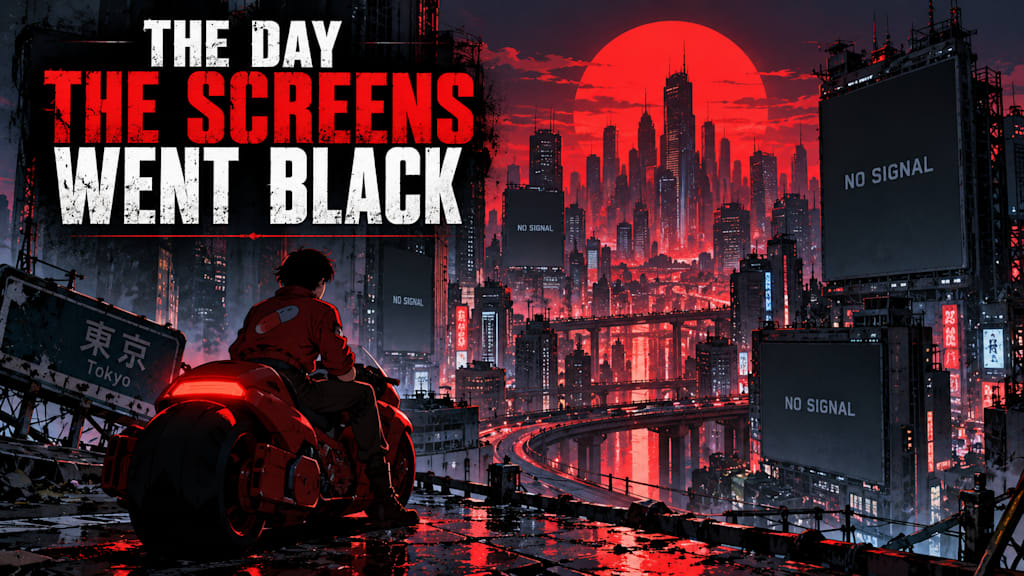
When every smartphone on Earth died, the city discovered that civilization had been running on borrowed time.
At 8:17 p.m., the world lost its mind.
Not gradually. Not after a warning. There was no countdown, no emergency broadcast, no final message from a government official assuring everyone that everything was under control.
One second, billions of people were staring at glowing rectangles.
The next, every screen went black.
In Kurohama, the city barely noticed at first.
The elevated highways still roared above the streets. Advertising holograms flickered between skyscrapers. Autonomous buses glided through intersections beneath the orange haze of industrial smog. Thousands of pedestrians moved through the shopping districts, their faces illuminated by neon signs and the cold blue light of dead screens.
Then somebody screamed.
A businessman struck his phone against his palm. A schoolgirl held hers beneath a streetlamp, desperately tapping the glass. A woman in a white coat shouted at her smartwatch, demanding that it tell her where her children were.
Nothing responded.
Around them, the city continued to move.
For another thirty seconds, everyone assumed it was their own device.
Then the first traffic collision happened.
Then the second.
Then the entire intersection stopped.
And somewhere in the distance, an alarm began to howl.
1. No Signal
Mika was repairing a motorcycle when the world went silent.
Well, not silent exactly. The workshop was still filled with the metallic clatter of tools, the hum of fluorescent lights, and the distant thunder of traffic. But the familiar soundtrack of notifications had disappeared.
She wiped the grease from her fingers and checked her phone.
Black screen.
She held the power button.
Nothing.
“Seriously?”
She tried the charger. She tried another cable. She opened the back panel of the old device, although she knew perfectly well that a software problem couldn't be fixed with a screwdriver.
Outside, the first sirens began.
Mika stepped into the street.
People were gathering beneath the giant screens that covered the buildings. The advertisements had not gone dark. They were still selling luxury apartments, energy drinks, designer clothes, and artificial happiness to anyone willing to look up.
But the phones in everyone's hands were dead.
A delivery driver abandoned his electric scooter in the middle of the road. Two teenagers argued over whether the outage was a government experiment. An elderly man stood perfectly still, holding his phone like a small, broken animal.
A little boy tugged at his mother's sleeve.
“Mom, how do we get home?”
She opened her mouth.
Nothing came out.
Mika felt something cold settle inside her chest.
Nobody knew where to go.
And nobody knew how to ask.
2. The City Without a Brain
By nine o'clock, Kurohama was beginning to come apart.
The subway gates had stopped accepting digital payments. Thousands of commuters crowded the platforms, demanding explanations from employees who had none to give. Taxis couldn't receive new bookings. Restaurants lost access to delivery systems and reservation databases. Shops that had abandoned cash years ago stared helplessly at customers holding useless cards and phones.
At hospitals, staff scrambled to access records stored behind systems that required mobile authentication. Emergency dispatchers were overwhelmed by calls from landlines, where those still existed. Drivers who relied on navigation apps wandered into blocked streets, creating traffic jams that spread like infections.
The city had not lost electricity.
It had lost coordination.
That was worse.
For years, Kurohama had replaced human decisions with invisible systems. People no longer memorized addresses, carried maps, or remembered telephone numbers. They trusted machines to tell them where to stand, when to move, whom to contact, and what to do next.
Now those machines were silent.
And beneath the silence was a terrifying question:
Had people forgotten how to live without instructions?
At 9:23, the government finally appeared on the public screens.
A stern official stood against a blue background. His mouth moved, but the audio system had failed in several districts. The message was repeated in enormous white letters:
REMAIN CALM. A TECHNICAL INCIDENT IS UNDER INVESTIGATION.
Nobody believed it.
A rumor spread that the outage was a cyberattack. Another claimed that the military had shut down the network to prevent a terrorist strike. Someone insisted that the satellites had fallen out of orbit.
The rumors traveled through crowds, shouted from windows, scribbled on cardboard, and passed from person to person.
Without social media, misinformation moved more slowly.
But it also became harder to correct.
At ten o'clock, a crowd stormed a telecommunications headquarters. Police arrived in armored vehicles. Someone threw a bottle. Someone else threw a brick.
A line of shields advanced beneath the neon glow.
The first tear-gas canister exploded.
And Kurohama discovered that even without smartphones, people could still find reasons to hate one another.
3. The Last Delivery
Mika had one person she needed to find.
Her younger brother, Ren, was sixteen. He had left their apartment that afternoon to meet friends on the other side of the city. Normally, she would have called him. If he didn't answer, she would have sent a dozen messages, checked his location, and complained until he responded.
Now she couldn't even remember his friends' surnames.
She grabbed her helmet.
Her motorcycle was an old combustion model, stubborn and loud, held together by replacement parts and Mika's refusal to buy anything new. It had no cloud connection, no navigation system, and no smart controls.
Tonight, those defects made it priceless.
She kicked the engine alive.
The streets were a nightmare of abandoned cars and flashing emergency lights. Holographic advertisements reflected across puddles. A massive screen above the financial district displayed a smiling woman holding a phone that would never turn on again.
Mika rode beneath it, through a city that looked like the future had arrived and immediately suffered a nervous breakdown.
She knew three routes to Ren's school. Two were blocked by police barricades. The third took her through an old residential district where the buildings leaned close together and the streetlights had not been replaced in decades.
People stood outside their homes, talking to neighbors they had ignored for years.
A shopkeeper was handing out bottled water. A group of students were drawing a map on the pavement with chalk. An old woman sat on a folding chair, directing lost pedestrians toward the railway station.
The city was failing.
But its people had started doing things again.
Not clicking. Not swiping. Doing.
Mika reached the school shortly before midnight.
The gates were open. Hundreds of students crowded the courtyard, surrounded by exhausted teachers. Some had been collected by their parents. Others were waiting because nobody knew how to contact their families.
Mika shouted Ren's name until her throat hurt.
Then a thin figure emerged from the crowd.
He was carrying a cardboard sign.
On it, in enormous black letters, he had written:
MIKA — I'M HERE.
She laughed, then grabbed him so hard he protested.
“How did you know I'd come?”
Ren shrugged.
“You always come.”
For the first time that night, Mika had no answer.
4. The New Dark Age
By morning, the outage had lasted twelve hours.
No official explanation had survived the night. Governments announced emergency measures through television, radio, loudspeakers, and printed notices. Some cities restored basic services using older equipment. Others declared curfews. In a few places, military units took control of major intersections.
The world had not ended.
That was the strange part.
People still needed food. Babies still cried. The sun still rose between the skyscrapers. Somewhere, a couple still argued about whose turn it was to wash the dishes.
Yet the economy was bleeding. Financial transactions stalled. Supply chains lost visibility. Airports filled with stranded passengers. People who had built their lives around remote work, digital payments, and instant communication discovered that their entire existence depended on a device they couldn't repair.
The wealthy had private generators and secure buildings, but even they couldn't summon information from a dead network.
For a few days, money could buy supplies.
It could not buy certainty.
Then something unexpected happened.
People began carrying notebooks.
They wrote down addresses, telephone numbers, meeting places, and instructions. Cafés put chalkboards outside. Neighborhoods established notice boards. Schools became information centers. Radio operators dusted off old equipment. Mechanics, electricians, and anyone who understood the physical world suddenly became essential.
A bakery started accepting handwritten IOUs.
A barber organized a bicycle courier service.
At the central station, strangers assembled a giant paper map and marked which roads were open, which shelters had beds, and where clean water could be found.
The map was inaccurate, constantly changing, and covered in ugly handwriting.
It was also the most useful thing in the city.
For the first time in years, people looked at one another before looking for an answer.
Not everyone welcomed the change.
The government called the growing neighborhood networks temporary emergency arrangements. Corporations promised that the systems would return. Commentators on surviving television channels described the outage as a test of social discipline.
But Mika noticed something else.
People were remembering things.
The name of the woman who lived upstairs. The face of the man who opened the corner shop every morning. The sound of a friend's voice without a speaker between them.
They were remembering how to be inconveniently, imperfectly human.
And that frightened some people more than the outage itself.
5. The Last Screen
On the fourth night, Mika and Ren climbed to the roof of their apartment building.
Below them, Kurohama glittered with the remnants of its old life. Some districts had lost power. Others shone beneath generators and emergency lighting. Fires burned in distant industrial zones. Helicopters swept across the clouds.
The giant advertisements were finally going dark, one building at a time.
Without them, the skyline seemed strangely exposed.
Ren sat beside her, turning his dead phone over in his hands.
“Do you think they'll fix them?”
“Probably,” Mika said.
“Then everything goes back to normal?”
She watched a group of people gathering around a street musician below. Someone had brought a drum. Someone else was singing. Their voices rose through the streets, rough and out of tune.
“I don't know,” she said.
Ren frowned at his phone.
“I can't remember Dad's number.”
Neither could Mika.
Their father had died two years earlier. His number had lived in her contacts, always available, never needed until it was too late to memorize it.
She felt the loss again, unexpectedly sharp.
Then Ren reached into his jacket and produced a small, folded piece of paper.
It was creased and stained, with numbers written in their father's handwriting.
“He gave it to me when I was little,” Ren said. “Said I should keep it somewhere safe.”
Mika took the paper carefully.
For a moment, neither of them spoke.
The city below them had lost its memory, but not everything had been erased.
Some things had survived because someone had taken the trouble to write them down.
At 11:59 p.m., a light appeared in the financial district.
One enormous advertising screen flickered to life.
The crowd below fell silent.
White letters appeared against a black background.
WE ARE WORKING TO RESTORE YOUR CONNECTION.
A few people cheered.
Others simply stared.
Then the screen changed.
No logo appeared. No corporate slogan followed. No official seal marked the message as authentic.
Just one sentence:
WHAT WILL YOU DO WHEN IT COMES BACK?
The screen went black.
Across Kurohama, people stood beneath the dead advertisements, looking upward.
Mika slipped the handwritten paper into her pocket.
For the first time in her life, she didn't reach for her phone to capture the moment.
She was there.
That was enough.
And somewhere beneath the city, in rooms filled with humming servers and emergency lights, the people trying to bring the world back online were beginning to understand the real problem.
The phones were not the only things that had stopped working.
The world had forgotten how much of itself it had handed over to them.
And when the screens finally lit up again, nobody could be certain what kind of civilization would be waiting on the other side.
About the Creator
Takashi Nagaya
I want everyone to know about Japanese culture, history, food, anime, manga, etc.
Enjoyed the story? Support the Creator.
Subscribe for free to receive all their stories in your feed.
Comments
There are no comments for this story
Be the first to respond and start the conversation.