
The Day the Phones Went Dark
The world did not end. It just stopped answering

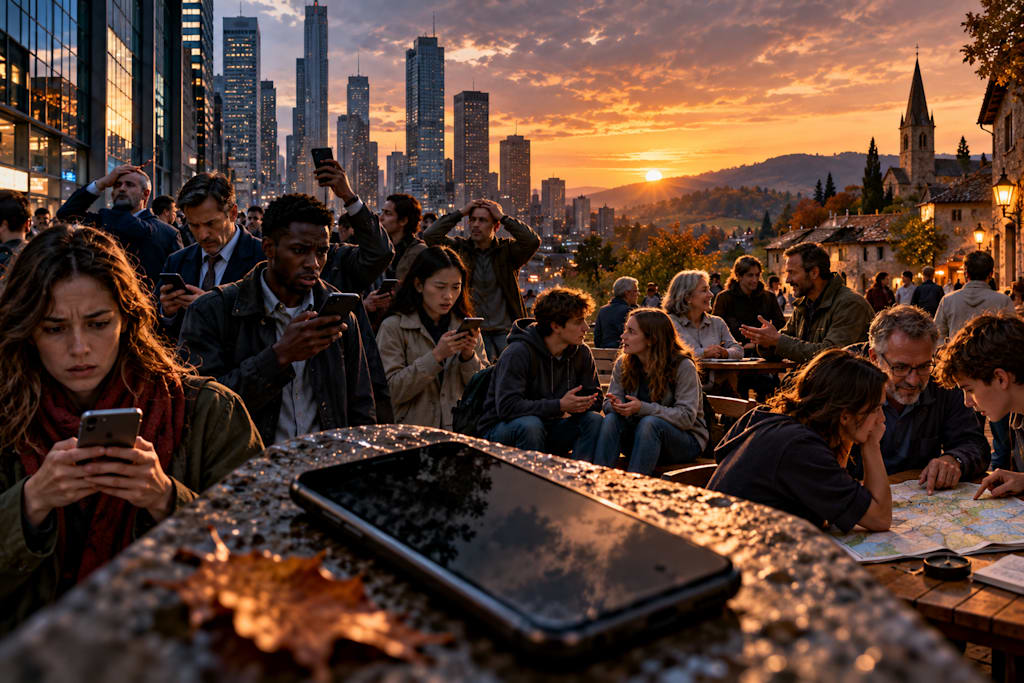
At 9:17 a.m., every smartphone in the world stopped working.
Not slowly.
Not region by region.
Not after a warning.
One second, people were scrolling, typing, swiping, watching, recording, navigating, arguing, checking, ordering, liking, comparing, and waiting for tiny red numbers to disappear.
The next second, every screen went black.
Then came the first universal gesture of the new age:
tap.
Tap again.
Hold the button.
Tap harder.
Shake.
Swear.
Charge.
Nothing.
In a café in London, thirty-two people looked up at the same time.
In Tokyo, commuters raised dead phones toward the ceiling as though signal might have become a physical substance trapped above them.
In Paris, a cyclist stopped in the middle of an intersection because the map had vanished.
In New York, a man discovered he did not know the address of the office where he had worked for eleven years.
In Rome, a woman realized the person she was meeting was known to her only as "M."
In a small town in western France, Paul stared at his phone for almost a minute before saying:
"Well."
His wife, Claire, looked at hers.
"Mine too."
They sat at the kitchen table.
Between them lay two black rectangles.
For the first time in years, neither knew what to do with their hands.
At 9:22, people began blaming batteries.
At 9:26, networks.
At 9:31, governments.
At 9:40, other governments.
By ten, television stations had interrupted programming.
"Global smartphone failure," the banners announced.
Experts appeared immediately.
Nobody knew anything.
This did not prevent them from speaking.
One blamed satellites.
Another blamed software.
A third said the event was "unprecedented," which was obvious enough to sound reassuring.
Landlines still worked.
Computers still worked.
Radio still worked.
Old mobile phones with buttons, discovered in drawers beside expired chargers and forgotten keys, sometimes worked too.
This created a new social hierarchy within hours.
People who still owned landlines became important.
People who knew phone numbers became extraordinary.
People who had paper maps became suspiciously powerful.
At 10:43, Claire opened a drawer and removed an address book.
Paul stared at it.
"You kept that?"
"I keep useful things."
"You kept the instruction manual for the toaster."
"Exactly."
She opened it.
Pages of names.
Numbers.
Addresses.
Birthdays.
Handwriting.
Actual handwriting.
Paul touched one line with a finger.
"My brother's number."
"You could call him."
Paul looked uncomfortable.
"Now?"
Claire raised an eyebrow.
He had not spoken to his brother in eight months.
They had exchanged messages.
That was different.
Messages allowed delay.
Messages allowed editing.
Messages allowed a person to sound warmer, colder, funnier, or less hurt than they actually were.
A telephone call contained fewer hiding places.
"I'll wait," Paul said.
Outside, the village was becoming unusually active.
People walked.
Not for exercise.
Toward one another.
The bakery had a queue because nobody could order ahead.
The pharmacist had written opening hours on cardboard because the online system was inaccessible to customers who usually checked from their phones.
At the bus stop, six teenagers stood in silence.
Then, reluctantly, one spoke.
Within ten minutes they were arguing about music.
By noon, the first great inconvenience had become visible:
nobody knew where anyone was.
Parents became nervous.
Employees became late.
Delivery drivers stopped beside roads consulting printed street directories kept in vehicles mostly for legal reasons.
Restaurants received fewer orders and more customers.
People knocked on doors.
Some discovered they had been living three meters from interesting people for years.
Others discovered exactly why they had avoided meeting their neighbors.
At 1:15, Paul went into town.
He intended to buy bread.
Halfway there, he instinctively reached for his pocket.
Nothing useful.
He saw a man standing beside a car.
"Excuse me," the man said. "Do you know the way to Saint-Martin?"
Paul gave directions.
The man listened carefully.
Not pretending to listen while checking a screen.
Actually listening.
"Second right after the bridge?"
"Yes."
"Then left at the church?"
"Correct."
The man repeated the route.
Paul experienced an emotion he had almost forgotten:
being useful to a stranger.
At the bakery, nobody was looking down.
The queue moved slowly because people were talking.
Not all conversation improved humanity.
Some of it was terrible.
Weather.
Parking.
Bread prices.
A rumor about the phones having been disabled deliberately.
But it was conversation.
A woman behind Paul said:
"I don't know what time it is."
Paul looked at the clock above the counter.
"One forty-three."
She laughed.
"I forgot those existed."
By evening, panic had softened into irritation.
Then inconvenience.
Then adaptation.
People found alarm clocks.
Watches were taken from drawers.
Printed menus appeared.
Taxi ranks returned.
Meeting places became specific.
"At the fountain at seven."
Not:
"I'll text you."
People started arriving on time because there was no other way to know whether someone was waiting.
Some waited anyway.
That changed things too.
On the second day, children asked how people had survived before smartphones.
Adults gave heroic answers.
"We managed."
This was partly true.
What they did not say was that they had once memorized phone numbers, argued over maps, waited beside public telephones, arrived late without explanation, got lost, missed people, and occasionally spent an entire afternoon not knowing what anyone else was doing.
By the third day, newspapers had sold out.
Libraries were crowded.
So were electronics stores, though nobody there had a solution.
People bought radios.
Paper notebooks.
Road atlases.
Disposable cameras.
Someone began selling printed lists of useful phone numbers.
This was called innovation.
By the end of the first week, new habits had formed.
Not better habits.
Different ones.
Office workers checked email from computers instead of phones.
People still wasted time.
They simply became less mobile while doing it.
Teenagers migrated to laptops.
Advertisers adapted.
Humanity did not become wiser.
That disappointed many commentators.
There had been predictions of rediscovery.
Connection.
Presence.
A global awakening.
Instead, people remained people.
They complained.
Adapted.
Improvised.
Cheated.
Helped.
Profited.
Got bored.
Fell in love.
Missed appointments.
Invented new distractions.
But some things did change.
Dinner tables became quieter in one way and noisier in another.
No screens glowed beneath plates.
Arguments had fewer emergency exits.
When someone told a boring story, everyone had to survive it.
Photos became rarer.
And because they were rarer, people sometimes looked longer before taking them.
At concerts, thousands of faces pointed toward the stage instead of thousands of screens.
At accidents, fewer people recorded and more people approached.
Nobody knew whether this was progress.
It was simply visible.
Two weeks after the blackout, Paul finally called his brother.
From the landline.
The number rang four times.
"Hello?"
Paul almost hung up.
"It's me."
A pause.
Then:
"I know."
Of course.
Claire had written his brother's number beside Paul's in the old address book.
Paul sat down.
"I thought I'd call."
"So did I."
Another pause.
Neither knew what to say.
Texting had allowed them to maintain contact without resolving anything.
The phone call did not.
After several seconds, his brother said:
"You still angry?"
"Yes."
"Me too."
Paul laughed.
"So that's going well."
His brother laughed too.
They spoke for forty minutes.
Nothing was fixed.
But something was no longer postponed.
A month passed.
Then three.
Engineers explained parts of the failure, though never completely.
Smartphones remained unusable.
Manufacturers promised replacements based on different systems.
People waited.
Rumors circulated about the first new devices.
Better security.
New architecture.
Guaranteed resilience.
Preorders opened.
Demand was enormous.
Claire read the article on her laptop.
"They're coming back."
Paul looked up from a newspaper.
"When?"
"Spring."
He nodded.
Neither said anything for a while.
Outside, someone knocked on the door.
It was the neighbor.
He needed help moving a table.
Paul stood.
"I'll be back in ten minutes."
Claire smiled.
"How will I know?"
Paul paused.
For years, that question would have required an answer.
Now it did not.
"You won't."
He closed the door behind him.
Claire remained at the kitchen table.
Beside her lay the old address book.
Its pages had become crowded with new numbers.
New names.
Notes.
Corrections.
Lives written in ink.
On the table beside it rested her dead smartphone.
She had never thrown it away.
Sometimes she picked it up automatically.
The habit remained in the hand long after the machine had stopped responding.
Then she would put it down.
Look around.
And listen for whoever might knock next.
About the Creator
Alain SUPPINI
I’m Alain — a French critical care anesthesiologist who writes to keep memory alive. Between past and present, medicine and words, I search for what endures.
Enjoyed the story? Support the Creator.
Subscribe for free to receive all their stories in your feed. You could also become a paid subscriber, letting them know you appreciate their work.
Comments
There are no comments for this story
Be the first to respond and start the conversation.