
The Conjecture That Fooled Mathematicians for a Century
How the Mertens function appeared to offer a route towards the Riemann hypothesis before computers exposed its hidden failure
Introduction
Mathematics contains many conjectures that appear correct because they work for every number anyone has tested. However, an infinite sequence can behave perfectly for an extraordinarily long time before producing an unexpected result.
The Mertens conjecture provides one of the finest examples. It survived for approximately a century, accumulated an enormous amount of supporting evidence and would have implied the famous Riemann hypothesis. Nevertheless, two mathematicians eventually proved that it was false without identifying the first number where it failed.
Franz Mertens
Franz Mertens was born in 1840 in what was then the Kingdom of Prussia. He later worked at universities in Poland and Austria, becoming an important figure in nineteenth-century number theory.
His name is attached to several important results concerning prime numbers. However, the Mertens function and its associated conjecture became especially significant because of their connection with the distribution of primes.
The story actually began with the Dutch mathematician Thomas Joannes Stieltjes. In an 1885 letter to the French mathematician Charles Hermite, Stieltjes claimed that he had proved a closely related result.
Stieltjes never published a valid proof, possibly because he later discovered an error. Franz Mertens investigated the behaviour of the function and published his observations in 1897, causing the proposition to become known as the Mertens conjecture.
The Möbius Function
Understanding the Mertens function first requires another mathematical idea called the Möbius function. It assigns every positive whole number one of three possible values: positive one, negative one or zero.
The value depends upon the prime factors contained within the number. Prime numbers are those divisible only by themselves and one, including familiar examples such as two, three, five and seven.
If a number contains the square of any prime factor, its Möbius value becomes zero. For example, twelve contains two multiplied by two, while eighteen contains three multiplied by three. Both numbers therefore receive a value of zero.
When a number has an even quantity of different prime factors, without containing any repeated prime factor, its value becomes positive one. Six contains the two different prime factors two and three, so it receives a positive value.
When a number has an odd quantity of different prime factors, without any repetition, its value becomes negative one. Thirty contains the three different prime factors two, three and five, so it receives a negative value.
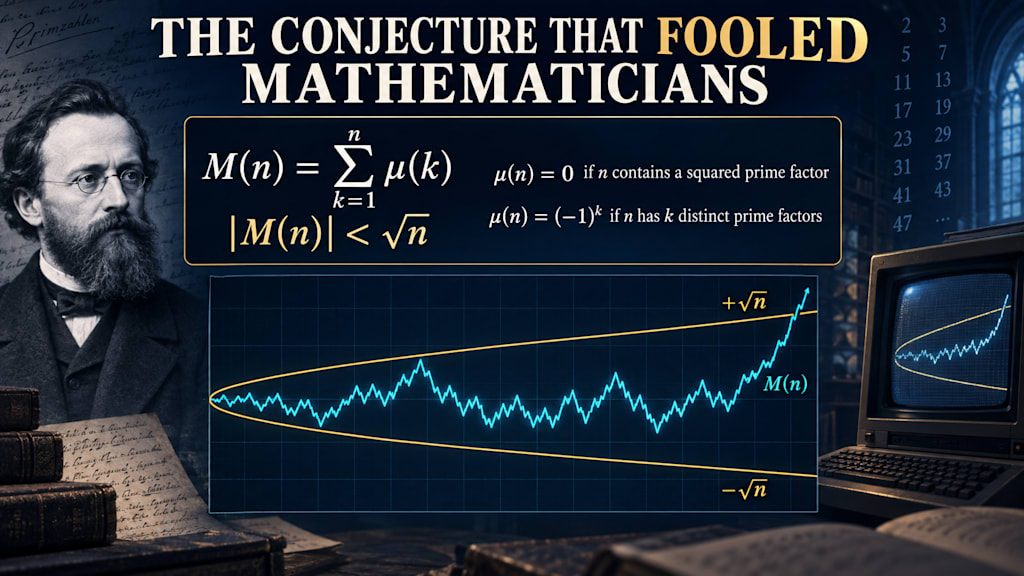
The number one is treated as a special case and receives a positive value. The important formulas showing these rules have been included within the accompanying image.
Building the Mertens Function
The Mertens function adds together all the Möbius values from one up to a chosen number. It behaves rather like a mathematical walker following an unpredictable path.
Every positive value moves the walker one step upwards, while every negative value moves it one step downwards. A zero leaves the walker standing in the same position.
The first number contributes positive one, and the number two contributes negative one. The accumulated total has therefore returned to zero after only two numbers.
The number three contributes another negative value, while four contributes zero because it contains the square of two. The running total consequently remains negative.
Five contributes another negative value, but six contributes a positive value because it contains two different prime factors. This process continues as every whole number is examined.
The resulting total wanders above and below zero in an irregular manner. Its behaviour is determined by the prime factors hidden within the numbers, producing a pattern that appears partly ordered and partly random.
The Mertens Conjecture
The conjecture proposed that the accumulated total would always remain within boundaries determined by the square root of the number being examined. These boundaries become wider as the numbers increase.
At one hundred, the proposed upper and lower boundaries are positive ten and negative ten. At one million, they become positive one thousand and negative one thousand.
The function could therefore wander progressively farther from zero. However, Mertens believed that it would never escape beyond the relevant square-root boundaries.
Calculations repeatedly supported this belief. Graphs of the function appeared to fluctuate safely between the two curves, even when mathematicians extended their calculations to extremely large numbers.
The precise mathematical statement of the conjecture appears in the accompanying image. The image also shows how the function was expected to remain between the two expanding boundaries.
The Riemann Hypothesis Connection
The importance of the conjecture came from its relationship with the Riemann zeta function. Bernhard Riemann discovered that the hidden structure of prime numbers was connected to particular zeros produced by this function.
The Riemann hypothesis makes a very specific claim about where all the important zeros must be located. Despite enormous effort from generations of mathematicians, nobody has yet proved or disproved it.
The Mertens conjecture would have imposed sufficiently tight control upon the Möbius totals to establish the Riemann hypothesis. Proving the apparently simple square-root boundary would therefore have settled one of the greatest problems in mathematics.
However, the reverse implication did not apply. The eventual failure of the Mertens conjecture did not disprove the Riemann hypothesis because the Mertens conjecture imposed a stronger restriction than Riemann’s original proposal required.
A weaker restriction upon the growth of the Mertens function remains equivalent to the Riemann hypothesis. It allows the function slightly more freedom than the failed square-root boundary, and that small allowance makes an enormous mathematical difference.
When Computers Strengthened the Wrong Belief
As computers became more powerful, mathematicians calculated the Mertens function across increasingly enormous ranges. Every successful calculation appeared to provide further evidence that the conjecture was correct.
However, calculations can never prove that a statement applies to infinitely many numbers. Checking a million, a trillion or even a vastly greater quantity still leaves infinitely many possibilities unexplored.
This represents one of the great dangers of experimental mathematics. A conjecture can accurately describe every accessible example while failing somewhere beyond any range that can be tested directly.
The increasing amount of computational evidence made the Mertens conjecture appear stronger. In reality, the first failure was simply hiding at a scale beyond the calculations being performed.
Odlyzko and te Riele Break the Boundary
In 1985, Andrew Odlyzko and Herman te Riele published a paper disproving the Mertens conjecture. Their argument used detailed information about the zeros of the Riemann zeta function together with carefully constructed numerical calculations.
They proved that the Mertens function must eventually rise beyond its positive square-root boundary. They also showed that it must eventually fall below the corresponding negative boundary.
Their proof therefore established that the proposed restriction could not survive forever. The Mertens conjecture was false, despite the immense amount of computational evidence that appeared to support it.
However, their argument was indirect and did not produce a particular number where the boundary was crossed. They proved that counterexamples must exist without locating the first one.
Where Is the First Counterexample?
Nobody can simply begin calculating values and expect to reach the first failure. The earliest counterexample could occur at an unimaginably large number far beyond the practical limits of direct computation.
This creates a fascinating situation. Mathematicians know with certainty that the function crosses the boundary, but they cannot point towards the first whole number where it happens.
Later researchers have improved the methods used to estimate where counterexamples might be found. Nevertheless, the first explicit violation remains hidden among numbers of extraordinary size.
The illustration accompanying this article shows the principle rather than a graph of the first known counterexample. The wandering line eventually crosses the upper boundary, representing what Odlyzko and te Riele proved must happen.
What the Disproof Teaches Us
The failure of the Mertens conjecture demonstrates why mathematical proof cannot be replaced by observation. Patterns involving small and moderately large numbers may be misleading because their true behaviour only emerges on an immense scale.
It also shows that apparently random fluctuations can contain extremely subtle long-term effects. The positive and negative Möbius values appear to cancel each other, but their cancellation is not balanced closely enough to obey the original boundary forever.
There is also an important lesson concerning computers. Computers can reveal patterns, test conjectures and assist with rigorous arguments, but billions of successful examples cannot establish an infinite mathematical statement.
A single counterexample can destroy a universal conjecture. However, no quantity of successful examples can provide the certainty of a valid proof.
Conclusion
The Mertens function begins with a remarkably simple procedure. Numbers receive positive, negative or zero values according to their prime factors, and those values are then added together.
From that modest beginning emerges a function connected with prime numbers, the zeta function and the Riemann hypothesis. Its behaviour appeared predictable enough for mathematicians to trust the same boundary for nearly a century.
Odlyzko and te Riele eventually proved that the boundary must fail, although the first explicit failure remains hidden among numbers of extraordinary size. The Mertens conjecture reminds us that mathematics can appear orderly for longer than anyone can imagine before revealing that the apparent rule was never a rule at all.
About the Creator
Alan Spencer
Have been an author and writer for over 20 years. Have been a journalist, editor, proofreader, and a designer and presenter of training courses. Have written over 100 articles, two books, and around 20 training courses.
Enjoyed the story? Support the Creator.
Subscribe for free to receive all their stories in your feed. You could also become a paid subscriber, letting them know you appreciate their work.
Comments
There are no comments for this story
Be the first to respond and start the conversation.