
The Cinematic Illusion: Why AI Generates Masterpieces but Fails at Fast-Food
We are living in a bizarre technological paradox where computers can synthesize hyper-realistic movies in seconds, yet lose their minds over a simple cheeseburger order.

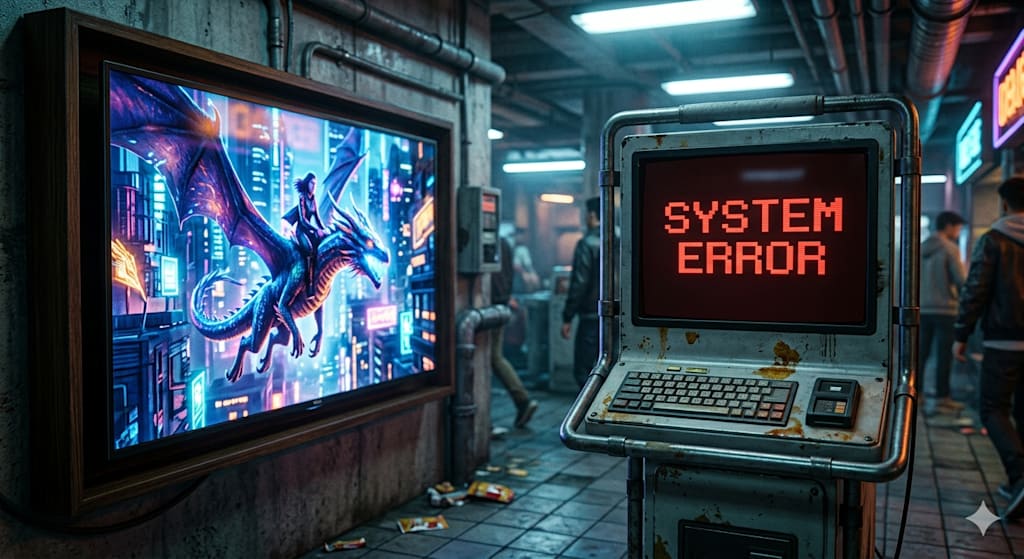
The technology sector has entered a deeply ironic phase of its evolution. If you listen to the multi-billion-dollar marketing pitches echoing out of Silicon Valley, the absolute conquest of artificial intelligence over every aspect of human life is not only guaranteed, but it is also running flawlessly ahead of schedule. We are constantly flooded with polished demonstrations of neural networks executing hyper-complex tasks that seem to borders on science fiction.
Yet, when this high-minded corporate hype is dragged out of pristine cloud data centers and forced to operate in the noisy, chaotic infrastructure of the physical economy, the results are shifting from revolutionary to completely chaotic.
The global public is experiencing a major shift in perception, moving away from blind fascination and straight into deep, analytical skepticism. This transition is vividly captured by a staggering 2,050% explosion in worldwide search interest regarding the operational breakdown of major drive-thru automation upgrades. When compared against the parallel 30% spike in users exploring advanced visual models like Kling AI, a fascinating digital contradiction emerges. The modern consumer is starting to ask a critical, uncomfortable question: How can a technology be sophisticated enough to invent a cinematic universe from a single text prompt, yet remain too primitive to correctly process a localized retail transaction?
The Fragility of the Frontline Algorithm
To understand this execution bottleneck, one must look at the fundamental difference between abstract generation and logical execution. The sudden wave of viral public backlash hitting fast-food automation rollouts this week highlights the extreme danger of over-engineering everyday consumer interactions. When an industry attempts to eliminate human intuition in favor of rigid language processing models, the absence of basic common sense becomes a massive, immediate financial liability.
The viral footage captured by frustrated drivers at automated order screens tells a story of systematic failure. When a customer hesitates, uses local slang, or orders over the background hum of a diesel engine, the algorithm panics. Unlike a human employee who filters out environmental static naturally, the machine treats every single frequency with identical computational priority.
Instead of pausing for assistance, it confidently hallucinates a close substitute, automatically multiplying orders into hundreds of dollars of unwanted items that customers cannot easily erase from their digital receipts. A mistake in an essay or a generated image is an artistic anomaly that can be ignored. But a physical system blocking a busy drive-thru lane during a high-volume lunch rush inflicts immediate, measurable damage on local revenue and brand reputation.
The Creative Escape: Why Video Generates Hype
This ongoing operational struggle explains why the tech elite is pouring so much capital into the sudden wave of generative video tools. For platforms like Kling AI, creating synthetic media is a safe haven because creative tasks are fundamentally unconstrained. There is no single "correct" answer in a cinematic sequence. If a model generates a slightly surreal shadow or an unnatural movement in a 5-second video clip, the audience accepts it as a stylistic choice or an acceptable limitation of current software.
The physical economy offers no such luxury for error. In a commercial warehouse, a medical clinic, or a retail lane, accuracy is entirely binary—the output is either perfectly correct or functionally broken. Silicon Valley is discovering that scaling up processing chips and throwing billions of parameters at a neural network can easily mask flaws in creative media, but it cannot buy the deep, contextual adaptability required to navigate a messy, unpredictable human environment.
The Coming Automation Realignment
The intense friction building up on the commercial frontline points toward an unavoidable correction in the current tech investment bubble. The corporate dream of completely erasing human labor from the economic balance sheet is running directly into a hard concrete wall of physical reality.
As forward-thinking firms in regions like Japan shift their focus toward structural corporate research and practical integration, the fantasy of total robotic autonomy is fading. The sustainable future of technology lies not in replacing the human element, but in optimizing human-in-the-loop systems. The businesses that survive the cooling of the current market hype will be those that realize computational power is useless without human nuance, keeping human beings at the absolute center of every critical infrastructure decision.
Have you ever experienced a hilarious or deeply frustrating failure while dealing with an automated customer service AI? Why do you think machines can paint pictures but struggle to understand a basic voice command? Let's share our real-world stories and analyze this paradox in the comments section below.
Intrigued by this unpolished, data-driven look behind the digital curtain? If you are determined to stay completely ahead of the curve on the real economic conflicts, technical bottlenecks, and strategic power struggles shaping our world this month, support this work by leaving a Like, Sharing this piece with your professional network, and hitting Follow for more unfiltered dispatches!
About the Creator
AI Lens
Exploring the profound intersection of human nature, philosophy, and the future of artificial intelligence. Writing about our evolving digital world.
Enjoyed the story? Support the Creator.
Subscribe for free to receive all their stories in your feed.
Comments
There are no comments for this story
Be the first to respond and start the conversation.