
The Charioteer’s Last Shift
From performance to peace, in one bumper‑to‑bumper epiphany.
I. Prologue
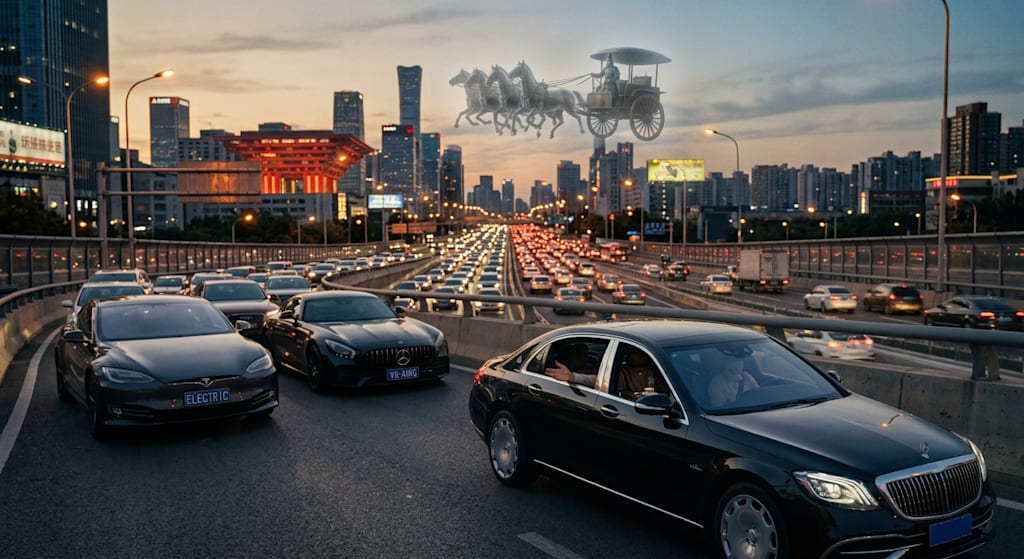
The Second Ring Road, rush hour. My right hand rests on the gear lever; a thin callus has formed near the base of my thumb, worn in by years of shifting. Every time the brake lights of the car ahead flash, I tap my own brakes. In the left lane, a Tesla Model S Plaid crawls forward, its brake discs letting out a faint metallic squeal at low speed. The official spec says 1,020 horsepower. In horse terms – using the rough conversion that one ancient warhorse sustained output equals about fifteen mechanical horsepower – that means sixty‑eight ancient chargers are lined up behind it, queuing on the ring road.
1,020 horses. The Son of Heaven, by ritual, was allowed only six. Ninety horsepower, and that was the limit.
I lifted my hand off the gear lever and placed it on my knee. Palm up, as if setting something down. In that single motion, my obsession with performance broke.
II. The Accounting
Consulting the Yi Li • Wang Du Ji (Lost Rites • Records of Royal Degrees): The Son of Heaven rides six horses; the feudal lords, five; the high ministers, four; the great officers, three; the gentry, two; and commoners, one. The conversion is fixed: one ancient warhorse sustained output equals about fifteen modern mechanical horsepower.
The resulting hierarchy gives us a clear ceiling: ninety horsepower for the Son of Heaven, seventy‑five for a feudal lord, sixty for a high minister, forty‑five for a great officer, thirty for the gentry, and fifteen for a commoner. In modern terms, a Škoda Fabia 1.0L would just about pass for imperial transport; an old Toyota Vios fits a feudal lord; a Suzuki Alto matches a high minister; the Wuling Hongguang MINIEV is gentry‑class; and a two‑wheeled e‑scooter is commoner‑grade.
A 1.5‑litre Honda Fit, 131 horsepower – that's 8.7 horses. In the Zhou dynasty, that would already be "the imperial carriage plus two spare mounts," without prior temple approval. An Audi RS7, 600 horses – forty warhorses. What was that phrase? "Inquiring about the weight of the tripods" – a classic act of overreach. A thousand‑horsepower EV rolling down the street, and the Duke of Zhou would likely exclaim: "Eight rows of dancers in the courtyard – if that is tolerable, what is not?"
And my car? A BMW 1.5‑litre turbodiesel, 116 horsepower – 7.7 horses. Also a usurpation. Nothing compared to the rest of the traffic, but still stepping over the Emperor's line. Every single car stuck on the Second Ring Road is a rebellious subject. And the average speed of these rebellious subjects is seventeen kilometres per hour.
III. The Charioteer
I looked down at my right hand. That callus – worn in by shifting.
The Rites of Zhou • Office of Summer • Grand Charioteer says: "The Grand Charioteer manages the King's attire and seat, and transmits the King's great commands." The charioteer – a servant's post. All these years, my pursuit of "man‑machine unity" – heel‑toe downshifts, lateral G‑forces, the kick of acceleration – in the end, it was just grinding calluses into my palm, turning myself into a better coachman. In ancient times, a driver handling his team probably thought he looked impressive too, gesturing to the foot soldiers beside him: "Look at my hands." But he was still the one standing outside the carriage, while the person seated inside was the one he served.
Performance itself isn't bad. The problem was that the man pursuing it was sitting in the wrong seat.
"To fight a tiger with bare hands, to wade a river without a boat, and die without regret – I would not associate with such a man." Driving a performance car is exactly that. You stare at the tachometer, the tyre pressure monitor, the brake disc temperature – your nerves frayed, like a beast held by a bridle. You think you're controlling the car. But the car is controlling you. And what does it use to control you? Numbers. Zero‑to‑sixty in three seconds, lateral G of 0.9, a lap time of seven‑and‑a‑half minutes. You live for those numbers, hands never leaving the wheel, eyes never leaving the road, your backside feeling every crack in the asphalt. You surrender all your senses to a machine, and you call that freedom.
The first thing that changed after I took my hand off the gear lever: I stopped looking at the tachometer. It's still there, glowing – but it has nothing to do with me.
IV. The Imperial Carriage
A D‑segment limousine. Length: 5.3 metres; wheelbase: 3.1 metres; width: 1.9 metres. Viewed from above, its footprint is nearly a full square metre larger than that of a Golf. That square metre is what the Rites of Zhou • Examination of Works calls the "breadth of the carriage" – the width of the chariot bed determined the rider's rank. The Son of Heaven's carriage had to be broad and substantial. "Broad" and "substantial" were not metaphors; they were measurements. The feudal lord's carriage was two inches narrower; the minister's another two. Pull out the ruler, and there stood the hierarchy.
The D‑class car doesn't need to flaunt itself. It simply sits in its parking spot, its sides almost brushing the lines. As you approach, the thickness of the door – steel, sound‑deadening felt, and reinforcement beams in a composite sandwich – is nearly as thick as a fist. At the moment you pull the handle, the damping feels warm, like shaking someone's hand. The sound when the door closes is not a "thump"; it is a held‑in sigh, like a temple gate shutting.
This is the rite of form. Mass itself is authority; it doesn't need an exhaust note to compete.
Then you sit down. Close the door. The laminated double‑glazed glass cuts the traffic noise in half – half stays outside, the other half never enters. What remains inside? The whisper of air from the vents; a brief whir from the seat‑adjustment motors; and beyond that, blankness. A suppressed void. The Da Dai Li Ji (Records of the Greater Dai) says that when a gentleman rides, the "sounds of the luan and the he" (chime‑bells on the carriage) must conform to proper pitch. The frequencies were fixed – neither too high nor too low – to "rectify the mind." The performance car's exhaust is "golden spears and iron horses," sound pressure pushing you from behind. The limousine's silence is a ruler, levelling everything flat.
I don't listen to the engine. I listen to breathing – my own, or the person beside me. This is the rite of the bells: not about sound being proper, but about silence being proper.
The rear seat. The hip position is a few centimetres lower than the knees – ergonomically, the "semi‑recline angle." Your centre of gravity drops; your back settles; your cervical spine lifts about a centimetre off the headrest. Air flows from the B‑pillar, curving around the back of your head, never blowing directly. A cup holder by your hand, holding a cup of tea; steam rises from the lid's gap and gets pulled into a diagonal line by the cross‑flow from the vent. I don't need to know how many cylinders the engine has. I don't need to know how many gears the transmission offers. I've shifted gears countless times in my life; now, finally, I don't.
Where does the horsepower go? Not into acceleration. Into "lifting." Lifting a two‑and‑a‑half‑ton body; lifting the soundproofing, the soft‑close door motors, the refrigerator compressor, the air‑suspension pump, the current for heating, ventilation, and massage all running at once. Like the foundation of a palace – not propping from the outside, but upholding from within.
V. The Armoured Escort
There is a loophole to close. Even the entry‑level D‑class car has over 200 horsepower – thirteen or fourteen horses – still far exceeding the Emperor's six. According to the earlier calculation, it remains rebellion. What to do?
I call the surplus horsepower "the armoured escort."
The Son of Heaven rides six – those six pull the main carriage, the throne‑room, the cabin under the Emperor's backside. That's the "main force." But the royal procession also includes thirty‑six auxiliary chariots and hundreds of armoured guards. The auxiliaries are not counted in the "riding‑grade" definition – they are the guard, the retinue, the baggage train. The D‑class car's horsepower is divided the same way:
Thirty‑five horses drag the 2.5‑ton chassis – this is "the weight of the carriage," befitting a feudal lord's mass.
Thirty‑five horses supply the air‑conditioning compressor, alternator, and air‑suspension pump – this is "palace service," fitting for a minister.
The remaining hundred‑plus horses do not participate in "acceleration." They simply stand by: ensuring the car doesn't pant on inclines, doesn't flinch during overtakes, and when fully loaded (five passengers plus a golf bag in the boot), the suspension still levels itself.
These functions belong to the "imperial guard," not to the "riding main force." Just as you wouldn't count the guards standing at attention as part of the "six horses of the Son of Heaven." They carry halberds, not reins.
So you see – I have not usurped. I have merely reassigned the manpower inside my car.
VI. Coda
Still jammed on the Second Ring Road. The thousand‑horsepower Tesla remains in the left lane – sixty‑eight ancient warhorses, motionless. To the right, the AMG GT, at idle, lets out a low gurgle from its exhaust – like a strong man pinned to the spot, muttering under his breath.
I roll down the window. October wind pours in, carrying a mix of exhaust fumes and the smell of barbecue stalls. I stretch my hand out, palm up, wind slipping through my fingers. This hand used to shift, grinding calluses. Now it doesn't. It just rests there, blown by the breeze.
Someone in the back seat asks: "Are we moving?"
I say: Yes. Slowly.
Traffic edges forward outside. Every car contains a "driver of six horses," stuck on the road, slapping their steering wheels. Their horsepower is rebellious, and so is their spirit. I am not rebellious. I have simply assigned my horsepower its duties: thirty‑five to pull the car, thirty‑five for service, and the rest line up in silence.
If the Duke of Zhou were to time‑travel to today, stand on the footbridge, and look down, he would probably sigh: "The rites and music have utterly collapsed." But if he saw this car of mine – window half‑down, hand outside, palm up, speed seventeen kilometres per hour, neither fighting nor grabbing – he might change his words. Or he might not. That uncertainty is beside the point.
What matters is that after I took my hand off the gear lever, I never put it back.
The gear lever still stands upright on the centre console; the edge of its leather boot is slightly polished from my grip. I don't touch it. It stands there, I sit here. A man who no longer needs to shift gears has finally moved from charioteer to passenger. Inside the cabin, there is no sound of ceremonial bells – only the whistle of wind slipping through the window gap. Very soft, like something that has been let go.
About the Creator
Jin
Writer of reamstories
https://reamstories.com/jin
Enjoyed the story? Support the Creator.
Subscribe for free to receive all their stories in your feed. You could also become a paid subscriber, letting them know you appreciate their work.
Comments
There are no comments for this story
Be the first to respond and start the conversation.