
The Busy Beaver Game and the Turing Machine
A simple imaginary computer reveals numbers that no computer can calculate
Introduction
The Busy Beaver game sounds like a harmless puzzle involving an unusually industrious animal. In reality, it is one of the strangest and most profound problems in mathematics and computer science.
The game uses imaginary devices called Turing machines, which follow extremely simple instructions written in a small table. Although the rules are elementary, attempting to find the busiest possible machine leads directly to enormous numbers, the limits of computation and questions that mathematics itself may be unable to answer.
Alan Turing’s Imaginary Computer
The Turing machine was described by British mathematician Alan Turing in 1936. Turing was attempting to define precisely what it means to perform a calculation by following a mechanical procedure.
His machine was not intended to be constructed as an ordinary physical computer. It was a mathematical model containing an infinitely long tape divided into individual squares, a reading and writing head, and a limited set of internal states.
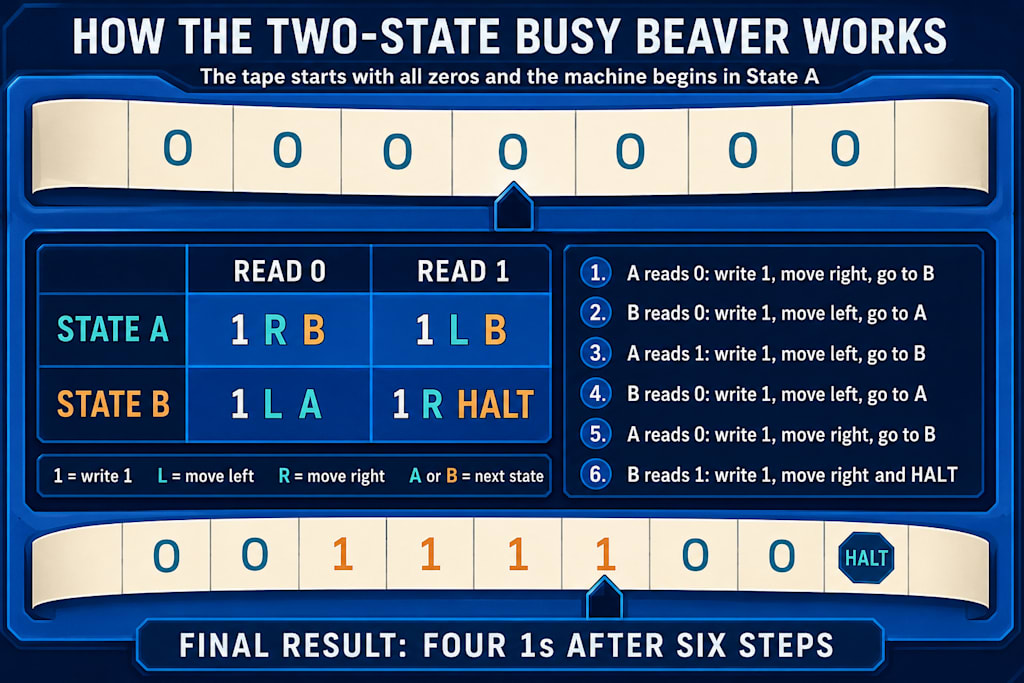
Each tape square contains a symbol, usually represented by a zero or a one. The head reads the symbol beneath it, writes another symbol if instructed, moves one square to the left or right, and changes to a different internal state.
A state can be imagined as the machine’s current position within its program. State A might provide one set of instructions, while State B provides another set. The machine continues following its instructions until it enters a special halt state or keeps operating for ever.
A Computer Reduced to Its Essentials
A modern computer contains processors, memory, storage devices and billions of electronic components. A Turing machine removes all this complexity and represents computation using only a tape, a moving head and a table of instructions.
Despite its simplicity, a Turing machine can theoretically perform any calculation that an ordinary programmable computer can perform, provided that it receives enough time and tape. It might work impossibly slowly, but speed is not the important issue.
The Turing machine became a foundation of computer science because it allowed mathematicians to study what computers could and could not calculate. It also demonstrated that some clearly defined problems cannot be solved by any general computer program.
The Halting Problem
One of Turing’s most important discoveries concerned the question of whether a program will eventually stop. Some programs perform their work and finish, while others become trapped in loops and continue operating indefinitely.
It might appear possible to create a special program that examines any other program and determines whether it will eventually stop. Turing proved that no such universal procedure can exist.
A program may successfully analyse many particular cases, but no single algorithm can correctly decide the behaviour of every possible program. This result became known as the halting problem, and it established a permanent boundary around what computers can determine.
The Busy Beaver game turns this limitation into a surprisingly entertaining competition. It asks us to find the longest-running machine that eventually stops, while excluding every machine that continues for ever.
Tibor Radó Invents the Game
Hungarian mathematician Tibor Radó introduced the Busy Beaver game in 1962. He imagined a competition between small Turing machines, all beginning on completely blank tapes.
Each competing machine has the same number of available states and uses only the symbols zero and one. The machines follow their individual instruction tables, moving along the tape and writing symbols until they either stop or run forever.
Only machines that eventually halt are allowed to compete. A machine may win by running for the greatest possible number of steps before halting, or under another version of the game, by leaving the greatest number of ones on its tape.
The winning machine is called a busy beaver because it performs an extraordinary amount of work with very limited resources. The number of states measures the size of its program, while the number of steps measures how long it remains busy.
The Simplest Busy Beavers
A one-state machine has very little opportunity to do anything complicated. The winning machine writes a single one, moves once and then halts, giving a maximum running time of one step.
With two states, the busiest halting machine can run for six steps and leave four ones on its tape. A three-state champion can run for 21 steps, while the four-state champion reaches 107 steps before finally stopping.
These figures appear modest, and they might suggest the sequence increases at a manageable rate. However, the five-state Busy Beaver machine produces an astonishing leap, running for 47,176,870 steps before halting.
The five-state champion leaves 4,098 ones on its tape. Its behaviour emerges from a tiny instruction table, yet it performs millions of operations before reaching its halt state.
Proving the Five-State Result
Heiner Marxen and Jürgen Buntrock discovered the five-state champion around 1990. Researchers strongly suspected that it was the winner, but finding a machine that runs for 47,176,870 steps does not prove that no other five-state machine runs for even longer.
The real difficulty involves examining every rival that has not stopped. Some machines enter simple repeating loops, which makes their endless behaviour easy to recognise. Other machines develop complicated patterns that can imitate productive activity for extraordinary periods before either halting or repeating.
An international collaboration known as the Busy Beaver Challenge eventually completed a formal proof of the five-state result. The researchers classified more than 181 million relevant machines and used computer-assisted mathematical methods to establish whether each machine halted.
The result was formally verified using a proof assistant, which checks every logical stage against precisely defined rules. After decades of uncertainty, the maximum five-state running time was confirmed as 47,176,870 steps.
The Terrifying Sixth State
Adding only one more state transforms the problem beyond recognition. The exact value for the six-state Busy Beaver remains unknown, but discovered candidates already produce running times and outputs of almost unimaginable size.
The increase is not comparable to moving from millions to billions or trillions. Busy Beaver values eventually grow faster than any function that a computer program can calculate for every input.
This means they ultimately outgrow exponentials, towers of exponents and every other computable growth pattern. No matter how quickly a computable function rises, Busy Beaver values will eventually rise faster.
A small Turing machine can therefore generate behaviour vastly more complicated than its short description suggests. The six-state search is not merely a larger version of the five-state problem because it enters a region where familiar computational methods begin to fail.
Why the Sequence Cannot Be Calculated
For any fixed number of states, there are only finitely many possible machines. It might therefore appear that we could run all of them simultaneously and wait until every machine that will stop has stopped.
The problem is that we cannot identify when the waiting period is complete. A machine that has operated for a billion years might halt during the following second, or it might continue forever.
Suppose that a computer could calculate the Busy Beaver running time for every number of states. Given any particular Turing machine, we could count its states and look up the corresponding Busy Beaver value.
We could then run the machine for that maximum number of steps. If it had not stopped by then, we would know it could never stop, which would solve the halting problem.
Turing proved that the halting problem cannot be solved by a general algorithm. Therefore, no general algorithm can calculate all Busy Beaver values.
A Game Connected to Unsolved Mathematics
The Busy Beaver problem is more than a contest for producing enormous numbers. A Turing machine can be designed to search for a counterexample to a mathematical claim.
For example, a machine could examine every even number to determine whether it can be written as the sum of two prime numbers. This is the famous Goldbach conjecture, which has been tested extensively but has never been proved for every possible even number.
Such a machine could halt if it discovered a counterexample. If the conjecture were correct, the search would continue forever because no counterexample would ever appear.
Knowing the relevant Busy Beaver value would provide a maximum possible running time for any halting machine of that size. If the search machine exceeded that limit without stopping, we could conclude that it would never stop and that no counterexample existed.
In principle, particular Busy Beaver values could settle major mathematical questions. In practice, the required values may be so large and difficult to prove that they merely replace one unsolved problem with an even more formidable one.
When Mathematics Reaches Its Limits
Busy Beaver machines are also connected with Kurt Gödel’s incompleteness theorems. Gödel demonstrated that any sufficiently powerful and consistent mathematical system contains true statements that cannot be proved using the rules of that system.
For sufficiently large Busy Beaver machines, a particular formal system may be unable to prove whether certain machines ever halt. The machine has a definite behaviour, but the available mathematical axioms cannot establish what that behaviour will be.
This is an extraordinary conclusion because the machine itself may contain only a modest number of states. A tiny table of instructions can encode a question that lies beyond the proving power of an established mathematical system.
Why Busy Beaver Matters
Most computer users will never need to calculate a Busy Beaver value. However, the game exposes a fundamental truth about software because a short program can produce behaviour that cannot be predicted through any universal shortcut.
Testing a program for a long time cannot always establish that it will operate correctly forever. Increasing computing power may solve larger examples, but it cannot remove the theoretical boundary discovered by Turing.
The problem also shows why apparently simple mathematical systems can generate extreme complexity. The rules may be known completely, while their long-term consequences remain inaccessible.
Conclusion
The Busy Beaver game begins with one of the simplest imaginable computers. A head moves along a tape, reads zeros and ones, follows a few instructions and eventually stops if its programmer has succeeded.
From these elementary rules emerges a sequence that outruns every computable function and connects directly with the halting problem, Gödel’s incompleteness theorems and unresolved mathematical conjectures. The Busy Beaver is therefore much more than an amusing imaginary animal because it marks the frontier between what computers can calculate and what must remain forever beyond any general calculation.
Editor’s Note
I used ChatGPT to help locate, organise, and examine information relating to the subject. I also used ChatGPT to create the accompanying image.
I wrote the final article in my own words, using the research gathered with ChatGPT's assistance, along with my own interpretation, selection, and presentation of the material. The finished article therefore represents my own work and editorial judgement, with ChatGPT used as a research and image-generation tool.
About the Creator
Alan Spencer
Have been an author and writer for over 20 years. Have been a journalist, editor, proofreader, and a designer and presenter of training courses. Have written over 100 articles, two books, and around 20 training courses.
Enjoyed the story? Support the Creator.
Subscribe for free to receive all their stories in your feed. You could also become a paid subscriber, letting them know you appreciate their work.
Comments
There are no comments for this story
Be the first to respond and start the conversation.