
The Book That Supposedly Killed AI
How a challenge to Frank Rosenblatt’s perceptron changed the direction of artificial intelligence
Introduction
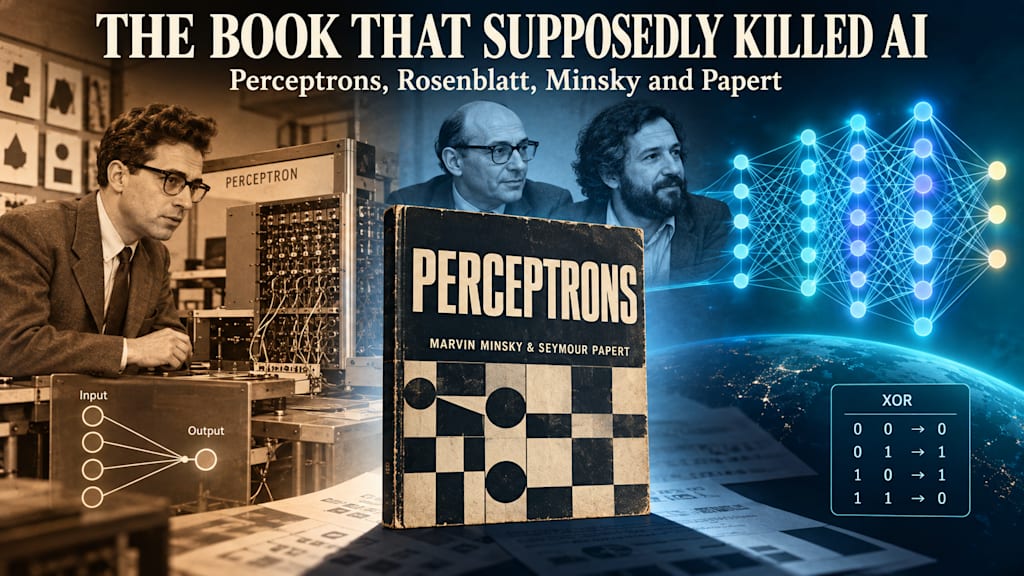
In 1969, two researchers published a book that appeared to deliver a devastating verdict on one of the most promising ideas in artificial intelligence. The book was Perceptrons, written by Marvin Minsky and Seymour Papert. Its target was a type of learning machine associated with Frank Rosenblatt.
Rosenblatt did not write the book with Minsky. He was the inventor whose work stood at the centre of the argument. Their disagreement became part of a famous story: that one book killed research into artificial neural networks and sent AI into a long winter. There is truth in its influence, but the full story is more complicated.
Rosenblatt’s Learning Machine
During the 1950s, Rosenblatt developed the perceptron, a system inspired loosely by the way nerve cells process signals. Instead of following only a fixed list of instructions, it could adjust connections in response to examples. That made it an exciting proposal at a time when computers were usually thought of as machines that did exactly what programmers told them to do.
Imagine showing a machine a collection of simple patterns and telling it which belonged to one category. As it made mistakes, the perceptron would alter the importance it gave to different inputs. With suitable patterns, it could gradually improve its decisions. The underlying idea, learning from examples, is familiar in AI today, but it seemed remarkable when Rosenblatt was developing it.
The promise invited big questions. If a simple network could learn to recognise patterns, what might a larger one achieve? Could such machines eventually recognise objects, understand language or display something approaching intelligence? The excitement ran ahead of what anyone had demonstrated, and that gap between promise and proof attracted Minsky and Papert’s attention.
What the Book Actually Showed
Minsky and Papert examined what particular perceptron systems could and could not do. Their book was a mathematical investigation, rather than an experiment showing that every possible learning machine was useless. They identified serious limits in the kinds of networks they studied.
One example became especially famous. Consider a machine given two yes-or-no inputs. It must answer “yes” when exactly one input is “yes”, but answer “no” when both inputs match. This is known as the XOR problem. A simple, single-layer perceptron cannot learn that rule, however many examples it sees.
That sounds like a small puzzle, but it exposes an important weakness. If a system cannot combine two inputs in this way, its ability to recognise more complicated relationships is limited. Minsky and Papert gave researchers rigorous reasons to question claims that the perceptrons then attracting attention would readily become intelligent machines.
Their result did not prove that all neural networks were incapable of learning XOR. Adding intermediate processing layers can overcome the limitation. The difficult question at the time was how to build and train more capable networks effectively, especially with the computing resources then available.
Did Minsky and Papert Kill Neural Networks?
The usual telling goes like this: Rosenblatt offered a path towards learning machines, Minsky and Papert demolished it, funding disappeared, and neural networks slept for decades. It makes a dramatic story, with a clear beginning, villain and eventual comeback. Historical accounts have questioned whether that neat sequence fairly describes what happened.
The book certainly mattered. It carried the authority of two prominent researchers and showed that confident claims about simple perceptrons needed qualification. A student or funder considering where to put effort could reasonably conclude that other approaches looked more promising. Neural-network research lost some of its earlier excitement and prestige.
Yet artificial intelligence did not die in 1969. Researchers continued working on computer vision, reasoning, language and other problems. Work on neural networks continued too, even when it was no longer the most fashionable part of the field. Funding decisions, disappointing promises and the practical limitations of contemporary computers cannot all be laid at the door of one book.
There is also a difference between proving that a particular design has limits and proving that an entire approach has no future. The former was a substantial contribution to knowledge. The latter is what the popular version of the story sometimes suggests, but it was never established by the XOR result.
The Rival Visions of Intelligence
The dispute reflected two ways of thinking about AI. Rosenblatt’s perceptron learned by changing connections after encountering examples. Other researchers placed more emphasis on representing knowledge explicitly and giving computers rules for manipulating it.
Both approaches offered something attractive. Rules can make reasoning steps easier to inspect, while learning systems can discover patterns that would be laborious to describe by hand. The difficulty is that neither approach, on its own, magically produces human intelligence.
Minsky himself had worked on neural networks earlier in his career. Presenting him simply as a man opposed to learning machines misses that history. His objection was directed at what existing perceptrons could achieve and at claims that seemed to outrun the evidence.
Rosenblatt, meanwhile, deserves more than the role of a defeated optimist. He pursued the idea that a machine might improve through experience rather than depend entirely on prewritten instructions. Modern AI has made that idea central, even though its systems are vastly more elaborate than his early perceptrons.
The Return of Neural Networks
Later researchers developed ways to train networks with intermediate layers, while improved computers made larger experiments practical. Neural networks eventually returned to the centre of AI research. Today’s systems can recognise images, process speech and generate text on a scale that neither side of the 1969 debate could have tested with the machines available to them.
Their success does not make Minsky and Papert’s analysis wrong. A single-layer perceptron still has the limitation they studied. The lesson is that a sound criticism of one design can coexist with the later success of a more capable design built from related ideas.
That distinction matters whenever a technology attracts extravagant predictions. A critic may be right about what the present version cannot do, while an inventor may be right that the underlying idea has further possibilities. Understanding which claim has actually been tested is more useful than declaring either person the permanent winner.
Conclusion
Perceptrons did not kill artificial intelligence, and Rosenblatt was not one of its authors. Minsky and Papert wrote a powerful critique of the learning machines associated with him. Their work helped cool enthusiasm for simple perceptrons, while a wider set of technical and funding problems shaped AI’s uneven progress.
The enduring story is about the distance between a promising idea and a working technology. Rosenblatt saw that machines could learn from examples. Minsky and Papert showed that a celebrated early design had real limits. Later researchers found ways past some of those limits, demonstrating why a setback in science need not be the end of an idea.
About the Creator
Alan Spencer
Have been an author and writer for over 20 years. Have been a journalist, editor, proofreader, and a designer and presenter of training courses. Have written over 100 articles, two books, and around 20 training courses.
Enjoyed the story? Support the Creator.
Subscribe for free to receive all their stories in your feed. You could also become a paid subscriber, letting them know you appreciate their work.
Comments
There are no comments for this story
Be the first to respond and start the conversation.