
The Biggest AI Productivity Mistake Almost Everyone Makes
Artificial intelligence can save hours of work, but only if it's used as a thinking partner instead of a shortcut. Otherwise, it may quietly become one of the biggest productivity traps of the modern workplace.

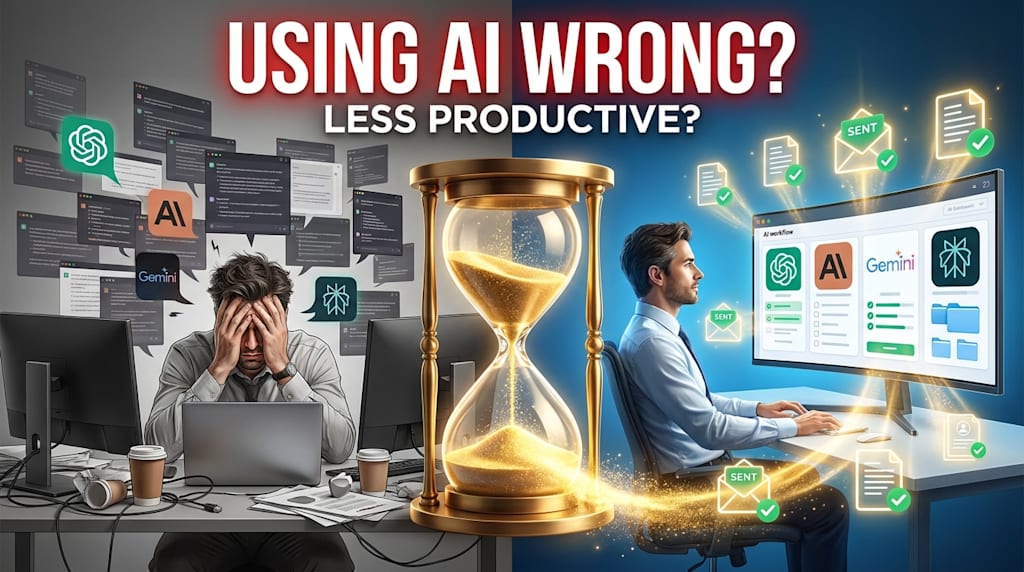
Not long ago, I watched two colleagues use the same AI tool to tackle similar assignments. One finished in less than an hour and spent the remaining time improving the final result. The other spent almost the entire afternoon correcting mistakes, rewriting paragraphs, and chasing details the AI had misunderstood.
The difference wasn't the software.
It was how they used it.
As AI becomes part of everyday work, many people assume that simply opening a chatbot will make them more productive. That assumption is understandable, but it is also one of the biggest misconceptions surrounding artificial intelligence today.
AI is incredibly fast, but speed alone does not guarantee better work.
One of the most common mistakes is treating AI like an answer machine. A vague question often produces a vague answer. When people copy that response without checking facts, adding context, or refining the output, they usually end up spending more time fixing mistakes than they would have spent creating a solid first draft themselves.
The irony is that AI was supposed to save time.
Instead, poor prompting and blind trust can create an entirely new editing workload.
Another productivity trap is trying to automate every task.
Not everything should be delegated to AI. Brainstorming ideas, organizing notes, summarizing research, or drafting routine emails are excellent uses for the technology. Critical decisions, sensitive conversations, and original thinking are different. Those require judgment that still belongs to people.
The most effective professionals understand this distinction.
They do not ask AI to replace their thinking. They ask it to accelerate the parts of the process that consume unnecessary time.
Consider writing.
Many people ask AI to produce a complete article and publish it with only minor edits. Others use AI to generate outlines, identify missing arguments, suggest stronger headlines, or simplify complex explanations before writing the final version themselves.
Both people use AI.
Only one is using it strategically.
The same principle applies to software development, marketing, research, education, and business planning. AI performs best when it handles repetitive work while humans remain responsible for direction, accuracy, and final decisions.
There is another reason some people become less productive after adopting AI.
They stop learning.
When every question receives an instant answer, it becomes tempting to skip the effort required to understand the underlying problem. Over time, that habit can weaken critical thinking. The technology appears to increase efficiency in the short term while quietly reducing long-term expertise.
This is why many experienced professionals continue to verify AI-generated information even when it looks convincing. They understand that confidence and correctness are not always the same thing.
Perhaps the biggest shift is psychological.
People often judge productivity by how quickly they produce something. Businesses, however, usually measure productivity by the quality of the outcome.
A report completed in twenty minutes is not valuable if it contains inaccurate information. A presentation generated instantly still requires human judgment before it reaches a client. Speed creates opportunity, but quality creates trust.
That is where AI delivers its greatest value.
Instead of replacing expertise, it amplifies it.
A skilled designer can explore more creative concepts. A researcher can review larger amounts of information. A marketer can test multiple campaign ideas. In every case, AI expands what knowledgeable people are already capable of doing.
The technology itself is not making people more or less productive.
Their habits are.
Those who rely on AI to avoid thinking may eventually find themselves producing more work with less value. Those who use AI to remove repetitive tasks while protecting their own judgment are likely to gain a lasting advantage.
The future of productivity will not belong to the people who use AI the most.
It will belong to the people who know when not to use it.
About the Creator
Future Lens
Exploring AI, technology, and the future of work through research-driven insights.
Enjoyed the story? Support the Creator.
Subscribe for free to receive all their stories in your feed.
Comments
There are no comments for this story
Be the first to respond and start the conversation.