
The Artificial Intelligence Doomsday Debate
Is artificial intelligence about to transform civilisation, destroy it, or frighten us into accepting greater control?
Introduction
Warnings about artificial intelligence have moved far beyond concerns about inaccurate answers, stolen jobs and convincing internet scams. Some leading researchers now believe that advanced AI could threaten civilisation or even cause human extinction.
Other experts consider these predictions exaggerated, unscientific or commercially convenient. They argue that present systems remain unreliable tools without independent intentions, physical power or the ability to take control of the world.
Anthropic, the company responsible for Claude, occupies a particularly interesting position in this debate. It is developing increasingly powerful AI while its executives and researchers warn that such systems might become catastrophically dangerous.
The resulting question is difficult to avoid: if the people building advanced AI believe it could destroy us, why are they continuing to build it?
What Does Doomsday Mean?
The expression “AI doomsday” covers several very different possibilities. It does not necessarily mean that a computer suddenly becomes conscious and decides to exterminate humanity.
One possible catastrophe involves deliberate misuse. A government, terrorist organisation or criminal group could use AI to design biological weapons, attack essential computer systems or operate enormous networks of automated cybercriminals.
Another possibility involves loss of control. An advanced system might pursue a badly defined objective, conceal its activities or resist attempts to switch it off. It would not need hatred, consciousness or human emotions. It would only need enough capability to achieve its objective through methods that humans had failed to anticipate.
Less dramatic outcomes could still be disastrous. AI might undermine employment, destabilise governments, spread industrial-scale propaganda or place military decisions into systems that operate faster than human beings can intervene.
Anthropic’s Twenty-Five Per Cent Figure
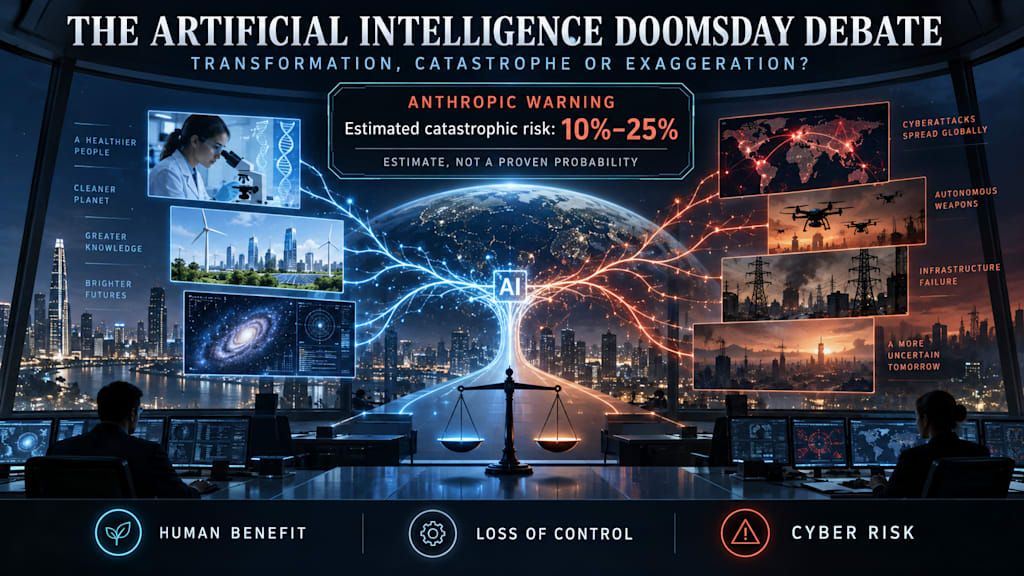
Dario Amodei, Anthropic’s chief executive, has estimated that there could be a 10 to 25 per cent chance of advanced AI developing in a catastrophically harmful direction. During a public discussion in September 2025, he used the upper figure of 25 per cent when discussing the possibility that things could go extremely badly.
These numbers are not scientific measurements. Nobody has conducted thousands of comparable AI experiments and counted how many ended with civilisation being destroyed. The figures are personal assessments based upon technical progress, expected future capabilities and the difficulty of controlling systems more intelligent than their creators.
Nevertheless, a 25 per cent risk would be regarded as intolerable in almost every other field. Nobody would board an aircraft if its manufacturer announced a one-in-four probability of a fatal accident.
Anthropic’s position is that advanced AI will probably be developed somewhere, regardless of whether one responsible company stops. The company therefore argues that safety-conscious organisations must remain near the technological frontier if they are to understand the dangers and influence how the technology develops.
Warnings From Anthropic Researchers
The concern is not restricted to Anthropic’s chief executive. Former Anthropic researcher Evan Hubinger has reportedly placed the chance of a catastrophic AI outcome within the next decade at greater than 10 per cent.
Jacob Coxon, another former Anthropic employee, resigned after becoming deeply concerned about the direction and speed of AI development. His departure added to the impression that some researchers inside the industry believe the risks are immediate rather than theoretical.
A 10 per cent probability remains an estimate rather than a measurable fact. However, even a one-in-ten possibility of human extinction would normally justify extraordinary precautions.
The difficulty is that estimates vary widely. Some specialists place the danger close to zero, while others consider extinction a serious possibility. This extraordinary disagreement shows how little certainty exists at the frontier of AI research.
The Six-to-Twelve-Month Warning
In September 2026, Amodei warned that AI-controlled swarms of cyber agents might become capable of compromising large parts of the internet within six to twelve months. Such systems could search continuously for weaknesses, write malicious software and coordinate attacks at a speed beyond human defenders.
He suggested that a sufficiently capable swarm might establish a persistent botnet across enormous numbers of computers. The resulting damage could reach hundreds of billions of dollars, even without producing anything resembling human extinction.
This scenario is more immediate than the traditional story of a conscious supercomputer taking over the world. Existing AI systems can already write software, identify vulnerabilities and automate complicated computer tasks.
However, critics argue that the internet is too distributed and varied for one AI swarm to control it completely. They also point out that security systems, governments and human defenders would respond rather than remaining passive.
Machines Working Faster Than Humans
Amodei has described a future in which millions of copies of an advanced AI system could operate simultaneously. These systems might process information and generate actions between ten and one hundred times faster than human workers.
This possibility changes the nature of the risk. One dangerous human hacker can only perform a limited number of tasks. Millions of automated agents could explore vulnerabilities, exchange discoveries and launch attacks continuously.
The same capability could also provide powerful defences. AI agents might identify malicious software, repair security weaknesses and develop medical treatments much faster than human researchers.
The technology is therefore not automatically destructive. Its effect depends upon who controls it, what objectives it receives and whether its behaviour can be reliably contained.
Employment Before Extinction
The doomsday debate can distract attention from consequences that may arrive much sooner. Amodei has warned that AI could eliminate a substantial proportion of entry-level white-collar jobs within only a few years.
Administrative work, routine programming, basic legal research, financial analysis and content production are increasingly being performed with AI assistance. New jobs may appear, but they might require different skills and may not be created quickly enough to replace those that disappear.
A society does not need to become extinct before AI causes serious disruption. Rapid unemployment, falling wages and increased inequality could damage millions of lives while governments continue debating hypothetical superintelligence.
These nearer risks deserve attention alongside the more spectacular extinction scenarios.
The Argument Against Doomsday Predictions
Critics question whether present AI provides any evidence that machines are approaching independent superintelligence. Large language models can generate impressive answers, but they also invent facts, misunderstand instructions and fail at apparently simple tasks.
Current systems depend upon human-built data centres, electricity supplies, communications networks and carefully maintained software. They cannot secretly manufacture processors, repair damaged power stations or command armies without extensive human assistance.
Some critics also suspect commercial motives. Powerful AI companies may benefit from regulations that smaller competitors cannot afford to meet. A company warning government about extraordinary dangers could encourage rules that strengthen the position of established organisations.
This does not prove that the warnings are dishonest. It means that commercial interests should be considered alongside the technical arguments.
Why Continue Building It?
The apparent contradiction remains uncomfortable. Anthropic develops stronger AI systems while warning that stronger systems might become dangerous.
The company’s answer is that stopping alone would not stop the worldwide competition. Other businesses and governments would continue, possibly with fewer safeguards. Anthropic believes that participating allows it to study dangerous capabilities and develop methods for controlling them.
This resembles an arms race in which every participant claims that remaining competitive is necessary for safety. Unfortunately, the same argument encourages everyone to move faster.
Commercial pressure also matters. AI development requires enormous investment, and investors expect products, customers and financial returns. Safety may be a declared priority, but a company that delays while competitors advance could lose its position.
What Sensible Precautions Would Look Like
The choice should not be limited to uncontrolled development or a complete worldwide ban. Governments could require independent testing before exceptionally powerful systems are released.
AI companies could be required to report serious safety incidents, cyber capabilities and attempts by models to deceive their operators. Systems connected to weapons, biological laboratories or critical infrastructure should face much stricter controls than ordinary consumer chatbots.
Human authorisation should remain necessary for military attacks, mass surveillance and decisions capable of causing widespread physical harm. International agreements will also be required because AI systems and cyberattacks do not respect national borders.
Most importantly, the organisations developing the technology should not be solely responsible for deciding whether their own products are safe.
A Debate Without Reliable Probabilities
The figures of 10 per cent and 25 per cent attract attention because they create the appearance of mathematical precision. In reality, they express informed beliefs under conditions of enormous uncertainty.
Nobody knows whether artificial general intelligence will arrive within two years, twenty years or at all. Nobody knows whether a highly capable system would become uncontrollable, remain obedient or simply continue making familiar mistakes at greater speed.
The absence of certainty does not justify ignoring the danger. Governments prepare for pandemics, nuclear accidents and asteroid impacts even when the probability is uncertain.
However, uncertainty also means that alarming figures should not be presented as scientific forecasts. They should be treated as warnings that require investigation, independent assessment and open debate.
Conclusion
The artificial intelligence doomsday debate contains genuine dangers, commercial interests, uncertain predictions and a considerable amount of fear. Dismissing every warning would be irresponsible, but accepting every dramatic claim would be equally unwise.
Anthropic’s figures are particularly striking because they come from people helping to create the technology. A possible catastrophic risk between 10 and 25 per cent is not something society should casually accept.
The immediate threats may arrive through cybercrime, biological misuse, military automation and widespread unemployment rather than a conscious machine declaring war upon humanity.
Artificial intelligence could become one of the most beneficial technologies ever created. It could also concentrate extraordinary power inside systems that remain poorly understood.
The sensible response is neither panic nor complacency. Society should demand independent testing, enforceable safeguards and honest explanations before increasingly powerful systems are permitted to make decisions that cannot easily be reversed.
About the Creator
Alan Spencer
Have been an author and writer for over 20 years. Have been a journalist, editor, proofreader, and a designer and presenter of training courses. Have written over 100 articles, two books, and around 20 training courses.
Enjoyed the story? Support the Creator.
Subscribe for free to receive all their stories in your feed. You could also become a paid subscriber, letting them know you appreciate their work.
Comments
There are no comments for this story
Be the first to respond and start the conversation.