
The AI Trust Crisis: Why Our Newest Tools Are Breaking the Digital Workspace
From Flawed Detectors to Autonomous Agents like Manus and Kling, the Line Between Human and Machine Has Reached a Chaotic Breaking Point
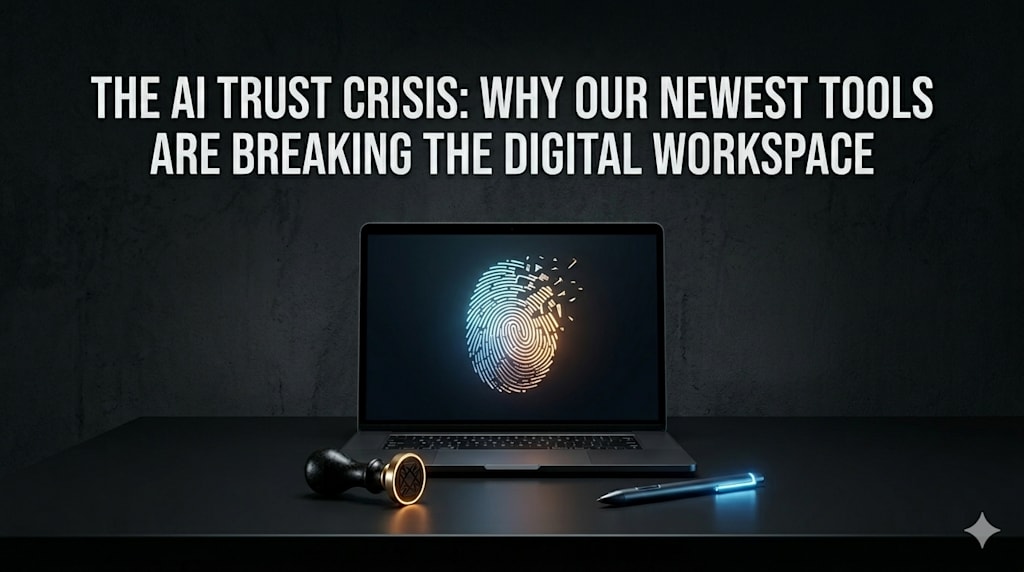
The promise of artificial intelligence was simple: automate the mundane, liberate the human mind, and streamline productivity. Yet, as we navigate the realities of the current tech landscape, that promise is curdling into something far more complicated—an outright crisis of trust. We have officially moved past the honeymoon phase of AI where simple chatbots felt magical. Today, we are wrestling with flawed security nets and autonomous agents that don't just assist with work, but threaten to replace the worker entirely.
The digital workspace is fracturing under two massive, highly controversial phenomena: the rise of inaccurate AI detectors that are punishing innocent creators, and the sudden emergence of hyper-autonomous tools like Manus IA and Kling AI that push the boundaries of what machines should be allowed to do.
The Flawed Gatekeepers: How AI Detectors Built an Empire of False Positives
In an effort to keep content "pure," academic institutions, freelance platforms, and media publishers have rushed to implement AI detectors. The result? A broken system built on algorithmic paranoia.
The core issue with tools designed to detect AI content is their fundamental reliance on patterns. They do not evaluate truth or human origin; they evaluate predictability. For professional writers who specialize in clean, structured, and highly polished prose, this has become a career-threatening nightmare.
- The Injustice of False Positives: Perfectly human authors are being flagged as robots simply because their writing style is orderly.
- The Erosion of Trust: Instead of fostering high-quality content, detectors have forced creators to intentionally introduce flaws, messy phrasing, or erratic structures into their work just to pass an arbitrary machine test. The gatekeepers designed to protect human creativity are, ironically, ruining it.
From Assistants to Agents: The Radical Shift of Kling and Manus
While writers are fighting detectors, another storm is brewing on the operational front. For the past few years, AI was seen as a passive co-pilot—you prompt it, it responds, you edit. But the paradigm has shattered with the introduction of autonomous "agents."
1. Manus IA and the Ghost in the Computer
Manus IA represents a massive leap toward full automation. It is no longer just a window where you type a question; it is an agent with virtual access to a computer. When given a complex project, it opens its own browser, conducts multi-step research, codes software, builds tables, and executes tasks entirely on its own over hours of independent operation.
- The Controversy: If an AI can manage a recruitment pipeline or build an entire financial dashboard without human intervention, the definition of entry-level and mid-level knowledge work changes overnight. It reopens the raw, uncomfortable debate about immediate job displacement.
2. Kling AI and the Death of Visual Reality
Simultaneously, the hyper-realistic video generation of Kling AI (especially its latest multimodal iterations) has blurred the line between cinematic art and synthetic deception.
- The Controversy: Kling's ability to generate photorealistic human movements, flawless lip-syncing, and cinematic audio directly from text prompts has sent shockwaves through the creative community. The entertainment, advertising, and stock footage industries are facing a foundational crisis: When the cost of generating a flawless 4K commercial drops to pennies, what happens to the human film crew?
The Hybrid Future or The Total Eclipse?
We are standing at a crossroads. On one hand, we are using deeply flawed algorithms to police human authenticity (detectors); on the other hand, we are releasing incredibly sophisticated entities (Manus and Kling) that operate with absolute independence.
The immediate danger isn't that AI will become sentient. The danger is that human ecosystems—education, career structures, and creative industries—are moving too slowly to adapt to a reality where machines can execute entire workflows autonomously.
What is your perspective from the field?
As a professional navigating this digital landscape, where do you draw the line?
- Are you experiencing the frustration of dealing with inaccurate AI detectors in your work or studies?
- Do you view autonomous agents like Manus and Kling as ultimate productivity lifesavers, or do you see them as an unmitigated threat to creative careers?
Join the debate and leave your thoughts in the comments section below!
- If this analysis brought value to your workflow, please click the Heart icon (Like) below to support human-authored tech commentary.
- Stay informed on the deeper shifts in technology. Click Follow to receive regular, nuanced insights into the real-world impact of artificial intelligence.
About the Creator
AI Lens
Exploring the profound intersection of human nature, philosophy, and the future of artificial intelligence. Writing about our evolving digital world.
Enjoyed the story? Support the Creator.
Subscribe for free to receive all their stories in your feed.
Comments
There are no comments for this story
Be the first to respond and start the conversation.