
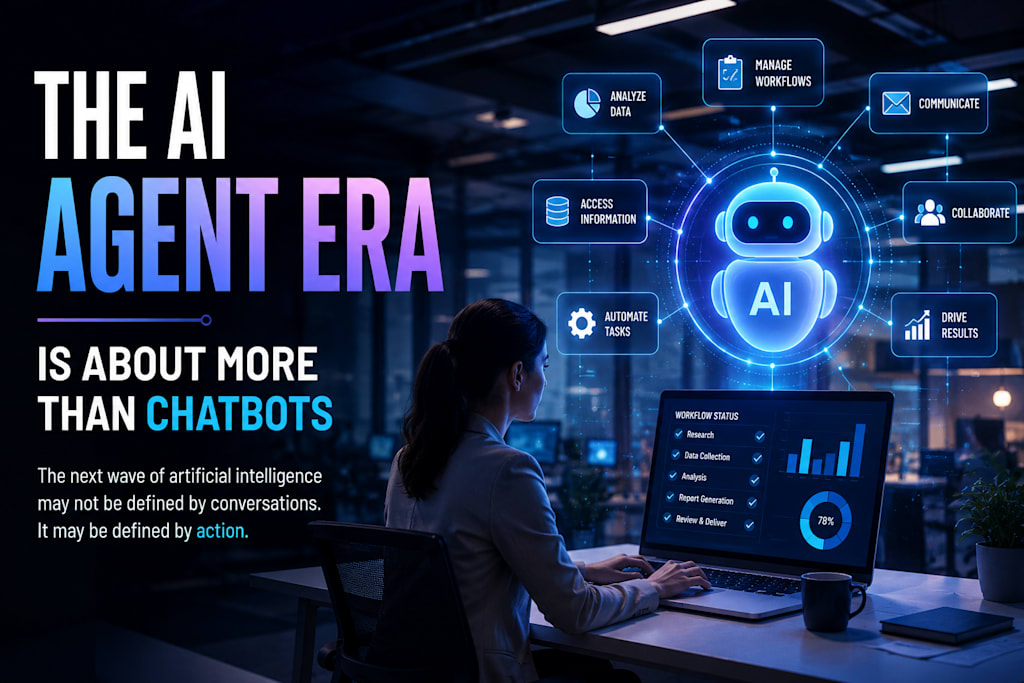
The AI Agent Era Is About More Than Chatbots
The next wave of artificial intelligence may not be defined by conversations. It may be defined by action.
For the past few years, the public face of artificial intelligence has been the chatbot.
People ask questions. AI responds. The interaction feels natural, conversational, and often surprisingly intelligent. From customer support to content creation, chatbots have become one of the most recognizable applications of modern AI.
But something bigger is beginning to emerge.
The technology industry is shifting its focus from AI that simply answers questions to AI that can actively participate in business processes. Instead of generating responses, these systems can retrieve information, make decisions, coordinate tasks, and interact with multiple tools across an organization.
In other words, AI is moving from conversation to execution.
This transition could become one of the most significant changes in enterprise technology over the next decade.
Why Chatbots Were Only the Beginning
Chatbots solved an important problem.
They made artificial intelligence accessible.
For the first time, millions of people could interact with advanced AI systems using natural language. The barrier between humans and machines became dramatically smaller.
Yet most chatbots still operate within a relatively simple framework. A user asks a question, the system generates a response, and the interaction ends.
Businesses, however, rarely operate through isolated conversations.
Organizations depend on workflows involving approvals, databases, reports, customer records, inventory systems, communication platforms, and countless other processes. Real work requires multiple actions happening across multiple systems.
Answering a question is useful.
Completing a task is transformational.
That distinction is driving the rise of AI agents.
From Assistants to Digital Workers
AI agents differ from traditional chatbots because they are designed to accomplish objectives rather than simply generate responses.
Imagine asking an AI system to prepare a weekly business report.
A chatbot might explain how to create the report.
An agent could gather information from multiple sources, analyze the data, generate insights, organize findings into a document, and prepare it for review.
The difference is subtle but profound.
One provides information.
The other performs work.
As businesses continue exploring artificial intelligence, this ability to execute complex workflows is attracting significant attention. Organizations are increasingly interested in systems that can reduce repetitive tasks, improve efficiency, and allow employees to focus on higher-value activities.
The result is a growing interest in managed AI agents that can operate within existing enterprise environments.
The Challenge of Enterprise Reality
Building AI systems for businesses is far more complicated than building consumer applications.
Enterprise environments contain vast amounts of data spread across multiple platforms. Information may exist in cloud services, internal databases, communication tools, financial systems, customer relationship management software, and countless other applications.
For AI agents to be useful, they must navigate this complexity.
They need access to the right information.
They need clear governance.
They need security controls.
And they need the ability to operate reliably without creating unnecessary risks.
This is where much of the industry's attention is now focused. The challenge is no longer proving that AI can generate impressive responses. The challenge is integrating intelligence into real business operations.
Companies are increasingly discovering that successful AI adoption depends as much on architecture and workflow design as it does on the underlying models themselves.
Why Managed Agents Matter
One of the biggest concerns surrounding enterprise AI is trust.
Organizations need confidence that AI systems will behave predictably, follow established processes, and operate within defined boundaries.
Managed agents address part of this challenge by providing structure around how AI systems interact with business workflows.
Rather than acting independently without oversight, managed agents can follow predefined processes, access approved resources, and operate within governance frameworks established by the organization.
This balance between autonomy and control may become one of the defining characteristics of enterprise AI.
Businesses want the benefits of intelligent automation.
They also want accountability.
The organizations that successfully combine both will likely gain a significant competitive advantage.
A Glimpse Into the Next Workplace
The rise of AI agents also raises larger questions about the future of work.
For decades, software primarily served as a tool people used to complete tasks.
AI agents introduce a different possibility.
Software may increasingly become an active participant in work itself.
Employees could spend less time gathering information and more time evaluating outcomes. Teams could focus more on strategy while intelligent systems handle routine operational processes. Workflows that currently require multiple applications and manual coordination could become increasingly automated.
This does not necessarily mean humans disappear from the process.
In many cases, human judgment becomes even more important.
The difference is that people may spend less time performing repetitive work and more time making decisions that require creativity, context, and critical thinking.
Building the Infrastructure Behind Intelligent Workflows
Creating enterprise-grade AI systems involves much more than connecting a language model to a user interface.
Organizations must consider scalability, security, governance, compliance, reliability, and integration with existing systems. The technical challenges become even greater when AI is expected to perform actions rather than simply generate text.
This is one reason engineering teams are increasingly focused on workflow architecture and managed agent frameworks. A recent exploration by GeekyAnts highlighted how platforms such as the Gemini API are enabling organizations to build more sophisticated agent-based systems that can operate across enterprise environments while maintaining structure and control.
The discussion reflects a broader industry trend.
The focus is shifting from what AI can say to what AI can do.
Beyond the Conversation
The chatbot era helped introduce artificial intelligence to the world.
The agent era may determine how deeply it becomes integrated into everyday business operations.
Organizations are already exploring how intelligent systems can assist with research, reporting, customer engagement, operational workflows, compliance monitoring, and countless other activities. As these capabilities mature, AI may become less visible as a standalone tool and more embedded within the systems people use every day.
That shift could fundamentally change how work gets done.
The most important AI systems of the next decade may not be the ones that generate the most impressive conversations.
They may be the ones quietly coordinating workflows, connecting information, and helping organizations operate more effectively behind the scenes.
Artificial intelligence is no longer just learning how to talk.
It is learning how to work.
Further Reading
This article was inspired by insights discussed in GeekyAnts' analysis of enterprise workflows and managed agents using the Gemini API.
About the Creator
Enjoyed the story? Support the Creator.
Subscribe for free to receive all their stories in your feed.
Comments
There are no comments for this story
Be the first to respond and start the conversation.