
The $40 Device That Replaced My Massage Appointments
How a cheap Amazon gadget became the most honest answer to modern back pain.
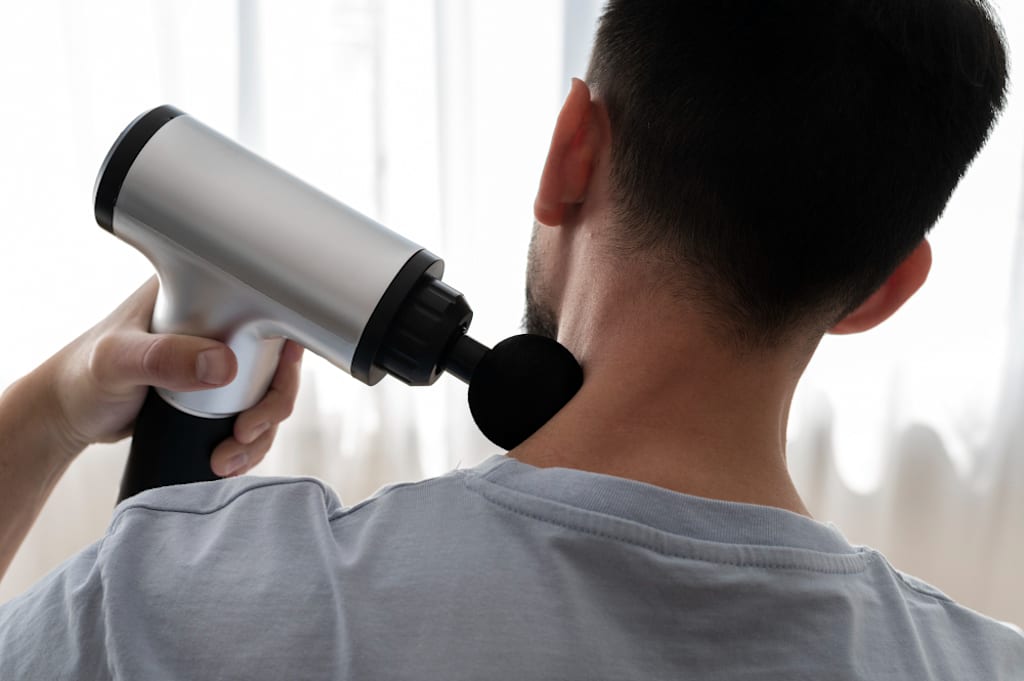
The $40 Device That Replaced My Monthly Massage Appointment
Last spring, a colleague of mine — a copywriter who'd been working from her spare bedroom for four years — showed up to a rare in-person meeting with a percussion massager stuffed in her tote bag. She used it in the parking lot before walking in. No embarrassment, no explanation. Just a woman who'd made peace with the fact that her upper back had become a permanent problem and a $45 Amazon purchase was the most reliable solution she'd found.
I thought about her recently when reading about how aggressively this product category has expanded over the last few years. What once felt like a niche gadget — the kind of thing you'd find next to neck pillows and compression socks at an airport Hudson News — has quietly become a household staple for a specific kind of person. The kind who sits too long, moves too little, and can't justify $120 every few weeks for a massage therapist.
Pain Became Normal and We Stopped Questioning It
There's something worth examining in how thoroughly we've accepted chronic back and shoulder discomfort as a baseline condition of adult life. Most people I know have a "thing" — a spot that tightens up after long drives, a shoulder that complains after too many hours at a desk, a lower back that announces itself every morning. We manage it, work around it, joke about it. We don't, for the most part, treat it.
Part of that is access. Physical therapy requires referrals in many insurance plans, and out-of-pocket massage therapy in most American cities runs $80 to $150 a session. For something that's chronic rather than acute — a slow burn rather than an injury — committing to that expense consistently is genuinely difficult. So people improvise. They buy foam rollers they use twice. They watch YouTube stretching videos on Monday and forget by Wednesday. And increasingly, they buy a back or shoulder massager and actually use it, because the barrier is low enough that it becomes habitual rather than aspirational.
The Device Got Good Faster Than Anyone Expected
Here's the part that surprised me when I actually paid attention: the hardware improved dramatically while the prices stayed low. The shiatsu massagers sold for $35 to $50 on Amazon today are not the flimsy vibrating pads of ten years ago. Brands like Renpho and Nekteck — both operating in that sub-$60 range — produce devices with multiple nodes, adjustable heat settings, and directional rotation that genuinely approximate the sensation of human hands working a knot. Not perfectly. But well enough that a person using one after a long day at a desk will notice a real difference.
The Shenzhen manufacturing ecosystem deserves credit for most of that. Companies there iterated aggressively on both materials and motor quality over a short period, producing devices that undercut Western competitors significantly without the quality gap that characterized earlier generations. Breo, SKG, and similar brands essentially rebuilt the category's value proposition from the ground up — and the market responded. Analysts tracking back and shoulder massagers growth and market share have noted the category expanding at roughly 7% annually through the mid-2030s, a figure that reflects genuine consumer adoption rather than speculative demand. A fuller breakdown of those projections is covered in this back and shoulder massagers sector report.
What a Parking Lot Massager Actually Tells Us
My colleague using her percussive device in a parking lot before a work meeting is a more interesting data point than any industry forecast. It signals something specific: that the stigma around visible pain management has eroded. A few years ago, that scene might have read as eccentric. Now it reads as practical. Athletes have normalized recovery tools publicly for years — NBA players have been photographed with Theraguns courtside since at least 2019, which did real work in legitimizing the category beyond the physical therapy clinic.
That normalization is spreading outward. Older adults managing arthritis and chronic tension are adopting these devices as part of daily routines rather than occasional treatments. People in physically demanding jobs — nurses, warehouse workers, tradespeople — are using them for recovery in ways that don't require a gym membership or a wellness budget. The device has found its way into contexts its original market research probably didn't anticipate.
What happens next in this category will likely hinge on whether the connected-device trend filtering through fitness wearables makes it down to the $50 price point. Theragun's higher-end models already sync with recovery apps, adjusting routines based on muscle group and session history. If that intelligence becomes cheap enough to embed in a mass-market device, the back and shoulder massager stops being a passive tool and starts functioning more like a coached recovery session. For the millions of people who've already accepted that their back is their problem to manage, that shift would be less a novelty than a natural next step.
About the Creator
Mark K. Belton
I’m Mark K. Belton, 26 years old, currently working as a Digital Marketing Intern. I have a strong interest in digital marketing and have been developing my skills in SEO, social media marketing, content creation, and online campaign
Enjoyed the story? Support the Creator.
Subscribe for free to receive all their stories in your feed.
Comments
There are no comments for this story
Be the first to respond and start the conversation.