
Textile Recycling Market Witnesses Strong Growth Amid Circular Economy Trends
The textile recycling market is growing due to rising demand for sustainable waste management and circular economy solutions worldwide.

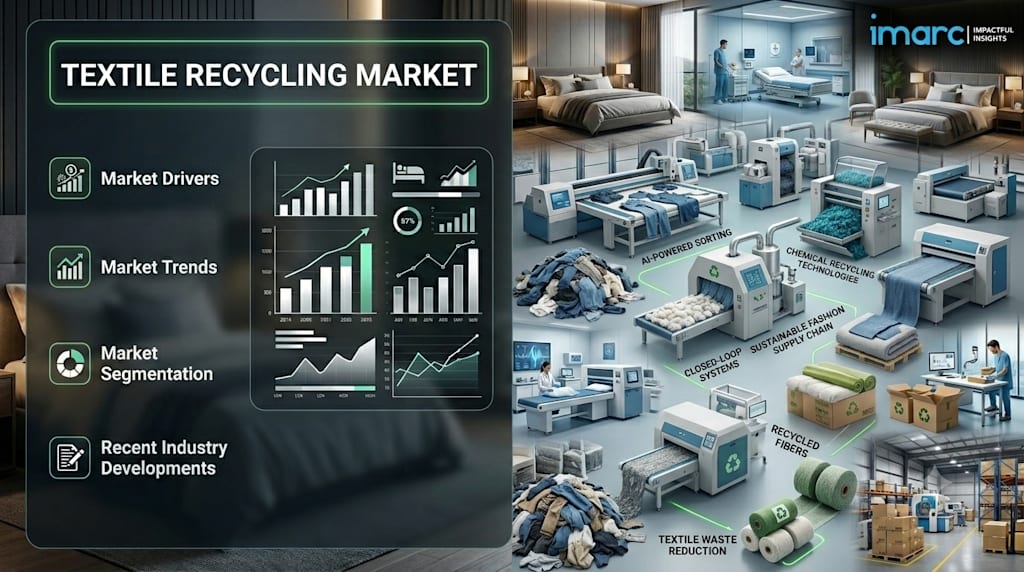
According to IMARC Group’s latest research publication, global textile recycling market size reached USD 5.6 Billion in 2025. Looking forward, IMARC Group expects the market to reach USD 6.8 Billion by 2034, exhibiting a growth rate (CAGR) of 2.27% during 2026-2034.
How AI is Reshaping the Future of Textile Recycling Market
- AI-Powered Fiber Sorting and Classification: Machine learning and NIR spectroscopy enable automated fiber identification with over 95% accuracy, dramatically cutting manual sorting costs.
- Predictive Quality Control in Recycling Facilities: Computer vision systems detect contamination and defects in real time, ensuring only high-grade recycled fibers enter downstream production.
- Chemical Recycling Process Optimization: AI analyzes sensor data across depolymerization systems to optimize temperature and pressure, improving yields and reducing energy use significantly.
Textile Recycling Industry Overview:
The global textile recycling sector is gaining strong momentum as sustainability mandates tighten worldwide. The EU Textile EPR Directive, which entered into force in October 2025, now requires all member states to establish producer-funded collection and recycling schemes. With over 12.6 million tonnes of textile waste generated annually in the EU alone, and less than 1% of textiles globally recycled into new products, the urgency for scalable recycling infrastructure has never been greater.
Textile Recycling Market Trends & Drivers
Tightening government regulations are the most powerful driver reshaping the textile recycling market today. The EU’s mandatory separate textile waste collection requirement, effective January 2025, has pushed member states to build dedicated collection infrastructure at scale. Extended Producer Responsibility schemes now require fashion brands to fund recycling operations directly—with eco-modulation fees tied to product recyclability. France’s Refashion scheme, collecting over 268,000 metric tons in a single year, shows how policy muscle translates into real recycling volume.
Technological breakthroughs in sorting and chemical recycling are unlocking segments of textile waste previously considered too complex to process profitably. AI-driven hyperspectral sorters, such as DataBeyond’s optical sorting system launched at ITMA Asia, can identify fiber blends at speeds impossible manually. Chemical recycling platforms are converting post-consumer polyester and cotton blends into virgin-equivalent raw materials—reducing dependence on petroleum-derived inputs. LIST Technology’s KneaderReactor, which enabled the world’s first 100% pulp-from-recycled-textile Lyocell T-Shirt, is a compelling proof point of what closed-loop textile production now looks like in practice.
Growing consumer demand for sustainable fashion and aggressive corporate sustainability commitments are creating a reliable pull-side market for recycled textile fibers. Major apparel brands are embedding recycled content targets into their sourcing strategies, and retail chains are integrating in-store textile take-back programs to secure feedstock supply. US startup Refiberd, combining AI with green chemical recycling, exemplifies a new generation of solutions built specifically to serve brand sustainability requirements. In parallel, the apparel sector’s contribution of approximately 1.8% of global greenhouse gas emissions keeps supply chains under scrutiny, reinforcing long-term demand for recycled alternatives over virgin fiber.
Leading Companies Operating in the Global Textile Recycling Industry:
- Birla Cellulose (Aditya Birla Group)
- BLS Ecotech Ltd. (BLS Group)
- Boer Group
- Lenzing AG
- Martex Fiber (Leigh Fibers)
- Pistoni S.r.l.
- Remondis SE & Co. KG
- Respun (Kay Gee Enterprises)
- Unifi Inc.
- Usha Yarns Ltd.
Textile Recycling Market Report Segmentation:
By Product Type:
- Cotton Recycling
- Wool Recycling
- Polyester & Polyester Fiber Recycling
- Nylon & Nylon Fiber Recycling
- Others
Cotton recycling represents the largest segment, driven by the high prevalence of cotton in clothing and its relatively straightforward mechanical processing compared to synthetic fibers.
By Textile Waste:
- Pre-consumer Textile
- Post-consumer Textile
Pre-consumer textiles hold the largest market share due to cleaner, homogenous waste streams that are easier and more cost-effective to sort and reprocess.
By Distribution Channel:
- Online Channel
- Retail & Departmental Store
Retail & departmental stores account for the largest share, serving as primary endpoints for recycled textile products and driving consumer awareness through high-visibility placement.
By End-Use:
- Apparel
- Industrial
- Home Furnishings
- Non-woven
- Others
Apparel holds the largest market share, as fashion brands increasingly integrate recycled fibers into new collections to meet consumer demand and sustainability commitments.
Regional Insights:
- North America (United States, Canada)
- Asia Pacific (China, Japan, India, South Korea, Australia, Indonesia, Others)
- Europe (Germany, France, United Kingdom, Italy, Spain, Russia, Others)
- Latin America (Brazil, Mexico, Others)
- Middle East and Africa
North America leads the global textile recycling market, backed by stringent environmental regulations, high consumer awareness, and significant investment in advanced recycling technologies and infrastructure.
Recent News and Developments in Textile Recycling Market
- October 2025: The EU Textile EPR Directive officially entered into force, requiring all EU member states to establish Extended Producer Responsibility schemes within 30 months. The directive mandates fashion brands and textile producers to fund the collection, sorting, and recycling of their products, marking the most comprehensive textile sustainability regulation ever enacted in Europe.
- September 2025: The European Parliament approved new rules requiring EU countries to establish EPR schemes covering clothing, footwear, household textiles, and accessories. Producers selling via e-commerce platforms and those outside the EU are included under the new framework, closing a long-standing regulatory gap.
- April 2025: Major European retailers including Inditex (Zara), H&M, Decathlon, Ikea, and Primark launched a voluntary pilot textile collection scheme in Spain, installing dedicated bins across high-traffic locations ahead of mandatory EPR requirements. The initiative underscores growing brand-level commitment to building consumer-facing recycling infrastructure.
Note: If you require specific details, data, or insights that are not currently included in the scope of this report, we are happy to accommodate your request. As part of our customization service, we will gather and provide the additional information you need, tailored to your specific requirements. Please let us know your exact needs, and we will ensure the report is updated accordingly to meet your expectations.
About the Creator
sujeet. imarcgroup
With 2 years of hands-on experience at IMARC Group, I have conducted in-depth market research and analysis across diverse industries including technology, healthcare, agriculture, and consumer goods.
Enjoyed the story? Support the Creator.
Subscribe for free to receive all their stories in your feed.
Comments
There are no comments for this story
Be the first to respond and start the conversation.