
Textile Machinery Market Strengthens with Rising Industry Investments
How supply chain optimization and smart factory investments are creating new growth opportunities for machinery manufacturers and textile producers

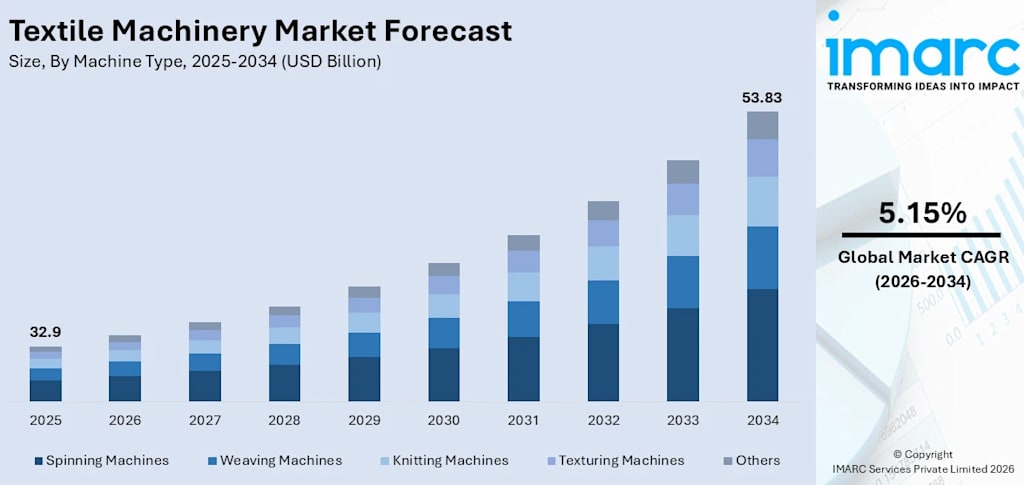
According to IMARC Group’s latest data, The global textile machinery market size was valued at USD 32.9 Billion in 2025. Looking forward, IMARC Group estimates the market to reach USD 53.83 Billion by 2034, exhibiting a CAGR of 5.15% from 2026-2034. Asia-Pacific currently dominates the market, holding a market share of over 61% in 2025.
The shifting landscape of global manufacturing, characterized by escalating production costs and rapid technological progression, is accelerating the demand for highly efficient production systems. Textile machinery now represents a multi-billion-dollar global market exceeding USD 30 billion and exhibiting steady year-on-year expansion. Demand is driven by rising health consciousness, busy lifestyles that favor on-the-go nutrition, and increased interest in plant-based, low-sugar and clean-label products. Retail innovation and e-commerce, private-label launches, and product reformulation for protein, fiber and functional ingredients are further accelerating uptake.
Download Expert Insights on the "Textile Machinery Market" Today
Textile Machinery Market Growth Drivers:
- Rising Automation Across Textile Manufacturing
Manufacturers are heavily prioritizing fully automated systems to combat rising operational costs and severe workforce shortages. Modern processing systems rely heavily on integrated robotics, specialized computerized numerical control mechanisms, and remote terminal diagnostics to boost throughput while mitigating structural material waste. This focus on automated precision ensures that massive, high-volume production runs meet strict quality baselines with minimal human intervention. Real-world rollouts show that upgrading traditional setups to automated lines directly minimizes system downtime, helping mills protect thin margins in increasingly competitive international export corridors.
- Advancements in Digitalization and Industry 4.0 Integration
The ongoing transition toward smart factories relies on a highly unified network of cloud platforms and hardware infrastructure. Factories utilize edge-computing setups and real-time analytical monitors to consistently track active energy use and equipment health across diverse processing lines. Having immediate visibility into machinery dynamics lets operators run predictive servicing schedules, preventing catastrophic component failures before they stall active operations. This digital overhaul bridges the gap between digital custom patterns and physical manufacturing, allowing floor managers to adjust output scales instantly based on fast-moving market demands.
- Escalating Global Demand for Fast Fashion and Luxury Apparel
Rapid consumer shifts toward modern apparel, intricate designs, and high-end clothing are placing intense pressure on mill capacity worldwide. Brands are forced to refresh their seasonal inventories much quicker, creating urgent demand for highly flexible production machinery that handles sudden batch switches without dropping speeds. This dynamic is especially visible across fast fashion segments, where specialized multi-functional equipment is required to replicate modern styles and complex embroidery on complex fabrics. Consequently, textile firms are forced to modernize legacy mechanical setups with versatile, high-output production assets.
Textile Machinery Market Trends:
- Widespread Deployment of Resource-Saving and Sustainable Solutions
Modern machinery brands are deeply focused on engineering eco-friendly processing hardware that slashes factory emissions and daily water consumption. This wave of green innovation addresses stricter climate mandates and sudden surges in eco-conscious consumer brand choices globally. For instance, textile technology developers recently introduced advanced cloud-connected energy tracking portals for complex warp-knitting systems. Pilot deployments confirm that these smart networks optimize warm-up cycles and cut baseline fuel consumption by approximately 5 to 10%, giving large-scale industrial textile processors a realistic path to shrink their carbon footprints.
- Surging Penetration of Online Ecosystems for Pre-Owned Machinery
The trade of certified pre-owned production hardware is rapidly shifting toward specialized digital marketplaces that offer complete end-to-end purchasing security. These virtual hubs provide comprehensive asset evaluation, mechanical testing, and direct logistics coordination, creating an exceptionally clear and trusted transaction path for both buyers and sellers. An excellent real-world example is the launch of specialized digital e-auction portals designed specifically to facilitate regional used machinery deals. This online framework helps mid-sized mills upgrade operations cost-effectively while heavily supporting circular economy models within industrial engineering.
- Elimination of Strategic Trade Duties to Foster Modernization
National governments are actively using updated regulatory updates and fiscal policy adjustments to encourage deep industrial modernization within local manufacturing ecosystems. For example, prominent sovereign finance frameworks have systematically eliminated targeted import levies on high-efficiency, shuttle-less weaving looms to aggressively accelerate the domestic production of technical textiles. Furthermore, regional budget allocations frequently feature heavy capital infusions alongside increased basic import duties on low-cost external fabrics. These combined state interventions effectively shield domestic textile enterprises from unfair pricing, providing strong financial incentives to buy cutting-edge processing systems.
Recent News and Developments in Textile Machinery Market
- February 2025: The Union Budget 2025-26 allocated INR 5,272 crore to the Ministry of Textiles, representing a notable 19% increase from the previous year. This policy initiative includes a dedicated five-year Cotton Mission alongside the systematic elimination of duties on specific shuttle-less looms to accelerate domestic production capabilities.
- January 2025: India’s Minister of Textiles officially inaugurated the dedicated national pavilion at Heimtextil 2025 in Frankfurt, highlighting advanced regional production capabilities. The state delegation used the global platform to invite foreign manufacturing investments under the competitive "Make in India" industrial framework.
- May 2025: Industry players showcased fully automated CNC flatbed sewing and advanced laser cutting systems at TexProcess in Atlanta, featuring innovative Moving Conveyor Technology. The setup demonstrated direct roll feeding and operational processing speeds hitting 3,000 stitches per minute, eliminating traditional manual alignment delays.
Note: If you require specific details, data, or insights that are not currently included in the scope of this report, we are happy to accommodate your request. As part of our customization service, we will gather and provide the additional information you need, tailored to your specific requirements. Please let us know your exact needs, and we will ensure the report is updated accordingly to meet your expectations.
About the Creator
Andrew Sullivan
Hello, I’m Andrew Sullivan. I have over 9+ years of experience as a market research specialist.
Enjoyed the story? Support the Creator.
Subscribe for free to receive all their stories in your feed.
Comments
There are no comments for this story
Be the first to respond and start the conversation.