
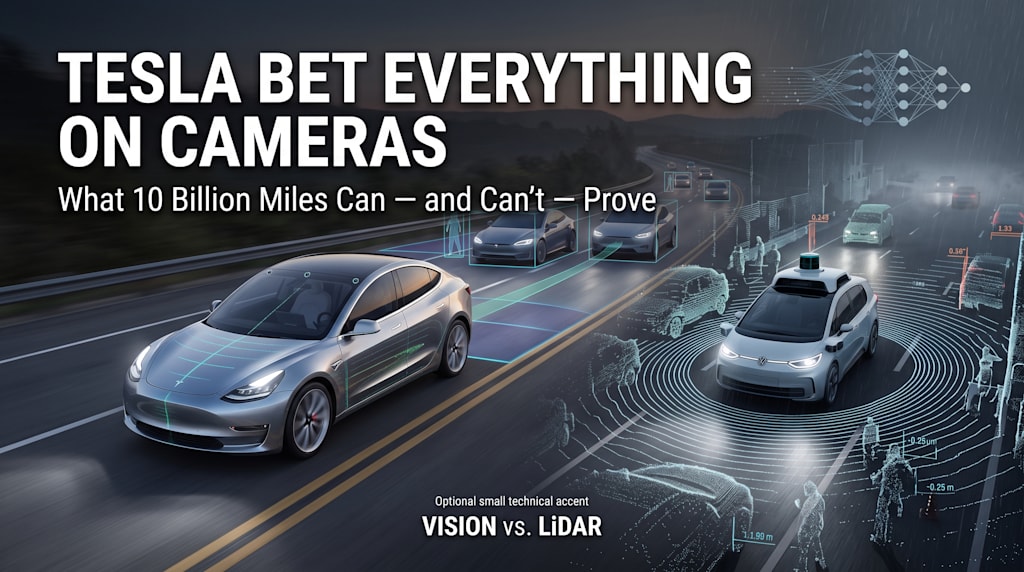
Tesla Bet Everything on Cameras. Here's What 10 Billion Miles Can and Can't Prove
Tesla's FSD fleet has accumulated billions of supervised miles without LiDAR. Federal regulators are now asking whether cameras alone can see well enough when conditions turn bad.

Editorial note: I use AI tools to assist with research, drafting, fact-checking, and editing. The analysis, opinions, engineering interpretation, and final editorial decisions are my own.
Most self-driving test vehicles you've seen in a news photo share one feature: a spinning sensor housing bolted to the roof. That housing is LiDAR, and nearly every serious autonomous driving program treats it as essential.
Tesla's cars don't have one. Its Full Self-Driving system relies on camera-based perception, with no LiDAR. On that approach, Tesla's Full Self-Driving (Supervised) fleet passed 10 billion cumulative miles in May 2026, according to the company's own safety page. That is an extraordinary scale for a consumer-deployed driver-assistance system.
That number usually gets presented as proof that Tesla is winning. What it proves is narrower. Two months before the fleet crossed 10 billion miles, the National Highway Traffic Safety Administration moved its investigation into how Tesla's cameras handle sun glare, dust and fog to an Engineering Analysis. That is the final investigative stage before the agency can push for a recall, and it covers roughly 3.2 million vehicles.
Both facts are true at the same time. Working out why is the best way to see where self-driving technology really stands.
What LiDAR measures that a camera has to estimate
LiDAR stands for Light Detection and Ranging. The sensor fires laser pulses at 905nm or 1550nm, the two standard automotive LiDAR wavelength bands, and times how long each pulse takes to return. From those return times, it builds a real-time 3D point cloud of everything around the vehicle: buildings, pedestrians, cyclists, the pothole you'd rather not find at 65 mph. Modern automotive units resolve distance to within centimeters at ranges beyond 100 meters, though real-world performance depends on how reflective the target is and on atmospheric conditions.
The engineering advantage is directness. A camera captures a flat image, and software has to infer how far away each object is. LiDAR measures that distance. There is no inference step to get wrong.
That is why Waymo, Mobileye, and nearly every major self-driving program outside Tesla build around it. When the failure mode is a collision, redundant sensing is ordinary engineering practice, not overkill.
The drawback has always been cost. A commercial-grade LiDAR unit has historically cost between $10,000 and $75,000 per vehicle. That is changing. Waymo's 6th-generation Driver, which began fully autonomous operations in February 2026, cut hardware cost by more than 50% compared with the previous generation, according to Electrek's reporting. The same sensor suite adds active heaters, wipers and sprayers to keep sensors clear in rain, snow and dust. That detail matters later in this story.
Even so, a LiDAR-based sensor suite still costs far more than a set of cameras. Today it isn't something you add to a $40,000 family car.
Waymo's slower path is a deliberate choice
Waymo tends to be cast as the cautious, slow-moving option. Its record suggests that undersells it.
Waymo operates at SAE Level 4, meaning its vehicles drive with no human behind the wheel. Its robotaxis carry paying passengers in San Francisco, Phoenix, Los Angeles, Austin, Atlanta and Miami without a safety driver. Its peer-reviewed safety analyses report substantially lower injury-related crash rates than human-driver benchmarks in the areas where it operates, according to Waymo's Safety Impact hub.
The trade-off is its operational design domain, or ODD: the specific conditions a self-driving system has been designed and validated to handle. Waymo's ODD is tied to detailed, pre-built maps of every street it serves. A new construction zone or an unmapped road requires an update before the vehicles can operate there. Expanding to a new city means mapping runs, regulatory approval, and a hardware-heavy fleet.
That looks like a weakness until you consider Waymo's argument: operating at Level 4 inside a validated domain is safer than operating at Level 2 everywhere. So far, the safety data supports that position.
The scale is arriving too. According to Waymo's February 2026 funding announcement, the company delivered 15 million rides in 2025, passed 20 million lifetime rides, and raised $16 billion at a $126 billion valuation.
Tesla's bet: drive the way people see
Tesla's stated rationale is simple. Roads, signs, lane markings and brake lights were designed by people, for human eyes. If a machine is going to drive like a person, it should be able to do it by seeing like one.
That argument has a second half, and it's the one hardware people tend to notice first: cost. Cameras are inexpensive, mass-produced components. Keeping LiDAR and radar off the bill of materials lets Tesla put the full sensor set on every car it sells. Without that, a fleet-scale data strategy wouldn't be possible at all. The vision argument and the cost argument point the same way, which is part of why Tesla has committed so firmly.
Tesla's Full Self-Driving (FSD) system uses eight cameras around the vehicle. The software identifies objects, estimates depth, predicts behavior and makes driving decisions in real time. It is built on transformer-based neural networks, including what Tesla calls Occupancy Networks, which predict from video alone which regions of 3D space are occupied. Tesla removed radar from new vehicles in 2021 and ultrasonic sensors by 2023. Cameras now carry the primary environmental perception load for FSD.
The radar removal was rougher than Tesla's messaging suggested. Early camera-only builds performed measurably worse before the neural networks caught up. Tesla bet that software would close the gap, and for most drivers in most conditions it has. Still, the transition showed how much this approach depends on continuous, aggressive software development.
For new readers, one clarification matters more than any other: FSD is not self-driving. Tesla classifies FSD as an SAE Level 2 partial automation system under SAE International's J3016 taxonomy, as described in NHTSA's investigation filing PE25012. It is a driver support feature, and the human driver remains responsible at every moment. The product name is aspirational. The legal classification is not.
The software underneath the cameras
The perception stack is also changing at the silicon level. In April 2026, Tesla shipped FSD v14.3 (build 2026.2.9.6). According to Tesla's release notes, as reported by Electrek on April 7, 2026, the update rewrote the AI compiler and runtime using MLIR (Multi-Level Intermediate Representation), an open-source compiler framework maintained under the LLVM project.
Tesla says the change delivered a 20% faster reaction time on HW4 vehicles. That is Tesla's own figure, and no independent benchmark exists yet. The architectural point stands regardless. The compiler decides how a neural network is mapped onto the in-car computer's hardware, which directly affects the delay between the car detecting a hazard and responding to it. That delay is exactly what NHTSA's EA26002 investigation is examining.
For anyone on the hardware side, updates like this show how much the vision-only approach depends on getting more performance out of fixed in-car silicon rather than adding sensors.
What 10 billion miles do and don't prove
Every mile driven with FSD engaged can feed training data back to Tesla. The growth curve is steep. The fleet logged about 670 million FSD miles in 2023 and 4.25 billion in 2025, then added more than a billion in the first 50 days of 2026 alone. By spring 2026, it was adding roughly 29 million miles a day, and it crossed 10 billion cumulative miles in May.
By comparison, Waymo reports 170.7 million fully autonomous, rider-only miles through December 2025. Tesla's number is far larger, but the two figures measure different things.
Tesla's miles are supervised Level 2 miles. A human is present and watching, and corrects small errors before they compound. Waymo's miles are Level 4 miles. No one can take over; the company carries the liability, and the system operates on its own. Treating the two as equivalent data is technically misleading.
The 10 billion figure also comes with some history. In January 2026, Elon Musk cited roughly 10 billion miles as the data volume needed for safe unsupervised driving. That revised upward his earlier estimate of 6 billion, and it came after Tesla missed its own target of delivering unsupervised FSD by the end of 2025. The milestone is real. Its meaning as a readiness threshold has moved.
Where Tesla's data gets noisy
More miles do not automatically mean better training data.
In supervised machine learning, model quality depends heavily on label accuracy, meaning the signal that tells the model what the correct action was in a given situation. When an FSD user takes over, the system has to infer why. FSD may have been about to make a mistake. The driver may have been nervous or distracted, or simply preferred a different line through a corner. That ambiguity weakens the training signal, and it is hard to clean up at scale. Waymo's professional operators follow defined intervention protocols, which gives cleaner labels from a smaller dataset. Whether Tesla's volume outweighs that quality gap is still an open question among machine learning researchers.
Tesla's safety statistics deserve the same scrutiny. The company reports that FSD drivers crash far less often than the U.S. average. Independent safety researchers have challenged the method because it compares new vehicles with modern safety systems against the entire U.S. fleet, including cars more than a decade old. A cleaner comparison is FSD engaged versus FSD disengaged in the same vehicles, and on that measure the margin is smaller.
Transparency is also uneven. According to Electrek's reporting, Tesla is the only autonomous vehicle operator that fully redacts crash narratives in its NHTSA filings, citing confidential business information. Waymo, Zoox, Aurora and Nuro publish detailed accounts.
What federal regulators found
On March 18, 2026, NHTSA upgraded its FSD investigation, designated EA26002, to an Engineering Analysis covering approximately 3.2 million vehicles. That is the last investigative step before the agency can seek a recall. The investigation examines whether FSD's degradation detection system recognizes when sun glare, dust, or fog has impaired its cameras, and whether it warns the driver in time. NHTSA identified nine incidents, including one fatal crash. According to NHTSA's investigation documents, Tesla's own analysis found that its updated detection system would have helped in only three of those nine.
A second investigation, Preliminary Evaluation PE25012, opened in October 2025. It covers 58 incidents in which FSD-equipped vehicles ran red lights, drifted into oncoming lanes, or entered wrong-way traffic. Tesla requested two deadline extensions to submit crash data, citing the need to manually review more than 8,300 records, according to Electrek's February 23, 2026 reporting.
Any honest assessment of camera-only driving has to account for two open federal investigations, one of which includes a fatal crash.
The physical limits of a camera
Cameras have physical limits that training data cannot fully remove.
Heavy rain, snow, and dense fog degrade camera image quality. LiDAR often holds up better in some of those conditions, because light at 905nm and 1550nm scatters less than visible light. It is not immune, though. Heavy rain, dense fog and road spray cause backscatter, multipath interference and signal attenuation that degrade LiDAR's point cloud too. Its weather advantage is real, but it depends on the conditions.
The bigger practical difference may be keeping the sensor itself clean. Waymo's 6th-generation hardware uses active heating, wipers, and sprayers to keep its sensors clear. Tesla's cameras rely on a clear windshield and clean lenses. Road grime, condensation, or chemical fogging inside the camera housing can all degrade perception.
Depth estimated from 2D images also carries more uncertainty than a direct time-of-flight measurement, however capable the network.
None of this is hypothetical. These are the failure modes NHTSA is investigating in EA26002.
The metrics that actually certify a driverless car
Mileage is the figure everyone quotes. It is not the figure that earns safety approval.
The benchmarks that matter for validating autonomous systems include disengagement severity, mean distance between hazardous events, ODD coverage, and performance in rare edge cases. A supervised dataset of 10 billion miles, in which people routinely catch small errors before they grow, does not show that the model keeps closed-loop stability once that safety net is removed. The model learns how humans drive. Whether it can recover from its own compounding errors on a dark, wet, unmarked road in an unfamiliar city is still an open question.
Most coverage also skips cybersecurity. Connected autonomous vehicles expose attack surfaces that scale alone does not address. They include the integrity of over-the-air updates, GNSS jamming, adversarial inputs targeting camera-based perception, and separate spoofing and interference risks that affect other sensor types, LiDAR included. The connected side of the car is already a proven target: at Pwn2Own Automotive in January 2026, researchers from Synacktiv gained root access to Tesla's infotainment system. That was not the driving system, but it shows how much attack surface a connected car carries. When cameras are the primary perception layer, adversarial robustness becomes a safety requirement. Neither Tesla nor the wider industry has given a complete public answer yet.
What to watch next
Neither approach has won, and the outcome may not be winner-take-all.
Waymo has shown that a geofenced, sensor-rich Level 4 robotaxi can run today in real cities, with paying passengers and a safety record that holds up to outside review. Tesla has shown that a vision-only system can drive well enough across billions of real-world miles that ordinary people pay for it and use it daily. Its cost structure also lets it scale in a way LiDAR-based fleets currently cannot. And the same camera-only design sits at the center of two open federal investigations.
The question underneath all of this is specific. Can cameras alone, without a direct time-of-flight measurement, deliver safe unsupervised driving in every operating domain, not just most of them? Mileage is one input. Validation methodology, sensor redundancy, cybersecurity, and closed-loop stability in the worst conditions are the others.
Three developments will reveal more than the next mileage milestone:
The outcome of NHTSA's EA26002 investigation. It will show whether regulators consider Tesla's camera degradation detection adequate.
Same-vehicle safety data. This means FSD-engaged versus FSD-disengaged results for the same cars, the comparison independent researchers have asked for.
Unsupervised performance data, from vehicles where no human is available to step in.
The sensor on the roof was never really the point. The real test is whether the software behind eight cameras can see well enough when conditions are at their worst. The next phase of data, and the next regulatory decision, will answer that.
Sources
Tesla: Full Self-Driving (Supervised) Vehicle Safety Report
Waymo: Safety Impact
Waymo: Beginning fully autonomous operations with the 6th-generation Waymo Driver (Feb 12, 2026)
Waymo: Accelerating our global growth, $16 billion investment round (Feb 2026)
Automotive World: Waymo's 6th-gen Driver goes live with 42% fewer sensors (Feb 13, 2026)
NHTSA: EA26002 investigation opening resume (Mar 18, 2026)
Repairer Driven News: NHTSA opens PE25012 on nearly 2.9 million vehicles (Oct 10, 2025)
Electrek: Tesla FSD v14.3 rolls out with MLIR rewrite (Apr 7, 2026)
Electrek: Tesla reaches 10 billion FSD miles (May 3, 2026)
Electrek: Tesla struggles to turn over FSD traffic violation data (Feb 23, 2026)
Electrek: Tesla's own Robotaxi data and crash-narrative redactions (Jan 29, 2026)
BleepingComputer: Tesla hacked, 37 zero-days demoed at Pwn2Own Automotive 2026
About the author: Imran Valiani is a Sales Director in PCB electronics manufacturing with 20+ years of industry experience. He writes about the hardware layer of technology — semiconductors, PCB manufacturing, AI infrastructure, embedded systems, and emerging electronics — at Silicon to Software.
Read more engineering analysis at SiliconToSoftware.com
About the Creator
Imran Valiani
Engineering the hardware behind modern technology. Silicon to Software covers semiconductors, PCBs, AI infrastructure, embedded systems, and emerging hardware — with practical analysis from 20+ years in electronics manufacturing.
Enjoyed the story? Support the Creator.
Subscribe for free to receive all their stories in your feed.
Comments
There are no comments for this story
Be the first to respond and start the conversation.