
Telepresence Equipment Market Outlook: Remote Collaboration Demand and Growth
The Telepresence Equipment Market is experiencing strong growth driven by increasing demand for advanced remote communication and collaboration solutions.

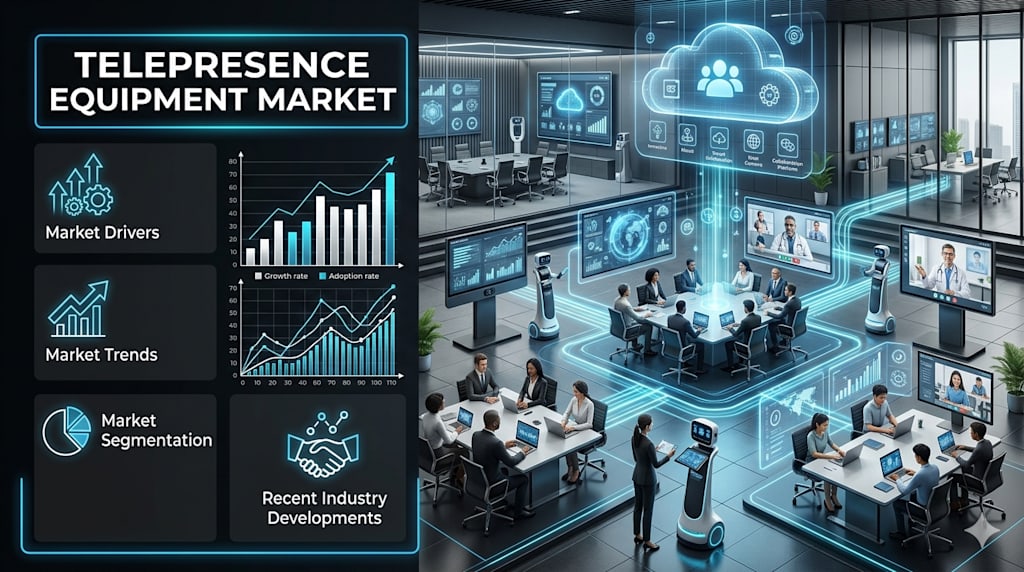
According to IMARC Group's latest research publication, The global telepresence equipment market size reached USD 2.7 Billion in 2025. Looking forward, IMARC Group expects the market to reach USD 3.6 Billion by 2034, exhibiting a growth rate (CAGR) of 3.23% during 2026-2034.
How AI is Reshaping the Future of Telepresence Equipment Market
- Predictive Meeting Management and Resource Allocation: AI algorithms analyze historical usage patterns and organizational calendars to optimize conference room scheduling and equipment deployment. Systems implementing these solutions have improved resource utilization by up to 35%, minimizing conflicts and ensuring seamless availability for virtual collaboration sessions across distributed teams.
- Real-Time Language Translation and Accessibility: Machine learning powers instant language translation capabilities during telepresence sessions, enabling multilingual participants to communicate naturally. AI-driven systems detect speech patterns and deliver real-time subtitles with exceptional accuracy, making global collaboration more inclusive and reducing language barriers that previously hindered international business operations.
- Automated Quality Enhancement and Network Optimization: AI monitors network conditions and automatically adjusts video resolution, frame rates, and compression levels to maintain optimal connection quality. Intelligent systems predict bandwidth fluctuations and proactively allocate resources, reducing lag and ensuring crystal-clear communication even during periods of network congestion or variable connectivity.

Telepresence Equipment Industry Overview
Hybrid work adoption is fundamentally transforming the telepresence equipment landscape. Over 55% of businesses have transitioned to hybrid models, with corporate installations accounting for 40% of total deployments. Healthcare applications represent 30% of market demand, leveraging telepresence for remote consultations and medical collaborations. The 5G-enabled telepresence technology adoption has increased by 35%, enhancing connectivity and reducing latency for real-time communication across distributed teams.
Telepresence Equipment Market Trends & Drivers
Healthcare sector expansion is driving substantial telepresence equipment adoption. Medical telepresence robots reached USD 147.16 million, serving remote consultations and specialist access in underserved areas. The World Health Organization's Global Strategy on Digital Health 2020-2025 promotes telemedicine delivery using telecommunication technologies for advancing community health. Healthcare institutions are utilizing telepresence for virtual patient care, eliminating transportation barriers and reducing virus exposure during in-person visits. Biomedical sensors measuring patient biometrics combine with 5G networks and cloud storage to enable comprehensive remote healthcare delivery, creating sustained demand for specialized telepresence equipment across hospitals and clinics.
Corporate collaboration requirements are accelerating telepresence deployment across enterprises. Small and medium-sized enterprises have seen a 30% rise in telepresence adoption as cost-effective solutions become more accessible. The shift towards hybrid environments has fueled a 45% increase in demand for telepresence-equipped conference rooms supporting seamless virtual meetings. AI-powered telepresence assistants have grown by 25%, optimizing meeting efficiency and automating scheduling processes. In August 2025, Cisco Systems announced a strategic partnership with a leading AI firm to enhance telepresence solutions with advanced analytics capabilities, providing users with actionable insights and improved collaboration experiences across distributed teams.
Education sector digitalization is creating robust growth opportunities for telepresence technology. Education institutions have adopted telepresence at a rate of 25%, facilitating virtual learning and global academic exchange programs. Universities are utilizing telepresence technologies to conduct virtual classrooms, expanding access to learning resources beyond geographic limitations. Mobile telepresence robots equipped with wheels and autonomous navigation are widely deployed in educational settings, offering enhanced flexibility for remote instruction. The integration of facial recognition, gesture control, and emotion detection enhances communication naturalness, while cloud-based connectivity and IoT integration allow seamless updates and remote management of educational telepresence systems.
Leading Companies Operating in the Global Telepresence Equipment Industry
- Avaya Inc.
- Cisco Systems Inc.
- Haivision
- HP Inc.
- Huawei Technologies Co. Ltd.
- Microsoft Corporation
- Plantronics Inc.
- Sony Corporation
- Vidyo Inc. (Enghouse Systems Limited)
- ZTE Corporation
Telepresence Equipment Market Report Segmentation
By Type
- Multi-Codec Telepresence
- Personal Telepresence
- Immersive Telepresence
- Room-based Telepresence
Room-based telepresence represents the largest segment, as it provides comprehensive collaboration capabilities suitable for enterprise meeting environments.
By Form Factor
- End-Points
- Display
- Camera
- Microphone
- Infrastructure
End-points exhibit clear dominance in the market, driven by widespread demand for cameras, displays, and microphones.
By Enterprise Size
- Large Enterprise
- Medium Enterprise
- Small Enterprise
Large enterprises account for the majority of global market share due to extensive collaboration infrastructure requirements.
By Industry Vertical
- Healthcare
- Education
- Pharmaceuticals
- Government
- Commercial
- Scientific
- Construction and Engineering
- Entertainment
- Others
Healthcare holds the largest market share owing to growing reliance on telemedicine and remote patient consultation services.
Regional Insights
- North America (United States, Canada)
- Asia Pacific (China, Japan, India, South Korea, Australia, Indonesia, Others)
- Europe (Germany, France, United Kingdom, Italy, Spain, Russia, Others)
- Latin America (Brazil, Mexico, Others)
- Middle East and Africa
North America exhibits clear dominance in the telepresence equipment market due to the presence of an advanced technology infrastructure and high digital transformation adoption rates.
Recent News and Developments in Telepresence Equipment Market
- August 2025: Cisco Systems announced a strategic partnership with a leading AI firm to enhance its telepresence solutions with advanced analytics capabilities. This collaboration strengthens Cisco's market position by providing users with actionable insights, improving meeting efficiency and overall collaboration experiences across distributed enterprise teams.
- July 2025: Microsoft eliminated API metering for Teams, removing variable costs and creating predictable, fixed pricing for custom development. This strategic move enhances the platform's appeal for organizations building custom integrations, reducing budget uncertainty and enabling more cost-effective telepresence deployments across enterprise environments.
- March 2025: The global telepresence robot market was projected to escalate from USD 303.1 million to USD 2.03 billion by 2035, driven by advancements in AI, IoT, and connectivity technologies. Enhanced telepresence robots featuring high-definition video conferencing and intuitive user interfaces are broadening applications from healthcare to virtual conferences.
- February 2026: Cisco CEO Chuck Robbins announced that 2026 would mark a turning point for enterprise AI use at the company's AI Summit. The event emphasized agentic applications and building greater trust and security into AI-powered collaboration tools, signaling continued innovation in telepresence technology integration.
- November 2025: Cisco TelePresence Management Suite (TMS) approached end-of-life with the last day of support scheduled for January 31, 2027. Organizations are actively seeking reliable replacements, with long lead times making early migration planning critical to avoid last-minute challenges in transitioning to modern collaboration platforms.
Note: If you require specific details, data, or insights that are not currently included in the scope of this report, we are happy to accommodate your request. As part of our customization service, we will gather and provide the additional information you need, tailored to your specific requirements. Please let us know your exact needs, and we will ensure the report is updated accordingly to meet your expectations.
About the Creator
Michael Richard
Michael Richard is a Market Research Expert specializing in market intelligence, competitive analysis, and data-driven insights. He helps organizations understand trends and emerging opportunities through in-depth research.
Enjoyed the story? Support the Creator.
Subscribe for free to receive all their stories in your feed.
Comments
There are no comments for this story
Be the first to respond and start the conversation.