
Tea Tree Oil Market Outlook: Natural Skincare Demand and Growth Opportunities
The Tea Tree Oil Market is experiencing strong growth driven by increasing consumer preference for natural and plant-based personal care products.

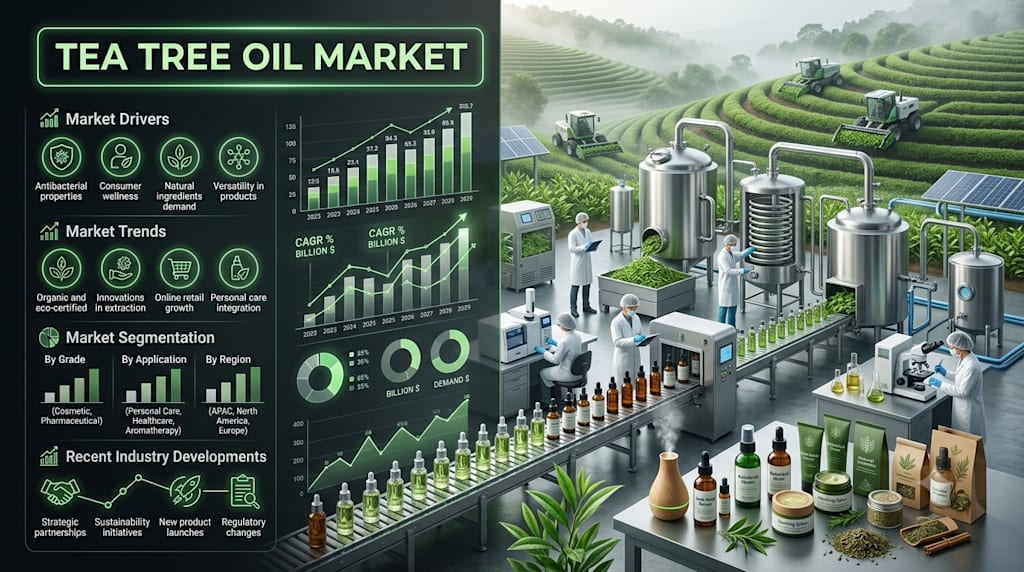
According to IMARC Group's latest research publication, The global tea tree oil market size reached USD 58.2 Million in 2025. Looking forward, IMARC Group expects the market to reach USD 82.7 Million by 2034, exhibiting a growth rate (CAGR) of 3.87% during 2026-2034.
How AI is Reshaping the Future of Tea Tree Oil Market
- Precision Agriculture and Crop Monitoring: AI-powered satellite imagery and IoT sensors analyze soil health, moisture levels, and weather patterns to optimize tea tree cultivation across 4,800 hectares. Machine learning algorithms process vast environmental data enabling farmers to maximize essential oil yields while minimizing resource inputs and crop losses from pest invasions.
- Quality Control and Chemical Profiling: Computer vision technology combined with spectroscopic analysis enables automated inspection of tea tree oil batches, verifying terpinen-4-ol concentrations above 30 percent and cineole levels below 15 percent to ensure ISO 4730 compliance, eliminating manual testing errors and accelerating quality assurance processes.
- Smart Distillation Process Optimization: AI systems monitor temperature, humidity, and pressure parameters during steam distillation, automatically adjusting extraction conditions to maximize oil yield and purity. Predictive algorithms analyze historical production data to optimize batch timing, equipment maintenance schedules, and energy consumption, reducing operational costs while improving pharmaceutical-grade output.

Tea Tree Oil Industry Overview:
Australia produces approximately 90 percent of globally recognized tea tree oil complying with International Organization for Standardization standards, with around 140 growers managing 4,800 hectares primarily in northern New South Wales and Queensland's Atherton Tablelands. AgriFutures Australia supports the industry through a levy of 25 cents per kilogram providing targeted research, development, and extension funding to protect global market access, strengthen regulatory compliance, and enhance production sustainability and profitability.
Tea Tree Oil Market Trends & Drivers
The shift toward natural and organic personal care products is fundamentally transforming consumer preferences and driving sustained market expansion across cosmetics, therapeutics, and household applications. Approximately 50 percent of exported Australian tea tree oil gets incorporated into healthcare, cosmetic, pharmaceutical, veterinary, and aromatherapy products valued for antibacterial, antifungal, and anti-inflammatory properties. The cosmetic and toiletries segment dominates with approximately 35 percent of total revenue, as tea tree oil becomes essential in shampoos, conditioners, skin clearing lotions, mouthwash, body lotions, shower gels, hand sanitizers, and face creams targeting acne, eczema, dandruff, and scalp conditions. Premium organic-certified variants command 20 to 35 percent price premiums over commodity grades, reflecting consumer willingness to pay for sustainably sourced, wild-harvested, and traceability-verified products.
Pharmaceutical and therapeutic applications are expanding rapidly as clinical evidence validates tea tree oil efficacy beyond traditional cosmetic uses. European pharmaceutical firms introduced prescription-grade acne gels formulated with pharmaceutical-grade tea tree oil, marking significant acceptance in therapeutic applications and demonstrating regulatory approval for OTC dermatology products. Tea tree oil demonstrates proven effectiveness treating fungal infections on scalp, skin, and toenails, plus herpes, cold sores, shingles, and warts due to antimicrobial properties documented through numerous scientific studies and literature. The pharmaceutical companies segment experiences significant growth as manufacturers develop clinical-grade formulations meeting European Pharmacopeia standards, requiring enhanced laboratory testing capabilities, sustainability certifications, and strategic sourcing partnerships with Australian producers.
E-commerce expansion and direct-to-consumer distribution channels are democratizing access to premium tea tree oil products while enabling smaller brands to compete against established players. Online retail infrastructure facilitates broader consumer reach across geographic markets, with platforms providing detailed product information, customer reviews, organic certifications, and competitive pricing that empower informed purchasing decisions. Leading companies including Now Foods, Young Living Essential Oils, Melaleuca Inc., and Thursday Plantation expanded product lines focusing on organic and therapeutic-grade offerings through strategic e-commerce partnerships, increasing availability across wellness stores, specialty retailers, and digital marketplaces. Indian wellness company Himalaya launched herbal facewash lines featuring tea tree oil targeting younger consumers, while Chinese contract manufacturers signed long-term supply agreements with Australian plantations supporting rising demand for herbal OTC creams across Asia Pacific.
Leading Companies Operating in the Global Tea Tree Oil Industry:
- Coromandel Mountains Tea Tree Oil Company
- G.R. Davis Pty Ltd.
- Integria Healthcare
- Jenbrook Australia
- Main Camp Natural Extracts Pty Ltd.
- Maria River Plantation
- Naturally Australian Tea Tree Oil Pty Ltd. (NATTo)
- NOW Foods
- Oribi Oils (Pty) Ltd.
- T.G. Cassegrain & Co Pty Ltd.
- The Lebermuth Co. Inc.
- Young Living Essential Oils LC
Tea Tree Oil Market Report Segmentation:
By Grade:
- Pharma/Cosmetic Grade
- Therapeutic Grade
Pharma/cosmetic grade represents the largest segment, as it meets stringent quality standards for pharmaceutical applications and cosmetic formulations requiring standardized terpinen-4-ol concentrations and antimicrobial efficacy.
By Distribution Channel:
- Supermarkets and Hypermarkets
- Direct Sales
- Departmental Stores
- Online Stores
- Others
Based on the distribution channel, the market has been segmented into supermarkets and hypermarkets, direct sales, departmental stores, online stores, and others.
By End User:
- FMCG Manufacturer
- Cosmetic Companies
- Pharmaceutical Companies
- Others
Cosmetic companies account for the largest market share owing to extensive incorporation of tea tree oil in personal care, skincare, haircare, and hygiene products targeting natural-conscious consumers seeking effective antimicrobial ingredients.
Regional Insights:
- North America (United States, Canada)
- Asia Pacific (China, Japan, India, South Korea, Australia, Indonesia, Others)
- Europe (Germany, France, United Kingdom, Italy, Spain, Russia, Others)
- Latin America (Brazil, Mexico, Others)
- Middle East and Africa
Europe exhibits clear dominance in the tea tree oil market with 46.73 percent share, driven by premium cosmetics demand, strict EU regulatory frameworks ensuring consumer trust, and strong import activity supporting natural ingredient adoption across aromatherapy and personal care applications.
Recent News and Developments in Tea Tree Oil Market
- March 2025: Down Under Enterprises, an Australian wholesale supplier of sustainable essential oils, developed Eelemani, a tea tree oil brand exclusively for the Chinese market. The new range strengthens awareness of Australian oil in Asia's fastest-growing region, addressing rising middle-class demand for authentic, premium-quality tea tree products with verified Australian origin and ISO compliance.
- February 2024: Main Camp Natural Extracts (Australia) expanded tea tree oil plantations and installed new distillation systems to increase pharmaceutical-grade oil output. The investment ensures traceability and compliance with European Pharmacopeia standards, supporting growing demand from European pharmaceutical firms developing clinical OTC dermatology products formulated with certified Australian tea tree oil.
- April 2024: John Paul Mitchell Systems, a leading professional haircare manufacturer, unveiled new packaging from post-consumer recycled plastic for its tea tree oil bottles. Tea tree bottles and jars now use 100 percent PCR, while tubes contain 25 percent PCR, demonstrating industry commitment to sustainable packaging practices appealing to environmentally conscious consumers.
- October 2025 to January 2026: Multiple Australian producers including Main Camp Natural Extracts, Oribi Oils, G.R. Davis, and Jenbrook Australia invested in plantation expansion, organic certification programs, upgraded distillation facilities, and export operation enhancements. These coordinated investments strengthen global supply chains, boost pharmaceutical-grade production capacity, improve efficiency, and support sustainable sourcing aligned with rising demand for certified natural ingredients.
- 2024 to 2025: European and Asian markets experienced accelerated adoption with new product launches including German pharmaceutical acne gels, French hygiene ranges by Yves Rocher, and The Body Shop relaunching tea tree skincare lines across Europe. Growing integration into cosmetics, aromatherapy, and therapeutic applications reflects broadening acceptance of tea tree oil beyond traditional personal care segments into clinical and wellness categories.
Note: If you require specific details, data, or insights that are not currently included in the scope of this report, we are happy to accommodate your request. As part of our customization service, we will gather and provide the additional information you need, tailored to your specific requirements. Please let us know your exact needs, and we will ensure the report is updated accordingly to meet your expectations.
About the Creator
Michael Richard
Michael Richard is a Market Research Expert specializing in market intelligence, competitive analysis, and data-driven insights. He helps organizations understand trends and emerging opportunities through in-depth research.
Enjoyed the story? Support the Creator.
Subscribe for free to receive all their stories in your feed.
Comments
There are no comments for this story
Be the first to respond and start the conversation.