
Tannin Market Gains Momentum Through Sustainable Material Demand
The Tannin Market is witnessing steady growth driven by increasing demand for natural and sustainable ingredients across multiple industries.

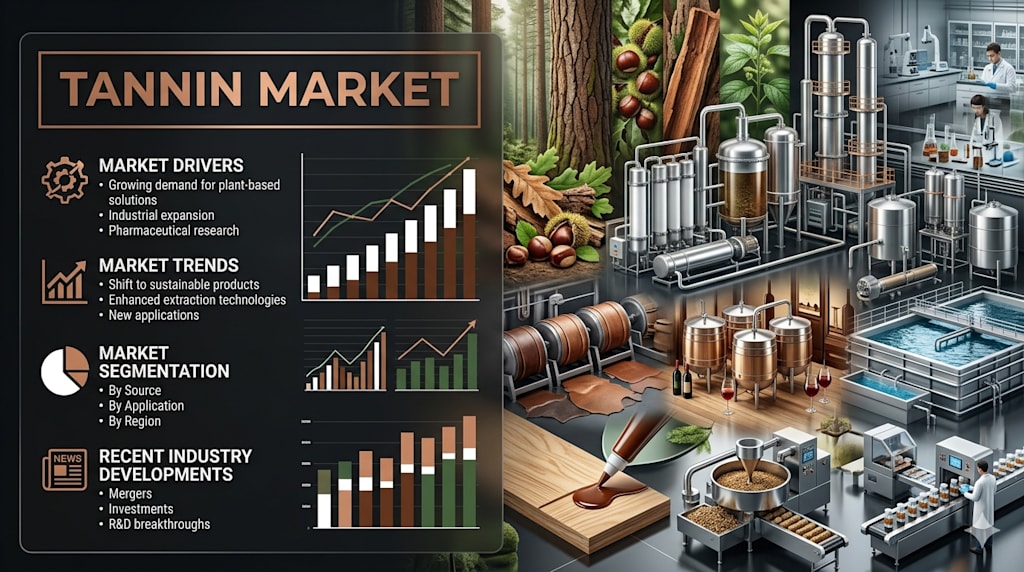
According to IMARC Group's latest research publication, The global tannin market size reached USD 10.6 Billion in 2025. Looking forward, IMARC Group expects the market to reach USD 15.7 Billion by 2034, exhibiting a growth rate (CAGR) of 4.36% during 2026-2034.
How AI is Reshaping the Future of Tannin Market
- Precision Quality Control and Contaminant Detection: AI-powered computer vision identifies impurities and inconsistencies in tannin extraction with exceptional accuracy. Automated inspection systems process samples at speeds exceeding manual methods by 10x, ensuring only premium-grade tannin products reach market distribution channels.
- Demand Forecasting and Inventory Optimization: Machine learning models analyze historical sales patterns, seasonal trends, and industry demand signals to predict tannin requirements across leather, wine, and pharmaceutical segments. Companies employing these systems report forecast accuracy improvements of up to 35 percent, reducing excess inventory while maintaining supply reliability.
- Sustainable Extraction Process Optimization: AI monitors extraction parameters including temperature, pressure, and solvent ratios to maximize tannin yield while minimizing waste. Real-time process control reduces chemical usage by approximately 20 percent, lowering production costs and environmental impact simultaneously.
Tannin Industry Overview
The global tannin market benefits significantly from Europe's robust leather and wine production ecosystems. India dominates leather production with 13 percent of global output and employs 4.42 million workers, providing substantial raw material sourcing opportunities. South Africa operates 89,384 hectares of wine grape vineyards, generating consistent demand for tannins in color stabilization and flavor development. Sustainable production initiatives, government export incentives, and infrastructure improvements across producing regions continue strengthening market fundamentals and competitive positioning.
Tannin Market Trends & Drivers
Leather Industry Expansion and Quality Demands: The leather sector remains the dominant application, consuming tannins for hide preservation and durability enhancement. Fashion and automotive industries drive robust demand, with India's modern tanning facilities demonstrating eco-sustainable extraction capabilities. The country's strong chemical auxiliary industry supports quality standards while maintaining cost competitiveness, attracting international leather manufacturers seeking reliable tannin supplies for premium product lines.
Wine and Beverage Industry Growth: Tannins play critical roles in wine production, influencing flavor profiles, color intensity, and aging characteristics. South Africa's vineyards demonstrate wine sector maturity with red varieties like Cabernet Sauvignon and Shiraz comprising significant plantings. Natural tannin content in grape skins, seeds, and stems creates organic demand within the wine industry, while beverage manufacturers increasingly utilize tannins as natural preservatives and color stabilizers in premium product formulations.
Health, Pharmaceutical, and Supplement Applications: Tannins' antioxidant, anti-inflammatory, and antimicrobial properties drive rapid adoption in pharmaceutical and nutraceutical sectors. Health-conscious consumers seek natural alternatives to synthetic additives, creating strong market momentum. Premium dietary supplements containing tannin-rich extracts demonstrate consistent sales growth, with products like specialized formulations showing tannin concentrations exceeding 15 percent, reinforcing consumer trust in natural plant-derived wellness solutions.
Tannin Market Report Segmentation
By Source
- Plants: Dominant segment including oak, quebracho, and chestnut sources representing majority market share
- Brown Algae: Emerging alternative source with growing research and application potential
By Product
- Hydrolysable Tannins: Largest product segment with versatile applications and strong antioxidant properties
- Condensed Tannins: Significant market share with robust performance in leather and wood applications
- Phlorotannins: Specialized segment derived from algae with expanding pharmaceutical potential
By Application
- Leather Tanning: Leading application segment, driving consistent market demand and growth
- Food and Beverages: Growing segment leveraging tannin preservation and flavoring properties
- Wood Adhesives: Expanding application utilizing cross-linking and bonding capabilities
- Pharmaceuticals and Health Supplements: Fastest-growing segment capitalizing on natural health trends
By Region
- Europe: Largest regional market supported by leather and wine industries
- Asia Pacific: Rapid growth driven by leather manufacturing and pharmaceutical expansion
- North America: Stable market with focus on premium and specialty tannin applications
- Latin America: Developing segment with agricultural sourcing advantages
- Middle East and Africa: Emerging opportunities in leather processing and pharmaceutical sectors
Leading Companies Operating in the Global Tannin Industry
- Ever s.r.l.
- Forestal Mimosa Limited
- Jyoti Dye Chem Agency
- Laffort SA
- S.A. Ajinomoto OmniChem N.V. (Ajinomoto Co. Inc.)
- Tanac S.A.
- Tanin Sevnica d.d.
- Tannin Corporation
- UCL Company (Pty) Ltd.
- W. Ulrich GmbH
- Silvateam S.p.A.
Recent News and Developments in the Tannin Market
- April 2025: Södra invested in a new tannin production line at its Värö facility in Sweden to industrially extract tannin from tree bark. The facility, scheduled for commissioning in 2026, will produce sustainable vegetable tanning agents for leather processing, offering a fossil-fuel-free alternative to conventional tanning chemicals with annual capacity serving millions of square meters of leather production.
- February 2024: Silvateam S.p.A., a global leader in plant-based tannins, acquired wet-green GmbH, creator of the patented wet-green technology for Olivenleder. This strategic partnership combines expertise in vegetable tannin extraction with bio-based tanning innovations, establishing new benchmarks for sustainable, biodegradable leather production worldwide.
- August 2023: Bentley Motors launched the first fully organic olive-tan leather option, utilizing plant-derived tannins for enhanced sustainability. The initiative reflects luxury automotive industry movement toward eco-friendly materials, demonstrating premium market segment demand for natural tannin-based products that meet environmental responsibility standards and consumer expectations.
About the Creator
Michael Richard
Michael Richard is a Market Research Expert specializing in market intelligence, competitive analysis, and data-driven insights. He helps organizations understand trends and emerging opportunities through in-depth research.
Enjoyed the story? Support the Creator.
Subscribe for free to receive all their stories in your feed.
Comments
There are no comments for this story
Be the first to respond and start the conversation.