
Taiwan Real Estate Market: Growth Driven by Urban Development and Rising Property Demand
The Taiwan real estate market is evolving steadily as infrastructure development, foreign investment, and changing housing preferences reshape residential and commercial property demand.

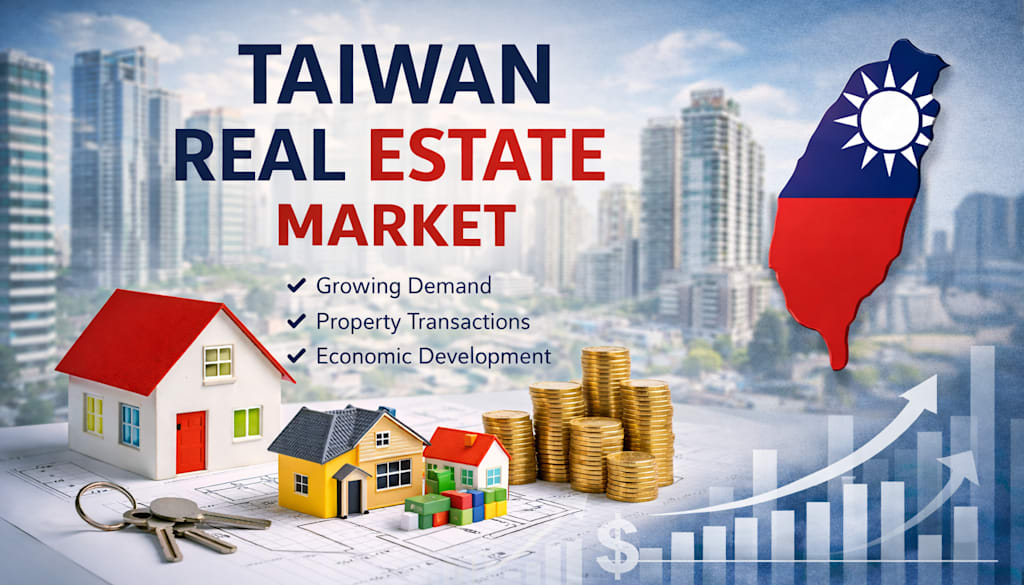
As cities expand, infrastructure improves, and lifestyles change, Taiwan's real estate sector continues its transformation. The market is witnessing consistent growth from local buyers, international investment, and continued urbanization of the main cities, influencing everything from residential homes to commercial buildings.
The real estate market in Taiwan reached 30.1 billion USD in 2025 and is expected to expand to 36.0 billion USD by 2034 at a CAGR of 1.90% for 2026-2034 according to IMARC Group.
One of the biggest influences driving this growth is the steady demand from local buyers. Low interest rates, high household savings, and real estate being regarded as a stable asset in the long-term are motivating more Taiwanese consumers to invest in residential properties. Changing working methods and the boom in remote work have also driven demand for larger homes and a desire to live in more suburban areas with better comforts and more space.
Another factor influencing the real estate market is continued improvements to infrastructure and major city development all throughout Taiwan. The investment into transportation infrastructure, the extension of the metro lines, highways and the addition of more public facilities have increased connectivity between urban and rural/suburban areas. These developments have also boosted the appeal and value of developing areas which can now be used as residential or commercial properties.
Growing international demand and foreign investment has had a substantial effect on the market. Foreign investors (primarily from Mainland China, Hong Kong, and South East Asia) continue to consider Taiwan a stable and attractive place to invest in real estate as a result of its solid infrastructure, its reliable economy and stable politics. Private investment and development of infrastructure encouraged by the government are also factors in international demand.
The adoption of new technology and digitization is slowly altering the experience of buying and selling real estate, online platforms and virtual tours are making the process easier and quicker. AI-powered analysis and digital transaction processes are also helping the market become more transparent, which enables buyers to make more informed decisions in a competitive market.
An increase in demand for modern commercial and mixed-use developments is another important driving factor. Major cities such as Taipei and Kaohsiung are undergoing extensive commercial development. The rise of service industries in Taiwan and business activity with other countries have had an effect on the market which is now benefiting the commercial sector.
The residential sector is still the largest segment of the market, largely due to local demand and continuous new housing developments. Commercial and industrial sectors are gradually increasing due to urbanization and development projects. The two main segments of the market, in terms of sales or rental, are also seeing growth. Residential rental prices in major cities continue to increase due to population growth in the cities and students and workers migrating into the cities. Property ownership continues to be desired by Taiwanese households for the long-term.
When it comes to how transactions are conducted, the two main market segments are the offline and online sectors. The market has become increasingly accessible through the use of online resources, which enable faster processing and information retrieval.
Northern Taiwan continues to dominate the market due to economic activities and large populations, centered in Taipei. However, both central and southern regions are also growing rapidly in terms of investment due to the expansion of infrastructure and new business opportunities.
One trend that is growing stronger in the real estate market is an increased emphasis on sustainable and smart development. Developers are starting to incorporate energy efficient designs and smart-home technologies into their properties and these are becoming popular with younger generations and investors who want a return on investment in the future. Smart and eco-friendly buildings are becoming more attractive and valuable due to growing environmental concerns.
The Taiwan real estate market stands out from other markets due to the stability and modernity which characterizes it. Even though the market is more mature than those found in other economies across Asia, changes in life style and the growing infrastructure of the region continue to bring forth new opportunities in both residential and commercial sectors.
Continued development of infrastructure, growth of urban areas, and a strong, persistent local and foreign interest in property means that the market should continue to grow. The growing economy and development in Taiwan ensures that real estate is an important asset for future growth and investment.
About the Creator
michael matthew
I’m a market researcher passionate about understanding people, markets, and motivations. My work blends data analysis, consumer psychology, and strategic insight to help brands and businesses make informed, human-centered decisions.
Enjoyed the story? Support the Creator.
Subscribe for free to receive all their stories in your feed.
Comments
There are no comments for this story
Be the first to respond and start the conversation.