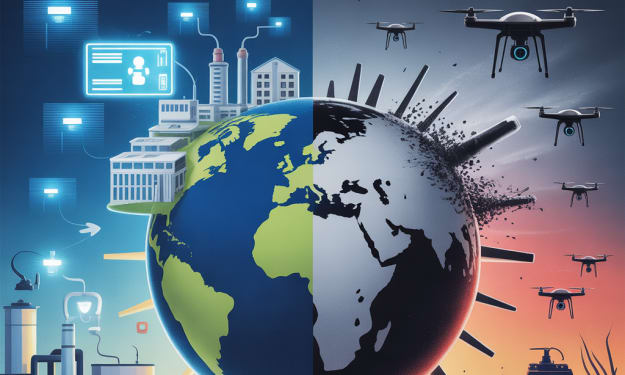
transhumanism
Transhumanism is an international and intellectual movement that aims to transform the human condition by developing and creating widely available sophisticated technologies to greatly enhance human intellectual, physical, and psychological capacities.
AMD + OpenAI: A Game-Changing Partnership in AI Infrastructure
Introduction: A Turning Point in AI Computing On October 6, 2025, the AI and semiconductor worlds took note: AMD (Advanced Micro Devices) announced a landmark partnership with OpenAI, pledging to provide massive GPU compute capacity for the next generation of AI systems. The announcement sent shockwaves across markets, opening a new chapter in how artificial intelligence infrastructure is built—and who will dominate that future.
By Omasanjuwa Ogharandukunabout a year ago in Futurism
When Hollywood Goes Digital: The Ethical Perils of AI in Film and TV
Hollywood has consistently embraced technological advancements, from ancient sound and Technicolor to modern computer-generated imagery (CGI), all of which have reshaped storytelling. However, artificial intelligence (AI) represents a more profound shift, affecting the very core of creative expression.
By Jenna Deedyabout a year ago in Futurism
A World Without America: Imagining the Global Impact
A World Without America: Imagining the Global Impact** The United States of America has long held a prominent role on the world stage. As a global superpower, its influence extends across politics, economics, science, culture, and military affairs. But what would the world look like without America? This hypothetical scenario, though extreme, invites us to explore the positive and negative consequences of a world where the United States does not exist—either historically or in the present. --- Economic Impacts** **Negative Aspects:** Without the United States, the global economy would look drastically different. As the largest economy in the world for much of the 20th and 21st centuries, America's financial systems, such as Wall Street and the U.S. dollar as the world’s reserve currency, have played a stabilizing role in international trade. Many countries rely heavily on the U.S. market for exports, investments, and aid. A world without America would likely experience greater economic instability and slower technological progress due to the absence of American innovations and investments. The absence of major U.S. companies like Apple, Microsoft, Google, and Amazon would significantly alter the global business landscape. The tech industry, in particular, might have developed differently or more slowly without American leadership. Moreover, many countries that benefit from U.S. foreign aid or disaster relief would face greater challenges in crises. **Positive Aspects:** On the other hand, a world without America could lead to a more balanced distribution of economic power. Emerging markets and other developed nations might have had more room to grow without U.S. dominance. The European Union, China, and regional powers could have played more central roles earlier in history, potentially creating a more multipolar economic structure. Additionally, some critics argue that U.S. economic policies have, at times, contributed to global inequality or environmental degradation. In its absence, perhaps global systems would have evolved in a way that prioritized sustainability or social equity more effectively. --- Political and Military Dynamics** **Negative Aspects:** The United States has often acted as a global police force, intervening in international conflicts and providing military support to allies. While this role has been controversial, it has also prevented or ended conflicts, stabilized regions, and deterred authoritarian regimes. A world without America could have seen more unchecked aggression from expansionist powers like Nazi Germany, the Soviet Union, or even modern-day regimes with imperial ambitions. The post-World War II global order, including institutions like the United Nations, NATO, and the World Bank, were all heavily influenced or initiated by the U.S. Without it, these institutions might not exist in their current form—or at all. This could result in weaker international cooperation and less coordinated responses to global crises. **Positive Aspects:** Conversely, some would argue that American military interventions have often led to long-term instability, civilian casualties, or unintended consequences, such as in Iraq, Vietnam, or Afghanistan. Without U.S. involvement in these conflicts, some regions might have found more local, diplomatic solutions to their issues, or avoided certain wars altogether. Furthermore, without the U.S. as a dominant superpower, other nations might have taken on more responsibility for global leadership, possibly leading to more diverse and cooperative forms of governance. --- Scientific and Technological Development** **Negative Aspects:** The U.S. has been a hub for innovation, especially in fields like medicine, aerospace, and information technology. NASA's contributions to space exploration, American universities’ role in academic research, and Silicon Valley's impact on digital technology have all shaped the modern world. Without these, progress in science and technology could have been delayed by decades. In addition, the internet—largely developed and popularized in the U.S.—has become a backbone of modern communication, education, and commerce. Without American leadership in tech, global access to information and digital tools might be less widespread or more fragmented. **Positive Aspects:** However, in a world without America, other nations may have risen to fill the innovation gap. Countries like Germany, Japan, the UK, or even China could have led the way in scientific discovery and technological advancement. This might have resulted in different approaches to technology, perhaps more localized or culturally tailored. --- Cultural Influence** **Negative Aspects:** American culture—through music, movies, fashion, and fast food—has become nearly universal. Hollywood, for example, has played a key role in shaping global entertainment. In a world without America, this cultural cohesion might not exist. People around the world may not share the same cultural references or global icons, leading to a more fragmented global culture. Also, many social movements that gained momentum in the U.S., such as civil rights, LGBTQ+ advocacy, and feminist waves, have inspired change worldwide. Their absence might have slowed progress in human rights and social equality. **Positive Aspects:** On the other hand, some critics view American cultural dominance as a form of cultural imperialism that overshadows local traditions and values. Without it, local cultures might have flourished more freely. Languages, cuisines, art forms, and indigenous traditions might have received more attention and preservation without the overwhelming influence of American pop culture. --- Environmental Consequences** **Negative Aspects:** The U.S. is one of the world’s largest carbon emitters and has been criticized for withdrawing from global climate agreements and prioritizing economic growth over environmental concerns. Its absence might reduce global carbon emissions. **Positive Aspects:** But it’s also true that many environmental innovations—from renewable energy technologies to conservation programs—have roots in the U.S. Without these, the fight against climate change might have fewer tools and resources. Moreover, U.S. scientific institutions have played major roles in researching and communicating environmental risks. ---
By America today about a year ago in Futurism
The Universe's Secret Algorithms: 5 Natural Secrets You Didn't Realize Were Code!
The Hidden Programming of the Universe: 5 Natural Secrets You Didn't Realize Were "Source Code" (A Guide for the Curious) Have you ever looked at a beehive or a snowflake and asked: How did this happen so perfectly? You're not alone. For centuries, scientists have thought of nature as a beautiful mess, but the shocking truth is that the universe is far from random. It's built on algorithms no less complex than the most complex code ever written by humans.
By PositivePulseabout a year ago in Futurism
Advanced Equipment: Hope or Threat?
Human history has always been in search of progress. When the wheel was invented, life changed; when electricity arrived, the world saw light with new eyes; and when the internet appeared, distances vanished. But today’s era is something different. This is the age where advanced level equipment has gripped every aspect of human life. These tools sometimes create destruction on the battlefield, sometimes spark revolutions in factories, sometimes give new life to patients in hospitals, and sometimes reshape the direction of education. On the surface, it all looks like convenience and development, but hidden behind it is a long tale of risks.
By Muhammad yarabout a year ago in Futurism
If Anyone Builds It, Everyone Dies
5 Disturbing Truths From the Book Claiming AI Will End Humanity Last year in Alameda, California, city officials halted a scientific experiment designed to combat global warming. The plan was to spray microscopic salt particles into the clouds to make them brighter and reflect more sunlight. Fearing unintended consequences for the regional ecosystem, they shut it down.
By Francisco Navarroabout a year ago in Futurism
Artistly.ai Review 2025: Is This AI Design Tool Worth the Hype (and Lifetime Deal)?
Have you ever stumbled upon a creative tool that makes you pause and think, “Why haven’t I tried this sooner?” That’s the kind of buzz surrounding Artistly.ai review conversations across design and content circles. In an industry where speed and originality often clash, platforms like Artistly.ai are stepping up with promises to transform the way creators work—whether you’re a designer, marketer, or entrepreneur looking to save time without sacrificing quality.
By Kamel Saidaniabout a year ago in Futurism
Technology Horizons 2050 and Beyond ♾️ Book Introduction
Future of Technology and Science as a Passion Dear Readers, In this short story, I will introduce you to my upcoming book Technology Horizons 2050 and Beyond: Emerging Technologies Shaping the Next 50 Years of Human and Machine Evolution (ISBN: 9798231583355).
By Dr Mehmet Yildizabout a year ago in Futurism
Top 10 Future Inventions That Could Change the World.
Top 10 Future Inventions That Could Change the World Introduction Since the dawn of human civilization, inventions have shaped the way societies live, work, and communicate. The wheel, electricity, and the internet are just a few breakthroughs that redefined entire eras. But as technology continues to accelerate, the future holds even greater promises. From advanced artificial intelligence to space colonization, the coming decades could deliver inventions that will radically change our world. Below, we explore ten of the most impactful innovations that experts believe are on the horizon.
By Sayed Zewayedabout a year ago in Futurism