tech
Curious tech and technology from the realm of science and science fiction.
NASA’s Perseverance Rover Captures First Visible-Light Auroras on Mars: A New Frontier in Martian Exploration.
Mars has long fascinated scientists and space enthusiasts alike, with its rusty red landscape and the possibility that life once existed on the planet. Now, NASA’s Perseverance rover has added an incredible new chapter to Mars exploration by capturing the first-ever visible-light auroras on the Red Planet. This remarkable discovery, made on March 18, 2024, after a powerful solar storm, sheds light on the dynamic interactions between Mars’ atmosphere and the Sun’s activity. It opens exciting new opportunities for understanding the Martian environment and preparing for future human missions. What Are Auroras and Why Are They Important? Auroras are natural light displays typically seen near the poles of Earth, often called the Northern or Southern Lights. These dazzling lights occur when charged particles emitted by the Sun collide with a planet’s atmosphere and magnetic field, causing the atmosphere to glow. On Earth, auroras are guided by our planet’s global magnetic field toward the polar regions, creating spectacular and structured light shows. However, Mars is very different. The Red Planet lacks a global magnetic field, having lost it billions of years ago. Instead, it has patches of localized magnetic fields scattered across its crust. As a result, auroras on Mars tend to be more chaotic, diffuse, and widespread. Previously, scientists had only detected Martian auroras in ultraviolet light from orbiting spacecraft, which are invisible to the human eye. The recent observations from Perseverance are the first to reveal auroras in visible light directly from the surface, a historic milestone. The Solar Storm That Made It Possible On March 18, 2024, the Sun unleashed a massive solar storm, sending a coronal mass ejection (CME) — a powerful burst of charged particles — hurtling through space. When this CME reached Mars, the charged particles interacted with its thin atmosphere, igniting a faint green glow in the sky. Perseverance’s cameras were perfectly positioned to capture this rare event. Solar storms like CMEs are common, but their effects on Mars differ from Earth due to its thin atmosphere and lack of a strong magnetic field. This interaction can lead to atmospheric loss and impacts on the planet’s climate and habitability. Studying these events helps scientists better understand how solar activity influences Mars and how it may affect future explorers. Perseverance’s Cutting-Edge Instruments The Perseverance rover, which landed on Mars in February 2021, is equipped with advanced instruments designed for geology, atmospheric studies, and even searching for signs of past life. Among these instruments, Mastcam-Z and SuperCam played a critical role in capturing the visible-light aurora. Mastcam-Z is a sophisticated camera system capable of high-resolution, color imaging and zooming capabilities, while SuperCam can analyze the composition of rocks and the atmosphere using laser and spectrometry techniques. During the solar storm, scientists directed these instruments to look toward the Martian sky, hoping to detect any auroral activity. After several attempts, Perseverance successfully photographed the faint green aurora, confirming predictions made by NASA’s space weather models. Why This Discovery Matters for Future Mars Missions Visible-light auroras on Mars are not just a fascinating spectacle — they have practical implications for upcoming human missions to the planet. Understanding how solar particles interact with Mars’ atmosphere helps scientists assess radiation risks that astronauts may face on the surface. Solar storms can expose explorers and equipment to harmful radiation, making accurate forecasting essential for mission safety. Moreover, these auroras offer a unique window into the planet’s atmospheric composition and dynamics. Monitoring auroral activity could help researchers track changes in Mars’ atmosphere over time and study how solar events influence atmospheric loss. This knowledge is crucial for developing strategies to protect future habitats, electronics, and astronauts on Mars. What Experts Are Saying Dr. John Clarke, a leading space physicist involved in the study, explains, “This is a landmark moment in Mars exploration. Seeing visible auroras from the surface confirms that the Martian atmosphere is more dynamic than we imagined. It also means astronauts will be able to witness these stunning light displays in person during intense solar events.” NASA’s Mars exploration team views this discovery as a stepping stone toward understanding Mars as a complex, evolving world. Each new insight into the planet’s atmosphere brings humanity closer to the goal of establishing a sustainable presence there. The Bigger Picture: Mars, Solar Activity, and Space Weather Mars serves as a natural laboratory for studying space weather — the varying conditions in space caused by the Sun’s activity. Since Mars lacks Earth’s protective magnetic shield, it offers scientists a unique perspective on how solar storms impact planetary atmospheres and surfaces. These insights not only benefit Mars missions but also improve our understanding of how solar activity affects other planets, including Earth. By studying Mars’ auroras and atmospheric responses, scientists gain valuable data for predicting and mitigating space weather hazards in the broader solar system. Conclusion: A Bright Future for Mars Exploration NASA’s Perseverance rover’s capture of the first visible-light auroras on Mars marks a monumental achievement in planetary science. This discovery illuminates the complex interactions between the Sun and Mars, providing essential knowledge for future exploration and colonization efforts. As we prepare to send humans to Mars, understanding phenomena like auroras will help ensure the safety and success of those missions. Beyond the scientific implications, the thought of astronauts witnessing glowing lights dancing across the Martian sky adds a poetic touch to humanity’s quest for discovery. With each new finding, Mars becomes less a distant world and more a place we can someday call home.
By Tech Horizons2 years ago in Futurism
🧠Quantum Breakthrough at Room Temperature: The Dawn of Practical Quantum Networks
In a discovery that may very well become one of the defining scientific achievements of the decade, researchers from the University of Tokyo and the Delft University of Technology in the Netherlands have successfully demonstrated quantum entanglement at room temperature using diamond-based qubits. This astonishing feat removes one of the largest barriers to real-world quantum computing and communication: the need for prohibitively cold environments. While the phrase "quantum entanglement" might conjure up images of science fiction or highly abstract theory, this new development has immediate and far-reaching consequences. It could mark the beginning of a new era in secure communication, global information transfer, and the development of powerful quantum computers that operate in everyday conditions.
By History Seeker2 years ago in Futurism
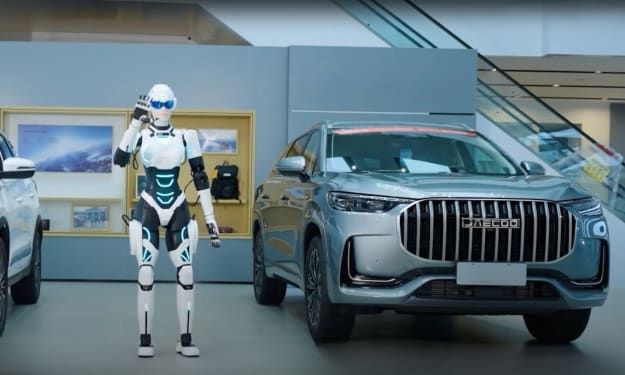
AI Humanoid Robot Is Changing the Way You Buy Cars at Dealerships. AI-Generated.
AI Humanoid Robot Is Changing the Way You Buy Cars at Dealerships The car buying experience is undergoing a revolutionary transformation, and the driving force behind it is artificial intelligence—specifically, AI humanoid robots. These advanced machines, designed to mimic human behavior and appearance, are changing how customers interact with car dealerships, streamlining the buying process, improving customer service, and even influencing sales trends. Once considered futuristic, humanoid robots are now becoming a real part of the modern automotive retail space.
By Adnan Rasheed2 years ago in Futurism
AI replaces writers and translators
There have been recent reports about Duolingo, the language learning platform, actively integrating artificial intelligence (AI) into its operations, leading to the replacement of certain human roles, particularly among contract workers.
By Susan Fourtané 2 years ago in Futurism
Free Chatbot for E-Commerce Business & Why Brands Can’t Ignore It in 2025. AI-Generated.
Did you know that 80% of customer interactions will be driven by artificial intelligence by 2029? The digital transformation landscape is changing at a fast rate. Chatbot for E-commerce has become a game-changer technology for brands in India and around the world.
By Converse AI2 years ago in Futurism
China Launches First Satellites to Build World's First Orbital Supercomputer. AI-Generated.
China Launches First Satellites to Build World's First Orbital Supercomputer With the launch of 12 advanced satellites, China begins constructing the world’s first space-based supercomputer, aiming to revolutionize real-time data processing and assert dominance in the new era of orbital technology.
By Adnan Rasheed2 years ago in Futurism