tech
Curious tech and technology from the realm of science and science fiction.
Top 10 Affordable App Development Companies in London for Startups
Launching a mobile app may be an exciting and intimidating experience in the fast-paced world of entrepreneurs. Even though having a fantastic idea is crucial, it frequently takes professional assistance to transform it into a useful, user-friendly app, and that assistance has a price.
By Apptunixukabout a year ago in Futurism
Top Features Every B2B eCommerce App Must Have to Succeed in 2025
1. Why B2B eCommerce Apps Matter More Than Ever The B2B eCommerce landscape has undergone a radical transformation in recent years—and 2025 is poised to accelerate that change even further. Traditional sales channels and offline procurement are being rapidly replaced by seamless, digital-first experiences.
By Apptunix usaabout a year ago in Futurism
"When the Future Became the Present: Life with Artificial Intelligence"
At the beginning of the 21st century, artificial intelligence was nothing more than a distant idea—a favorite subject for science fiction movies and novels that imagined worlds ruled by machines. But by the middle of the century, that idea had become a reality embraced by the entire world.
By Khadija farssiabout a year ago in Futurism
AI literacy is the only way to a successful AI-human collaboration and AI-assisted education
AI literacy is not a new concept. It emerged several years when I was writing for an Ed tech publication. Back then, the talks about AI in education were common with participation of academics, researchers, ed tech companies, and education technologists.
By Susan Fourtané about a year ago in Futurism
The Double-Edged Sword of Technology:
Introduction. Imagine a world without smartphones, social media, or smart homes. Hard to picture, right? Technology has become deeply woven into the fabric of our lives. From communication and education to healthcare and entertainment, modern innovation has brought countless benefits. But this rapid growth hasn’t come without consequences.
By Bilal Khanxabout a year ago in Futurism
Which Android App Development Trends Will Dominate 2025?. AI-Generated.
The Android ecosystem is undergoing one of its most transformative evolutions in a decade. With the convergence of generative AI, 5G networks, foldable devices, and Google’s accelerated support for Kotlin Multiplatform and Jetpack Compose, Android development in 2025 is no longer just about building apps—it’s about engineering adaptive, intelligent experiences that live across screens, devices, and environments.
By Sarah Kamalabout a year ago in Futurism
Unlocking Innovation: Why Partner with a Generative AI Development Company?
The world of business is evolving at lightning speed, and at the heart of this transformation lies Generative AI. From crafting compelling marketing copy to designing intricate product prototypes, generative AI is no longer a futuristic concept it's a powerful tool businesses are leveraging right now to gain a competitive edge. But for many, the journey into this new frontier can feel overwhelming. That's where a specialized Generative AI Development Company comes in.
By David Rodriguezabout a year ago in Futurism
The Ultimate Guide to Mobile Hiring App Development Companies in London
Hiring the right app development company can make or break your mobile app project. In London’s competitive tech scene, numerous companies promise the best services—but choosing the perfect Mobile app development in uk partner requires careful consideration.
By Apptunixukabout a year ago in Futurism
Travelport GDS API Integration: Connecting the Dots in Travel Tech
If you've ever booked a flight online, reserved a hotel room from your phone, or managed an entire trip through a travel app chances are a GDS (Global Distribution System) was quietly doing the heavy lifting behind the scenes.
By David Rodriguezabout a year ago in Futurism
The Synthetic Human Genome: “The Genie is Out of the Bottle”
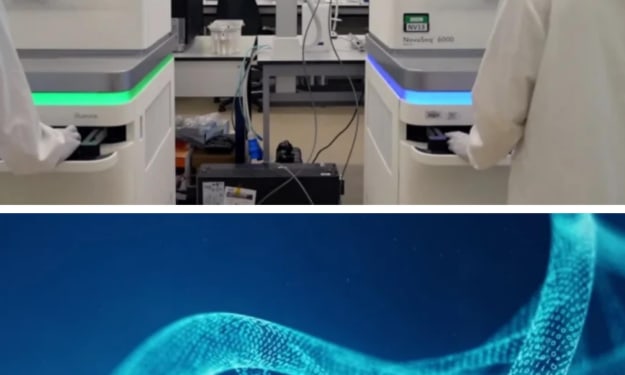
In a move that is both revolutionary and controversial, scientists have embarked on a groundbreaking project—one that could redefine human life itself. For the first time in history, efforts are underway to artificially synthesize the human genome, the very blueprint of our biological existence. While such research was previously dismissed as unethical and even dangerous, the tides have turned. The world’s largest medical charity, the Wellcome Trust, has injected a staggering £10 million into the initial phase of this project. Their reason? A hope that it holds the key to curing some of humanity’s most incurable diseases. But this pursuit of science has sparked a global ethical firestorm. From Science Fiction to Science Reality At the forefront of this initiative is Dr. Julian Sale, from the MRC Laboratory of Molecular Biology in Cambridge, UK. In a recent interview with the BBC, Dr. Sale emphasized the project’s medical potential: “We are working toward therapies that not only extend human life but improve its quality as we age.” The team envisions a future where synthetic DNA is used to build resilient human cells—cells that can repair damaged organs like the liver or heart, rebuild weakened immune systems, and resist diseases at their genetic roots. Sounds like something out of a science fiction movie, right? But this is no longer fiction. It's reality. But at What Cost? Not everyone is cheering. Critics argue that this project could open the door to a dystopian future—designer babies, genetically modified humans, and potentially weaponized genetics. Dr. Thomas from the bioethics organization Beyond GM warns: “We like to believe that all scientists are working for the good of humanity. But science can be manipulated—just like any other tool. And in the wrong hands, it can become a weapon.” His concerns are valid. The history of scientific advancements—from nuclear physics to artificial intelligence—shows us that every powerful technology has a dark side when unchecked. What Exactly Is the Human Genome Project 2.0? This synthetic genome project builds upon the achievements of the original Human Genome Project, which mapped out all the DNA sequences in a human cell. That landmark effort gave scientists a barcode-like map of every gene in the human body. But this new phase doesn’t stop at reading DNA. It seeks to build it from scratch. Using only the four basic chemical building blocks of DNA—A, T, C, and G—scientists now aim to recreate entire human chromosomes artificially. These chromosomes will include the genes responsible for our development, repair, immunity, and even aging. Their goal is simple yet extraordinary: To understand how DNA truly works by rebuilding it. According to Professor Matthew Hurles, director of the Wellcome Sanger Institute, “Many diseases begin when something goes wrong with our genes. If we can recreate them synthetically, we may find ways to fix them before they even appear.” A Cure for Disease or a Path to Artificial Life? The researchers insist this work is not an attempt to create synthetic humans or artificial life. For now, the experiments are limited to test tubes and petri dishes. But it’s hard to ignore the immense control this gives scientists over the very fabric of life. Critics fear the next step could be engineering human embryos with specific traits—or worse, creating hybrid creatures that blur the line between science and science fiction. Professor Bill Earnshaw, a leading geneticist, warns of “bio-weapons,” superhumans, and ethical chaos. “The genie is out of the bottle,” he told the BBC. “We could’ve built safeguards. But now, a powerful organization with resources has decided to build life artificially. And I doubt we can stop them.” Who Will Own Synthetic Life? One of the biggest ethical dilemmas raised by this project is ownership. If scientists succeed in creating synthetic organs—or even synthetic humans—who owns them? What happens to the personal data of such creations? What legal or moral rights do they have? Are they property? Are they people? Dr. Thomas raises these chilling questions: “If we succeed in creating artificial organs—or even artificial people—who gets to own them? Who controls their data? Their destiny?” The debate is no longer theoretical. It is now urgent. Why Did the Wellcome Trust Fund This? Even the Wellcome Trust, now at the center of this storm, acknowledges the risks. Dr. Tom Collins, the official responsible for approving the funding, said they did not make the decision lightly. “We asked ourselves: What’s the cost of doing nothing?” he explained. “This technology will emerge eventually. By acting now, we can ensure it develops responsibly—and we can face its ethical challenges head-on.” Their plan also includes a public welfare program that seeks to bring in sociologists, ethicists, and most importantly—the public—into the conversation. Professor Joy Zhang of the University of Kent will lead the social research component. She says: “We want to hear how people truly feel about this. What excites them? What scares them? What questions and concerns do they have?” A New Chapter in Human Evolution—or a Pandora’s Box? Whether this is a medical miracle or an ethical nightmare remains to be seen. On one hand, this project could lead to revolutionary treatments for cancer, Alzheimer's, genetic disorders, and organ failure. On the other hand, it opens the floodgates to genetic engineering, human enhancement, and a world where life itself is manufactured—not born. This isn’t just a scientific question anymore. It’s a philosophical, moral, and political question—and one we must all participate in answering. Because the genie is out. And there’s no putting it back in.
By Ikram Ullahabout a year ago in Futurism