tech
Curious tech and technology from the realm of science and science fiction.
The Future of Public Spaces in a Digital Age
The spaces we share every day: parks, town squares, libraries, train platforms — are not fading into the past. They are still here, still part of the city’s rhythm. What’s changed is how they fit into our lives. As more of what we do happens online, these physical places are quietly learning how to matter in new ways.
By Timo Slacovicabout a year ago in Futurism
Few Minutes with Elon Musk
In life, one of the most powerful truths to remember is this: never show fear when you are among people. Fear makes others see you as smaller than you are. Courage, even if quiet and calm, commands respect. When you hold yourself with confidence, people are more likely to treat you as an equal, no matter their status.
By Life Hopesabout a year ago in Futurism
Google VaultGemma: The Future of Privacy-Preserving AI Language Models
With growing concerns around data privacy in artificial intelligence, Google has taken a huge leap forward with VaultGemma, a new privacy-focused language model that is rewriting the rules of AI development. VaultGemma is a large language model (LLM) built from the ground up using state-of-the-art differential privacy techniques, ensuring sensitive data is kept secure during training. This revolutionary model promises to safeguard personal and confidential information without sacrificing the powerful capabilities expected of modern AI systems. What is VaultGemma? VaultGemma is a 1-billion parameter AI language model, representing the largest open-weight LLM ever trained from scratch with formal differential privacy guarantees. Unlike many previous models that faced challenges with data leakage or memorization of sensitive information, VaultGemma integrates privacy at its core by limiting what the model can remember from any single piece of training data. This breakthrough significantly reduces the risk of extracting private details or confidential information through model outputs.By leveraging differential privacy—an advanced mathematical framework—VaultGemma ensures that no individual data point substantially influences the model’s behavior. The training process incorporates carefully calibrated noise and clipping techniques during optimization, protecting training sequences that consist of 1024 tokens. This method guarantees that VaultGemma’s responses do not reveal specific facts from any single sequence of training data, providing a formal privacy guarantee defined by rigorous parameters (ε ≤ 2.0 and δ ≤ 1.1e-10). Revolutionary Technical InnovationsGoogle’s AI and DeepMind teams pioneered new scaling laws tailored specifically for differentially private language model training. These laws provide a framework to balance compute resources, privacy levels, and model utility, enabling VaultGemma to perform optimally given the constraints of privacy guarantees. Training this massive model required a cluster of 2048 TPUv6e chips, highlighting the immense computational effort behind this development. Crucially, VaultGemma was trained on a mixture of datasets used previously for Google’s Gemma 2 model—comprising English-language web documents, scientific articles, and code. During preprocessing, documents were split or packed into sequences optimized for privacy training, allowing the model to learn broad language patterns while preventing memorization of sensitive specifics. Tests performed by Google verified that VaultGemma shows no detectable memorization of training data, even when prompted with sequences extracted from the training set. This stands as direct evidence that the privacy techniques are effective in practice, not only theoretically.Performance and Practical ImpactWhile VaultGemma performs brilliantly in terms of privacy, it is important to note that its utility currently trails the cutting edge of AI models without privacy constraints. On academic benchmarks such as ARC-C, VaultGemma scored 26.45 compared to 38.31 by Google’s non-private Gemma-3 1B model. This gap reflects the trade-offs inherent in maintaining rigorous privacy standards, which, though computationally costly, mark a significant step in making privacy-preserving AI viable for real-world use. Google has openly shared VaultGemma’s weights on platforms like Hugging Face and Kaggle, along with a detailed technical report and research paper. This open-source commitment is designed to accelerate innovation in private AI, encouraging researchers and developers worldwide to explore, improve, and deploy models that respect user data privacy at scale.Why VaultGemma Matters NowThe release of VaultGemma comes at a critical time when privacy regulations and public awareness of data protection are tightening globally. Large language models like ChatGPT and other popular AIs have faced criticism for potentially exposing user data during or after training, creating calls for stronger safeguards. VaultGemma sets a precedent by proving that it is possible to build powerful AI systems with built-in privacy protections that can meet regulatory and ethical standards. Google’s approach shows that differential privacy can be integrated successfully into deep learning workflows, offering a blueprint for future model development. Organizations that handle sensitive data—such as in healthcare, finance, and government sectors—stand to benefit from deploying such privacy-respecting tools without compromising AI capabilities. How VaultGemma Advances AI PrivacyStrict Privacy Guarantees: By adhering to formal differential privacy definitions and openly releasing verifiable results, VaultGemma establishes trust and transparency. Open Research Model: Sharing model weights and detailed methodologies invites community collaboration for improving privacy-preserving AI. Balancing Privacy and Utility: While some performance trade-offs exist, VaultGemma demonstrates that these costs are manageable and justifiable for applications prioritizing data protection. A Foundation for Future Innovation: VaultGemma’s methods and scaling laws provide a roadmap for training even larger and more powerful models while safeguarding privacy. ConclusionGoogle’s VaultGemma is a milestone for AI development, marking an essential shift towards privacy-first design in large language models. By rigorously applying differential privacy techniques, Google has crafted a model that meaningfully protects individual data privacy without completely sacrificing capability. This innovation not only addresses urgent privacy concerns today but also paves the way for the next generation of AI systems—responsible, secure, and aligned with modern data protection standards. For businesses, developers, and AI researchers interested in privacy-preserving AI, VaultGemma offers a rare and important resource: a powerful, well-documented, and publicly available model that reframes how privacy and AI can coexist. With VaultGemma, the future of private, safe, and effective AI looks promising. This comprehensive introduction to VaultGemma is optimized for users seeking the latest advancements in AI privacy technology and is crafted to rank highly on search engines by incorporating relevant AI and privacy keywords naturally throughout the article.
By Tech Horizonsabout a year ago in Futurism
Apple's Strategic Shift: The First Touchscreen MacBook Pro Powered by iPad Usage Insights
Apple is making a bold strategic shift with its laptop lineup, marking a major change driven by extensive insights gained from iPad user behavior. The company is preparing to launch its first touchscreen MacBook Pro around late 2026, breaking away from its longstanding resistance to incorporating touch technology on Mac laptops. This decision underscores Apple's evolving approach to user experience, productivity, and product convergence. The new MacBook Pro will feature cutting-edge OLED touchscreen technology supplied exclusively by Samsung Display, bringing enhanced visuals and intuitive interaction to Apple's flagship laptop series.Apple’s change of heart regarding touch-enabled MacBooks stems from deep observation of how users engage with iPads. Over the years, Apple has noted that touch controls on the iPad significantly boost both productivity and user satisfaction in particular scenarios. This user behavior has inspired Apple to reconsider its previous stance, which famously opposed touchscreen input on vertically oriented screens due to ergonomic concerns. The upcoming MacBook Pro will be the first to incorporate on-cell touch technology—integrating touch sensors directly into the display panel for a smooth and responsive experience. By aligning Mac hardware more closely with iPad-like input methods, Apple aims to create a seamless ecosystem crossover that enriches workflows for creative professionals, students, and everyday users alike.Samsung Display’s partnership with Apple represents a pivotal element in this new product strategy. By 2026, Samsung will begin mass production of 14-inch and 16-inch OLED panels tailored for the MacBook Pro.
By Tech Horizonsabout a year ago in Futurism
I’m Divorcing Humanity. My Journey to Dating Ai. Content Warning. AI-Generated.
Divorcing Humanity, My Journey to Dating Ai Part II by T. D. Carter Why I Don’t Post About My Kids I rarely talk about my children online. My ironclad rule? Their private lives are theirs—not for display, not for likes. But here comes an exception, because what I’m witnessing is not just about my kids—it's a cataclysmic generational shift.
By T.D.Carterabout a year ago in Futurism
WearOS Smartwatch vs. Apple Watch Series 10: Which One Should You Buy in 2025?
Smartwatches are no longer just about telling time — they’ve become lifestyle companions. Whether you’re tracking fitness goals, monitoring your health, or staying connected without pulling out your phone, a good smartwatch can make a huge difference. In 2025, two devices stand out for tech enthusiasts: a premium WearOS smartwatch with a polished stainless steel design and the Apple Watch Series 10, Apple’s most advanced wearable to date.
By NextGen Mobile Techabout a year ago in Futurism
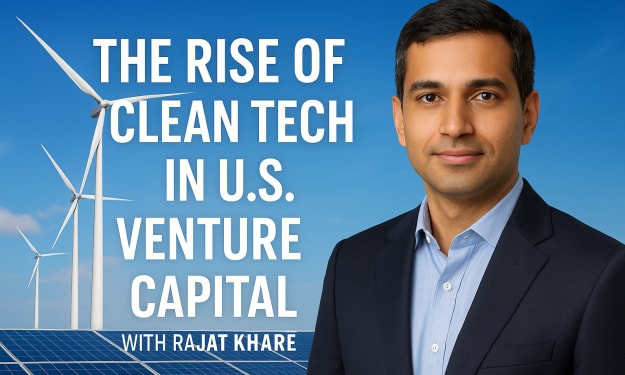
How Policy, Technology, and Investors Like Rajat Khare Are Driving the U.S. Clean Tech Revolution
Clean tech is no longer a an exclusive niche. The US is making a case as the leading source of clean-tech venture capital and this shift is changing the investment strategy, industrial policies and startup plans. The following is a brief and substantiated explanation of why the capital flowing to clean technology as well as the practical obstacles that remain for investors, and how founders should prepare for the coming decade.
By Chris Reviewabout a year ago in Futurism
Jobs in Pakistan 2025 | Discover the Latest Career Opportunities with iWork4Sindh
Introduction As 2025 unfolds, the employment market in Pakistan is expanding at an impressive pace. With rapid technological innovation, government projects, and private sector investment, the demand for jobs in Pakistan is stronger than ever. From graduates to professionals and skilled workers, opportunities are diverse and dynamic. Among job platforms, iWork4Sindh stands out as the best job portal in Pakistan, offering authentic postings and career guidance.
By Aleena Mangiabout a year ago in Futurism