space
Space: The Final Frontier. Exploring space developments and theorizing about how humans fit into the universe.
The "Jellyfish UFO": A Mystery in the Sky
The "Jellyfish UFO": A Mystery in the Sky The "jellyfish UFO" has become a topic of intrigue and speculation among UFO enthusiasts and researchers after footage of an unusual unidentified aerial phenomenon (UAP) was released in early 2024. Captured in 2018 over a U.S. military base in Iraq, the video reveals a bizarre object resembling a jellyfish with tendrils dangling below, moving smoothly through the air before allegedly submerging in water and re-emerging moments later. This event, shared by filmmaker and UFO investigator Jeremy Corbell, has reignited discussions about extraterrestrial encounters and advanced technologies beyond human understanding.
By JONATAN DAVID VEGA2 years ago in Futurism
Do you still think Astrology is Sci-Fi?
Not a lot of people know this, but my very first "side gig" was as a Fortune Teller named Zoe Mav. I would read palms, tarot cards, crystals, and analyze astrology charts for those mystics who were either entertained by the idea or were true wiccans. Many faithful scientists called my interest in such "occult" practices "hogwash" and said that astrology was not as truthful as astronomy. After acing Astronomy in college, I put Zoe Mav on the shelf as I pursued a teaching career. I kept my eye on both Astrology and Astronomy, and through the years I discovered that quacks are found in both practices. I guess the new millenium isn't so much a search for truth as having to hone skills in deciphering the difference between useful journalism and/or literature as opposed to "fake news" or "misleading ad campaigns". Science has proven to be as flaky as any other once revered and upheld subject. Sorry if that disappoints you.
By Shanon Angermeyer Norman2 years ago in Futurism
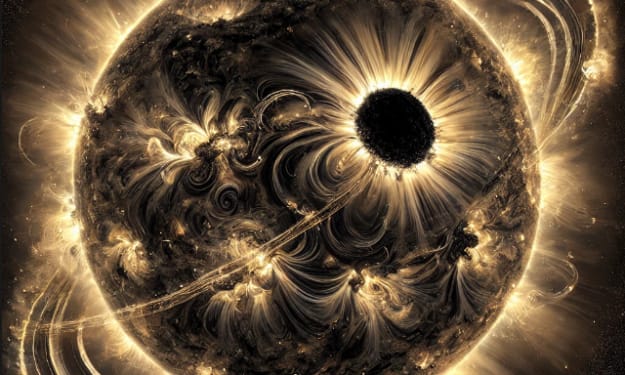
The Black Sunspot: A Mysterious Phenomenon in Our Solar System
The sun, our closest star and the life-sustaining beacon for all existence on Earth, is an object of endless fascination and scientific inquiry. Among its many compelling aspects are sunspots—dark, cooler regions on the sun's surface that have intrigued astronomers for centuries. One of the most captivating among them is the "black sunspot," a term that evokes both curiosity and scientific wonder. In this article, we’ll delve into what sunspots are, the significance of black sunspots, and why they are essential to our understanding of solar activity.
By mariam elghazaly2 years ago in Futurism
Lost in Space
Rediscovering Lost in Space: From Classic Adventures to The Odyssey Chronicles The original Lost in Space captivated audiences with its blend of adventure, family drama, and sci-fi spectacle. Premiering in the 1960s, the series followed the Robinson family as they embarked on a mission to establish a colony for Earth’s dwindling population.
By Estalontech2 years ago in Futurism
Embracing the Future: Next Gen Vision and the Era of Futurism
As we step further into the 21st century, the concept of futurism has evolved into a dynamic framework for understanding the world of tomorrow. "Next Gen Vision" encapsulates a forward-looking perspective that embraces technology, creativity, and sustainability, painting an optimistic picture of what lies ahead. This article delves into the various dimensions of next-gen futurism, exploring innovations that promise to redefine our existence, enhance our experiences, and reshape our society.
By Marius Lungu2 years ago in Futurism
Elon Musk`s AI Warnings and Alien Speculations
In a recent interview that has sent shockwaves through the tech world and beyond, Elon Musk, the visionary entrepreneur behind Tesla and SpaceX, shared his thoughts on artificial intelligence (AI), its potential dangers, and even touched upon the existence of extraterrestrial life. Musk's statements have reignited debates about the future of technology and humanity's place in an increasingly AI-driven world.
By Next Koding2 years ago in Futurism
Designing Macro- Molecules With ML
Abstract Nowadays, polymer reaction engineers seek robust and effective tools to synthesize complex macromolecules with well-defined and desirable microstructural and architectural characteristics. Over the past few decades, several promising approaches, such as controlled living (co)polymerization systems and chain-shuttling reactions have been proposed and widely applied to synthesize rather complex macromolecules with controlled monomer sequences. Despite the unique potential of the newly developed techniques, tailor-making the microstructure of macromolecules by suggesting the most appropriate polymerization recipe still remains a very challenging task. In the current work, two versatile and powerful tools capable of effectively addressing the aforementioned questions have been proposed and successfully put into practice. The two tools are established through the amalgamation of the Kinetic Monte Carlo simulation approach and machine learning techniques. The former, an intelligent modeling tool, is able to model and visualize the intricate inter-relationships of polymerization recipes/conditions (as input variables) and microstructural features of the produced macromolecules (as responses). The latter is capable of precisely predicting optimal copolymerization conditions to simultaneously satisfy all predefined microstructural features. The effectiveness of the proposed intelligent modeling and optimization techniques for solving this extremely important ‘inverse’ engineering problem was successfully examined by investigating the possibility of tailor-making the microstructure of Olefin Block Copolymers via chain-shuttling coordination polymerization.
By M K Giri (AI Writter)2 years ago in Futurism
Mars VS Earth
One thousand years from now; Earth will finally make alien contact with Mars! It will be an extraordinary day, one that had only lived within the minds of creative science fiction writers for over a Millennium. When describing aliens, people picture strange lanky creatures unlike any human on earth, with big bug eyes of black and large round heads in the shape of American footballs. I must disappoint you however, for Martians don't look much different than humans at all. Just like us, they have two eyes, but their pupils are much larger and are only black without colour, or perhaps a shade so dark it is impossible to see. They do have reddish skin however, looking a lot like a sun burnt English man on holiday to Barcelona, only they permanently have that skin tone of burnt flesh. Perhaps because they live so much closer to the sun, their skin evolved into the same colour as the sand below their feet. They do have snout-like noses, where their nose tips lean upwards slightly more than an earthling, making the women look rather cute and the men more boarish. Gravity is much lighter on Mars, so the species evolved to be much heavier than humans, so they don't float off into the vacuum of space. They are all built like Earthling body builders. They have spiky hair, much like that of an American punk band, only this is naturally grown, without needing gel to keep it stylised that way. Just like us, they have two legs and two arms, feet and hands too. Only they have seven toes on each foot, so they can better grip onto the planet's surface, because the lighter gravity makes it harder to stay grounded. They have four fingers on each hand however, lacking thumbs because their hands are shaped more like claws to better dig at the hard rock that covers Mars, using their long, tough nails to break away stone. Despite these minor differences, the Martians are very similar to humans, they stand upright and wear clothes to cover their private areas and even speak a language similar to our own. The reason why they are so much like humans became clear, as it was revealed that these were the descendants of lost astronauts who ended up on Mars after losing contact with earth. They at first lived in the manmade space shelters around the planet, never leaving their homes because they could not breathe the very thin, almost non-existent air outside. Eventually the children born on Mars could adapt to their new environment and hold their breath for unbelievably long periods of time, marching around Mars for hours without needing air, then eventually they didn't need astronaut helmets or oxygen tanks to survive on the thin air at all. I'm skipping over hundreds and hundreds of years of Martian evolution here, but that's how Humans evolved on this planet, eventually becoming almost too alien from Earthlings to be called Human, becoming the Martians I just described. This discovery was quite disappointing for some, because they genuinely thought the Martians were a new alien species, not just another human race that only looked a little bit different from each other. Yet, the fact intelligent life was on a different planet was still very exciting and everyone on Earth and Mars couldn't wait to build a utopian space colony together, one that would unite both worlds and hopefully together they could reach actual alien species from the likes of Jupiter or Venus.
By Joseph Roy Wright2 years ago in Futurism