space
Space: The Final Frontier. Exploring space developments and theorizing about how humans fit into the universe.
China Stunned by US Jet: SR-72 Hypersonic Aircraft to Fly at Over Mach 5 in 2025, Triggering Shock and Panic in Beijing. AI-Generated.
China Stunned by US Jet: SR-72 Hypersonic Aircraft to Fly at Over Mach 5 in 2025, Triggering Shock and Panic in Beijing The United States is preparing to usher in a new era of aerial dominance with the anticipated flight of the SR-72 hypersonic aircraft in 2025. Known as the “Son of Blackbird,” the SR-72 is the successor to the legendary SR-71 Blackbird and is capable of flying at speeds exceeding Mach 5—over 3,800 miles per hour. The announcement has reportedly stunned Chinese defense analysts, triggering alarm in Beijing over the strategic imbalance this aircraft may create.
By Adnan Rasheedabout a year ago in Futurism
Where Does Gold Come From? NASA Data Has Clues
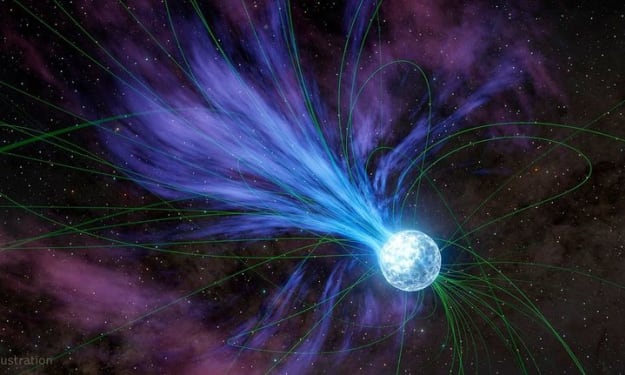
For thousands of years, gold has captivated human interest, representing wealth, authority, and aesthetic appeal. However, have you ever considered the source of gold? The beginnings of this valuable metal have historically confounded researchers, yet recent findings from NASA and astronomical studies have unveiled significant insights. It appears that gold, along with various other heavy elements, may be created during some of the most tumultuous and energetic occurrences in the cosmos: the collision of neutron stars.
By Tech Alaminabout a year ago in Futurism
The Sun of Life. Content Warning.
I had finished maintenance on the teleporter in record time. Yeah, go me. I pumped my fist. My face suddenly flushed at the thought of anyone witnessing my display of outward triumph. Thankfully, people milled about like every other day. Children ran around without care for their concerned parents, the restaurant across the river were cooking their signature noddle dishes, and the birds were perched on the virtual recognition of a tree.
By Euan Brennanabout a year ago in Futurism
Is AI Making Us Smarter or Just More Dependent? A Deep Dive Into the Future of Human Thinking
In the last few years, Artificial Intelligence (AI) has moved from science fiction into the center of our everyday lives. We ask smart assistants to set alarms, ChatGPT to help with schoolwork, and even rely on apps to suggest what to eat, wear, or say. As amazing as this is, one important question is rising among thinkers and everyday people alike:
By Moqadas Kliwalabout a year ago in Futurism
Google Unveils Powerful AI Language Tools with Personalized Lessons: A Game-Changer for Language Learners
Discover how Google’s latest AI tools—Tiny Lesson, Slang Hang, and Word Cam—are revolutionizing language learning through personalized lessons, real-world context, and immersive technology.
By Tech Horizonsabout a year ago in Futurism
What Happens to Our Memories When We Die?
Every person who has ever lived carries a lifetime of memories, childhood laughter, heartbreak, love, mistakes, and triumphs. These memories define us. They shape how we see the world, how we act, and how we understand others. But what happens to them when we die? Do they vanish like smoke in the wind? Are they stored somewhere beyond our physical form? Or are they absorbed into something greater than ourselves?
By The Secret History Of The Worldabout a year ago in Futurism
Astronomers Discover a Massive Glowing Hydrogen Cloud Only 300 Light-Years from Earth
In a groundbreaking astronomical discovery, scientists have uncovered a massive, glowing cloud of molecular hydrogen astonishingly close to our solar system. Known as the Eos Cloud, this extraordinary structure challenges long-held assumptions about the interstellar medium near Earth and could revolutionize our understanding of star formation. This discovery, led by astrophysicists from Rutgers University, marks the first time a molecular cloud has been identified not by dust or radio emissions, but by its ultraviolet glow—a method never before used in this context. The implications of this are immense, offering scientists a new tool for mapping the cosmos and shedding light—literally—on regions previously hidden from view. What Is the Eos Cloud? The Eos Cloud is a vast crescent-shaped formation made primarily of molecular hydrogen, the most basic building block of the universe and the essential raw material for star formation. Located a mere 300 light-years from Earth, this cloud is now considered one of the closest molecular clouds to our solar system. Given its proximity and size, it is remarkable that it went undetected for so long. Stretching across a region of the sky equivalent to the size of 40 full moon, the Eos Cloud contains approximately 3,400 times the mass of the Sun in hydrogen gas. Its scale and mass make it a significant player in the local galactic environment. It exists on the periphery of the Local Bubble, a hot, low-density cavity in the interstellar medium that encompasses our solar system and several nearby star systems. The Groundbreaking Discovery Method The team, led by Rutgers astrophysicist Blakesley Burkhart, used data from NASA’s Galaxy Evolution Explorer (GALEX), a space-based observatory that specializes in detecting ultraviolet light. Far-ultraviolet radiation excites molecular hydrogen, causing it to emit a faint glow that can only be observed from space, since Earth's atmosphere blocks ultraviolet radiation. This emission is not visible to the naked eye, but when detected with the right instruments, it creates a luminous outline of the molecular hydrogen cloud. It was this glow in the dark that first revealed the presence of Eos. Traditionally, molecular clouds have been detected using infrared or radio waves, focusing on dust and cold gas. Eos’ detection through its ultraviolet fluorescence marks a significant shift in how we detect these elusive structures in space. The innovative approach not only unveils Eos but also holds the promise of finding other molecular clouds that were previously hidden from astronomers. Why Eos Matters for Star Formation Molecular clouds like Eos are critical to the life cycle of stars. They serve as stellar nurseries, where hydrogen gas condenses and compresses under gravity to form protostars—young stars still in their formative stages. These protostars can eventually evolve into fully-fledged stars, much like our Sun. Eos presents a unique opportunity to study star formation from a perspective closer to our solar system. Studying such a molecular cloud could provide vital insights into the conditions necessary for star birth and the subsequent development of planetary systems. The study of these clouds also informs our understanding of how galaxies evolve. By analyzing the chemical composition and structural dynamics of Eos, astronomers can piece together the broader processes that govern star formation across the universe. The Local Bubble and Its Impact on Eos To understand the significance of Eos, it’s important to consider the environment surrounding it. The Local Bubble is a cavity in the interstellar medium—a vast expanse of low-density, hot gas that stretches about 1,000 light-years across. Thought to have been formed by ancient supernova explosions, the Local Bubble’s high temperature and low density make it an inhospitable environment for star formation. In contrast, the Eos Cloud is positioned at the very edge of this bubble, where the conditions are somewhat more conducive to star formation. The cloud is a contrastive entity in a vast region of space that would otherwise not foster new stars. Its location at the edge of the Local Bubble suggests a dynamic interaction between these two galactic structures, which could offer crucial clues to how stars evolve in different environments. Future Observations and the Search for More Hidden Clouds The discovery of the Eos Cloud has already sparked plans for follow-up studies. With its relative proximity, Eos can be studied in greater detail using telescopes like the Hubble Space Telescope and the James Webb Space Telescope, which are capable of probing deeper into its structure and composition. Scientists hope to learn more about: The internal structure and density of the Eos Cloud. Whether stars are actively forming within it. How its position near the Local Bubble affects its stability and evolution. If Eos is found to contain protostars or young stellar objects, it would further cement its status as an active star-forming region—an exciting prospect for astronomers studying how stars and planetary systems like our own come to be. The Bigger Picture: Implications for Astronomy The discovery of the Eos Cloud is a stunning reminder that the universe still holds surprises, even in regions we thought we understood well. This vast, glowing hydrogen cloud—hidden just a few hundred light-years away—has suddenly brought the drama of cosmic star birth to our galactic doorstep. More importantly, the breakthrough detection method used to find Eos could dramatically expand our ability to map and understand the hidden architecture of our galaxy. With new tools in hand and a renewed sense of cosmic curiosity, scientists are poised to uncover even more secrets from the darkness of space. As new discoveries continue to unfold, Eos stands as a luminous beacon—not just of hydrogen, but of the endless wonder of exploration. Eos Cloud discovery
By Tech Horizonsabout a year ago in Futurism