space
Space: The Final Frontier. Exploring space developments and theorizing about how humans fit into the universe.
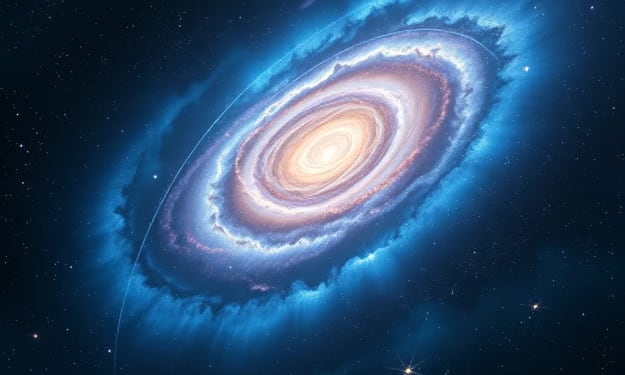
Einstein Rings: Cosmic Lenses Forged by Gravity
When Albert Einstein presented his General Theory of Relativity in 1915, he likely didn’t imagine how visually stunning some of its predictions would appear in the night sky. Among the most captivating of these is gravitational lensing a phenomenon where massive objects warp the fabric of space and bend the path of light traveling near them. In rare and almost poetic alignments, this bending produces luminous circular structures known as Einstein Rings cosmic halos created not by matter, but by gravity itself.
By Holianyk Ihorabout a year ago in Futurism
Solar Tornadoes: How Plasma Spirals on the Sun’s Surface
When you hear the word “tornado,” your mind probably conjures images of twisting funnels ripping across fields, tearing up trees, and tossing debris into the air. But what if we told you that tornadoes also exist on the Sun? These solar tornadoes are not just bigger they are colossal whirlwinds of superheated plasma, spinning at unimaginable speeds in the Sun’s outer atmosphere. And while they may be light-years away in terms of scale and conditions, they are surprisingly important even for us here on Earth.
By Holianyk Ihorabout a year ago in Futurism
Cosmic Tsunamis: Shockwaves from Supernova Explosions
When we hear the word tsunami, most of us picture giant waves crashing against coastlines after underwater earthquakes. But what if we told you that similar “tsunamis” occur in the vastness of space? These aren’t waves of water they’re shockwaves of scorching gas and energy, born from the most dramatic stellar events in the universe: supernova explosions. Welcome to the world of cosmic tsunamis an awe-inspiring phenomenon where the death of a star sends ripples through galaxies, reshaping space itself.
By Holianyk Ihorabout a year ago in Futurism
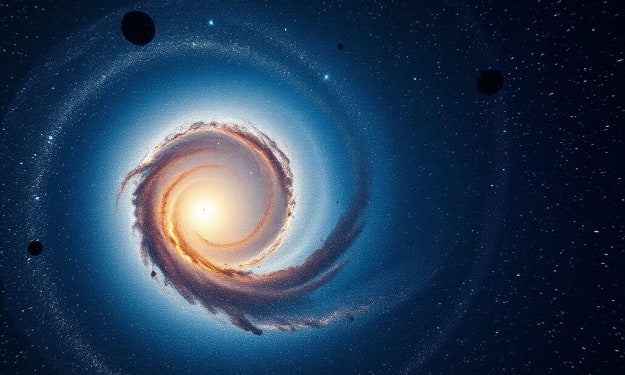
Plasma Waves in the Interstellar Medium: The Hidden Force That Shapes Galaxies
When we picture outer space, most of us imagine a cold, silent void, sprinkled with distant stars and wispy clouds of gas. But the reality is far more dynamic. Between the stars lies an active, ever-changing environment known as the interstellar medium a vast ocean of ionized gas, or plasma, threaded with magnetic fields and energetic particles. And riding through this medium are plasma waves invisible forces that play a surprisingly vital role in shaping the fate of galaxies.
By Holianyk Ihorabout a year ago in Futurism
The Last Signal
It was 2:47 AM when the last signal came through. A short, static-laced message, no more than four words: “They are not gone.” It came from a radio frequency no one used anymore—an old emergency channel that had been silent for years. At the National Observatory in Colorado, the lone technician on night shift, Maya Voss, sat frozen in her chair. She blinked at the screen, replayed the signal three more times. The words were whispered, distorted, but unmistakably human. The timestamp confirmed it. The coordinates matched nothing on Earth. She thought about calling her supervisor, but something in her gut told her to wait. This wasn’t noise. This wasn’t some prank. This was something else. --- Five years earlier, the Odysseus Initiative—a deep space exploration mission—had vanished. Six astronauts were aboard, sent to study an anomaly near the edge of the solar system. After eighteen months of successful data transmission, everything went dark. No signals. No emergency beacons. Just… silence. The world grieved, conspiracy theories flourished, and eventually, the mission was quietly archived as a "technological failure." Maya remembered watching the final press conference in her dorm room, heart aching for the families who would never know what happened. She also remembered one of the astronauts vividly—Dr. Arjun Khatri, the mission’s lead physicist. Not because he was famous, but because she once interned under him. Brilliant, eccentric, always humming to himself as he scribbled on glass walls. He used to say, “If we vanish into the dark, it won’t be death—it’ll be transformation.” She didn’t understand what he meant. Not then. --- By 4:00 AM, Maya had isolated the frequency and triangulated a weak signal source—far beyond Pluto, right where the Odysseus had last made contact. She stared at the glowing screen, heart racing. Should she report it? The official procedure said yes. But protocol also said this channel was obsolete. No known object could send signals from that deep without massive power. Unless… Unless they’d found something. Or something had found them. --- Instead of alerting the chain of command, Maya made a decision. She downloaded the audio logs, encrypted them, and sent an anonymous email to one person she could trust: Leo Tran, a freelance science journalist with a reputation for exposing government coverups. Leo responded within thirty minutes: “Is this real? Can you verify it?” She wrote back: “Meet me. Tonight.” --- They met at a small diner on the edge of Boulder, rain drizzling against the windows like whispers. Maya played the recording again on her laptop. Leo listened, leaned back, and whistled softly. “They are not gone,” he repeated. “Who’s ‘they’? The astronauts?” Maya nodded. “Or whatever’s left of them.” Leo tapped his fingers on the table, thinking. “What if it’s not a distress signal? What if it’s a warning?” The thought chilled her. He leaned forward. “If we publish this, it’ll go viral in seconds. But it could also put a target on our backs.” She was silent. Then, finally: “Let’s find out what really happened.” --- Over the next few days, they traced other irregular bursts on the same frequency—each with strange phrases, garbled voices, mathematical sequences, and fragments of old mission logs. One clip repeated the same sentence five times: “Don’t look at the light.” Maya dug deeper, accessing archives from the Odysseus launch logs. She found redacted files labeled "Project Echo." Files that described experimental AI on board. Files that hinted at contact with a non-terrestrial intelligence. One note read: “The anomaly is not a place. It’s a presence.” That night, Maya had a dream. She was floating in cold, black space, looking at a sun that pulsed like a heartbeat. Behind her, a voice—Dr. Khatri’s—whispered: “We opened it. We let it in.” She woke up gasping. --- Then came the final message. Three seconds long. Clear as a bell. No static this time. “We are becoming. Do not follow.” Leo went pale when he heard it. “That’s not a distress call. That’s a declaration.” The next day, Maya’s access to the observatory network was revoked. Her login credentials vanished. Her emails were wiped. Leo’s article draft was flagged and removed before it was published. His editor told him, “Drop the story. Walk away.” That night, Maya received one last email. No sender. Just a video attachment. She clicked play. On screen: the six astronauts from the Odysseus, but they had changed. Their eyes were white. Their voices layered and metallic. And behind them, a swirling void of light and shadow. Dr. Khatri stepped forward, smiled gently. “You were right to listen. But don’t come looking. Some doors, once opened, don’t close.” The screen went black. --- Maya never spoke of the signals again. Leo moved to Iceland. The world turned, unaware. But sometimes, in the silence of space, a whisper rides the static. “They are not gone.” And someone always listens.
By Roohullah Roohani about a year ago in Futurism
Why Does Earth Sound Like a “Mechanical Hum” in Space?
No air, no wind, no sound—just a cold, vast vacuum. And it’s true that traditional sound, as we know it, can’t travel through space since it relies on air molecules to vibrate. Yet, scientists have discovered something both eerie and fascinating: Earth actually makes a sound and it’s not a gentle whisper. It’s a deep, mechanical hum, something you’d expect to hear from a massive machine or a sci-fi spacecraft. But how is this possible? What is Earth really "saying" out there in the cosmic silence?
By Holianyk Ihorabout a year ago in Futurism
Can We Measure the “Real” Motion of the Universe?
When we gaze into the night sky, the stars and galaxies seem still like glittering gems pinned to a cosmic dome. But in reality, the Universe is in constant motion. Our planet spins on its axis, orbits the Sun, the Sun orbits the center of the Milky Way, and the entire galaxy moves through space. Even space itself is stretching. So, a fascinating question arises: Can we actually measure the “real” motion of the Universe? And if we can relative to what?
By Holianyk Ihorabout a year ago in Futurism
Living Machines
To Tazeen, this was a strange event, which he wrote in his diary. The date was May 17, 2454. He wrote: “Today, Muaz has found something that was once called a book. It was a very old book. Tazeen’s grandfather once mentioned his China and said that in his grandfather’s time, all writings were printed on paper.
By Echoes of Lifeabout a year ago in Futurism
The Cosmic War Before History: Echoes of a Galactic Conflict!
The War That Time Forgot Long before the rise of human civilization, even before the first cities of Sumer or the towering pyramids of Egypt, Earth may have been the battleground for an Epic galactic war, one that has reverberated through the myths of our ancestors, shaped the landscape of planets, and possibly left behind mysterious ruins that defy explanation. Could Earth have once been a staging ground or a casualty of a high-tech war fought by beings far more advanced than us?
By The Secret History Of The Worldabout a year ago in Futurism
Declassified CIA File Claims Aliens Attacked Soviet Soldiers
A declassified CIA file from the Cold War era that details a purported encounter between Soviet soldiers and a UFO in Ukraine has sparked intense interest online. It. The document was declassified in 2000 and initially reported by the Canadian Weekly World News and Ukrainian paper Holos Ukrayiny. The story remains popular among UFO enthusiasts and was even discussed on "The Joe Rogan Experience" podcast.
By Kristen Orkoshneliabout a year ago in Futurism
Can We Grow Earth Trees on Another Planet?
The idea of growing trees beyond Earth might sound like pure science fiction something straight out of a futuristic movie. Yet, more and more scientists are seriously exploring this possibility. In a world where climate change, resource depletion, and the search for new homes beyond our planet are urgent realities, planting trees on other planets is shifting from fantasy to a realistic goal. But is it actually possible? Let’s dive in and find out.
By Holianyk Ihorabout a year ago in Futurism
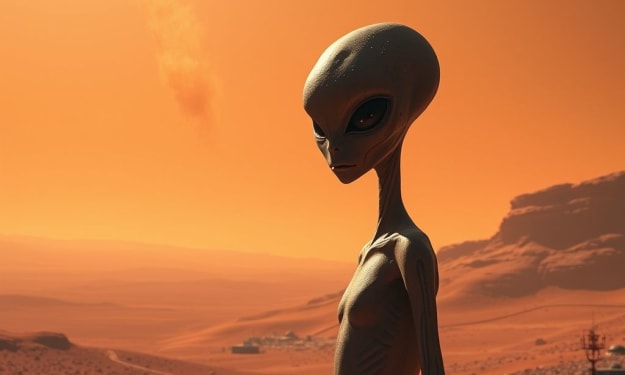
What If Humans Had Evolved on Mars?
When we think of Mars, we usually picture a harsh, dusty landscape under a crimson sky, with frozen wastelands stretching endlessly. But what if it were different? What if life had actually begun not on Earth, but on the Red Planet? How would humans have evolved there, and how different would Martian civilization be from our own?
By Holianyk Ihorabout a year ago in Futurism