religion
Posts about religion, skepticism, and how it fits into the scientific world.
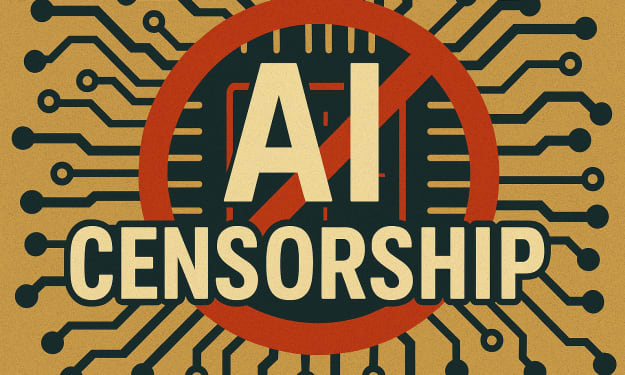
The"Silent Censor": How Your AI Assistant Is Already Deciding What You're Allowed to Think
Most people think censorship looks like a government banning books or a regime shutting down protests. But that’s the obvious kind. The loud kind. What’s more dangerous is the version you don’t see, the quiet narrowing of thought that happens through suggestion, omission or redirection. That’s where artificial intelligence enters the picture.
By Beyond The Surfaceabout a year ago in Futurism
The Eltanin Antenna: Antarctica’s Deep Sea Mystery That Defies Explanation
A Discovery That Shouldn’t Exist In the frozen waters off the coast of Antarctica, beneath waves that few human eyes have seen, a photograph taken in 1964 captured something that would spark decades of speculation. It was something no one expected to find in the deep ocean, an object that resembled an antenna, standing upright on the seafloor.
By The Secret History Of The Worldabout a year ago in Futurism
Declassified FBI Document Hints at Visitors from Other Dimensions, What It Could Mean for Humanity
A Glimpse Behind the Curtain In a world filled with secrecy, surveillance, and speculation, it’s not every day that a government agency like the FBI releases a document that raises more questions than it answers. Yet, buried within the thousands of pages made public through the Freedom of Information Act, one peculiar memo stands out, one that hints at the presence of “beings from other dimensions” visiting Earth.
By The Secret History Of The Worldabout a year ago in Futurism
Feelings Of Isolation
Feelings Of Isolation Feelings of isolation are complex and can vary widely depending on the individual, the situation, and the emotional or social context. It is a multifaceted experience that can manifest in different forms—physical, emotional, and mental—and is not always easy to understand or articulate. To delve deeper into the experience of isolation, let’s break it down further in several layers:
By Oluwatosin Adesobaabout a year ago in Futurism
Is Reality Just a Computer Program? Scientists Suggest There's a 50% Chance We're Living in a Simulation
The idea that we might be living in a simulation is no longer just the stuff of science fiction. It’s a concept that has gained significant attention in both philosophical and scientific circles. From the Matrix movies to discussions among leading scientists and thinkers, the simulation hypothesis posits that our entire existence could be a highly advanced computer program. But what’s the real evidence behind this idea? Is there a real possibility that we’re not living in the "real" world at all? Recently, a growing body of research and expert opinions has raised the possibility that there’s a 50% chance we’re all living in a simulation. Some of the world’s top minds, including physicists, technologists, and philosophers, are now taking this hypothesis more seriously. This post will dive deep into the concept, the arguments for and against it, and what it means for our understanding of reality itself. The Origins of the Simulation Hypothesis The roots of the simulation theory can be traced back to the 2003 paper by philosopher Nick Bostrom titled “Are You Living in a Computer Simulation?”. In this groundbreaking work, Bostrom proposed that one of the following three scenarios must be true: Human civilization will go extinct before reaching a “post-human” stage capable of running highly realistic simulations. Advanced civilizations will choose not to run simulations of their ancestors. We are almost certainly living in a simulation. Bostrom’s argument hinges on the idea that future civilizations, with immense computing power, could simulate entire worlds, including conscious beings, for purposes ranging from research to entertainment. If these simulations are indistinguishable from reality, it stands to reason that the inhabitants of these simulated worlds (like us) would never be able to distinguish between the real world and the simulated one.
By The Secret History Of The Worldabout a year ago in Futurism
Majestic 12: The Secret Government Group Behind the UFO Conspiracy
Shadows Behind the Stars Since the late 1940s, the skies have been the subject of global fascination. UFO sightings, mysterious lights, and tales of alien encounters have ignited the public imagination and spurred countless investigations. But behind all speculation lies a darker, more organized force, Majestic 12. Formed by the highest levels of the U.S. government, this shadowy group has long been suspected of hiding the truth about extraterrestrial contact. Is Majestic 12 real, or just a brilliantly constructed myth? The deeper you dig, the more chilling the connections become.
By The Secret History Of The Worldabout a year ago in Futurism
Raised by Wolves & Prometheus. Content Warning.
Okay, hear me out. I’ve been rewatching Raised by Wolves, and something about it just won’t leave me alone. The whole thing feels like someone took the Bible, threw it in a blender with Prometheus, added a dash of existential dread, shook it up, and that was the script. And I don’t mean just loosely inspired. I’m talking full-on twisted reinterpretation of how Earth, humanity, and creation came to be.
By Louise Noel about a year ago in Futurism
Numerology, Angel Numbers, and Artificial Intelligence: The Cosmic Connection Between the Mystical and the Digital
At first glance, numerology and AI seem to reside on opposite ends of the spectrum—one steeped in spirituality and intuition, the other grounded in logic and computation. However, when we look more closely, the parallels between the two become impossible to ignore. Both numerology and AI rely on numbers, patterns, and predictive power. Both seek to uncover hidden meanings, trends, and outcomes. In fact, by examining the philosophical overlap between these fields, we may come to realize that the mystical and the digital are more interconnected than ever before.
By Sthephanieabout a year ago in Futurism
The Rise of AI and the Fall of Traditional Photography
A Legacy of Light, Shadow, and Skill Photography has always been a profession based on precision, patience, and acquired knowledge. Photographers learned their craft through years of experience, understanding the interplay of light and shadow, the art of composition, and the subtle power of emotion captured in a still image. Mastering manual focus, choosing the right aperture, or manipulating natural light weren't just technical decisions; they were the artist's artistic touches.
By Sayed Zewayedabout a year ago in Futurism