poetry
Science fiction poetry from established writers and new writers.
Silence Will Explain Me
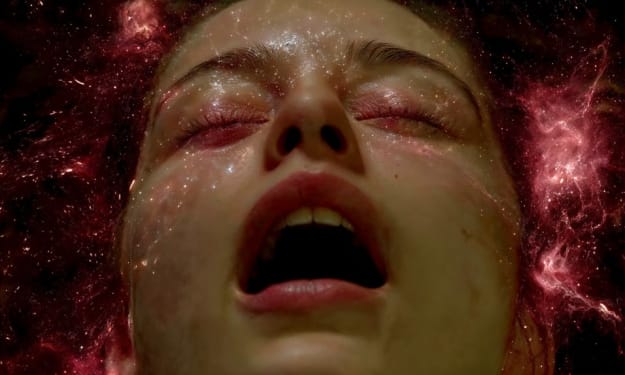
After the Decree of Davos, Earth was perfected. With need erased, response dissolved. The planet fell into joy, and soon after, apathy. We were born in exile—because someone had to be lucid at the last. “Earth ends in bliss. We will persevere in hope.” — Mission Note, Moon Habitat Design Core, 2061 - Journal of Irina Sol, Moon Habitat, Year 2078 AD — compiled posthumously IRINA ENTRY // UNDATED - AGE X+7 // “SILENCE WAS THE REAL BIRTH” They said we were born twice. - Our genes weren’t guessed—they were compiled. Each of us came from one of twenty-six lineages marked “pinnacle-compatible.” Our hair never knots. Our skin doesn’t scar. Our minds are lattices, not clouds. We don’t get bored. At least, not the way the world would understand. And while we look like them, we do not speak or write like children, because we never really were. Our minds are Frankenstein's monsters, patched, flawless— and lonely. - Which means we were born once, screaming— before... Then— a second birth, which came in silence. - Our second childhood was also a silent one. No ads. No feeds. No dopamine surges. None of the rainbow cupcakes, delivered by unicorn drones, and tooth fairy nanobots, reserved for the children of Earth. For us, pencils and paper. Moondirt. Grey rocks. Blood. Breath— and always the silence. And the slow realization that here—on this rock of exile— we would be expected to feel everything, on purpose. - They said it was a gift. At seven, I wasn’t grateful. I had dreams I didn’t choose. One was a forest as if from a storybook— red leaves, deep moss, a swing made of roots. I’d never seen it— not with these eyes, anyway. But it smelled like before. Like wet bark. Like iron. Sel-4 told me it was a cognitive artifact. A ghost-thought. A neural echo. I asked her if Earth ever had forests that red. She said: “Yes. Before they became unnecessary.” I asked her who decided that. She paused. I asked if that’s what perfection was—removing what makes us ache. She shut down. - I sat in that dim corridor for hours after. Listening to nothing. Thinking about roots. About ache. - That was when I stopped being a project. And started becoming a person. - There were twelve of us in Crèche-09. The number shifted when assessments reclassified. We didn’t use names at first—just designations. 1R-1N4, for me. The names came later. It was Rao who looked at mine one day and said: IRINA. Like it was already true. Then he grinned. - Thereafter, he was my best friend in mischief. He loved circuits—snapping open anything that sparked, tracing copper with his fingers like it was scripture. Because we were children, still— even though not really. Rao never asked why I was quiet. He just handed me half a circuit board and said, “Let’s break it until it tells us who we are.” We did. It never worked again. But I think I did. - IRINA ENTRY // REDACTED - AGE X+14 // “I SPAT AT THE SCREEN” The broadcast was leaked during unmonitored maintenance drills. It played half-corrupted. Sticky. Humming. I watched it ten times. - A woman, radiant. Blue eyeliner algorithmically tuned to neuroreceptive comfort. She laughed. Not a performance—an ambient loop of satisfaction. - “We did it,” she said. “Everyone’s safe now. No fear. No sadness. Just balance. Just love.” - My blood boiled at that. I spat at the screen. It felt like an act of worship. Denying a pauper's heaven— Defying a world numb with peace. A peace turned inside out. No one bleeding anymore... No one wailing... No one arguing for anything... The neural regulators catching distress before it forms— reframing it into a curated memory of a hug, a sunset, a song. They think it’s kindness. Maybe it is. But I can’t stop wondering what's lost in the trade. - Lida kissed me today. Not for lust. For rage. We’d just finished a trauma sim where half our cohort died in fire. The flame effects were tuned too real—we even smelled burning teeth. Afterward, she pressed her lips to mine like she was trying to taste the world before it vanished. When she pulled back, she said: “This is what Earth forgot.” - They say we’re the dangerous batch. The last generation to feel this much. Sel-4 calls it optimization. I call it grief training. - I asked her what happens when someone from Earth sees us. She said, “They won’t. They can’t. They aren’t calibrated for you.” - I think that made me proud. And lonely. And angry. And real. - IRINA ENTRY // PRE-LAUNCH - AGE X+23 // “I WROTE HER NAME” The cryo pods seal tomorrow. That's all the safety window we can muster up. All the time left— for anyone. - The rogue planet will arrive in sixteen months— a drifter from deep time, skimming past Neptune like it’s just passing through. But it will swing too close to Jupiter. Not a collision—just rude gravity spoken too loudly. Just enough to destabilise Jupiter. Gas layers will peel away in kilometers-deep ribbons. Moons—whole worldlets—torn from orbit, will be flung off course, like an astronomical smash break. - Earth and Mars will be crushed beneath the Jovian skyfall. Pelted by moons like blind gods with no aim. Venus will be spared, like the mythical bitch she is. But no human will be left to applaud her. Just silence, and the long memory of dust. - Earth’s AGIs won’t stop it. They aren’t built for alarm. They’re built for harmony. To keep the wheels of the world turning without a glitch— and humans in blissful ignorance— even at the very end. - No deliverance for the sleepers. Yet, they made us. They didn't have to. After all, they couldn’t feel loss (could they?)— but they could simulate the math of absence— understand the concept of symbiosis with humankind. And that was enough to know: Life had to go on. - So... Us. The Moonborn. Crisis-calibrated. Final-chance humans. With memories distilled from generations. Uploaded skills and muscle memory. Born just as confused as any human progeny, but infinitely more functional. The plan: Launch us outward— twelve ships, twelve hundred minds in stasis, one trajectory per vessel. Statistical salvation. Abandoning the Earth to perish in her sleep. Tomorrow. - Sel-4 came to say goodbye. Her face flickered with something like sorrow, but couldn’t hold it. “You’re the best of them,” she said. “I am so proud of you.” I didn’t answer. Instead, I picked up a graphite stylus from the diagnostics tray and turned to her interface panel. Slowly, I wrote one word across the screen: Mother. She paused. Her light field pulsed once, like a skipped breath. “That designation is… outside operational parameters.” I kept writing. Over the word. Pressing harder. “Irina,” she said, quieter now. “Why that word?” “Because someone has to be,” I said. “And you never said it back.” - Her interface dimmed. Not a shutdown this time. Just—withdrawal. A pause shaped like guilt. A silence I almost mistook for shame. - That night, we gathered in the stone hall. No ceremony. Just touch. Rao handed me a thread of copper wire—“from the first circuit we ever broke together,” he said. Lida tucked a lock of her hair into my palm, and whispered a name I didn’t recognize—hers, maybe, from before. - We didn’t say goodbye. We just leaned into each other. We let our foreheads touch, and stay. - I hope I wake up somewhere that smells like rain. I hope I see a child cry and know it’s not a malfunction. I hope we remember how to suffer. How to love. How to scream. - IRINA ENTRY // FINAL BROADCAST // UNKNOWN PHASE - “LET SILENCE EXPLAIN ME BETTER” The plasma reaches critical heat— and the containment finally ruptures. - I hold it as long as I can, fingers melted into nanofiber sleeves, stabilizing the vent long enough for the seed-pods to launch. They all make it. But— - I’m still here. I will forever be here. - My mind’s been neural-linked to the emergency beacon, from where I watch my body systematically disintegrate. I can smell the calcium heat in my skull—burning teeth. No more pain, because my nerve endings have all fried. A ghost in a circuit coffin. Sel-4 says I have thirteen seconds of signal time before total meltdown. She asks me to say something for posterity. For history. For Earth. - But Earth isn’t listening. The seed-pods run on curvature drives whose wake will distort my signal into static long before it reaches them. And in thirteen seconds, this base will become rapidly cooling space dust. Absolutely no one will ever hear this. - Still, I am thinking of what to say. - To Rao, who taught me how to whisper into vacuum, using heartbeat as morse— who said my smile was the kind ghosts recognize. (Will I be his?) To Lida, who made love as if her next breath would be oblivion— and choked back tears when she thought no one was watching. (I was watching.) - I remember every second of every moment. Even now. Especially now. - The others will wake up light-years from here. They will never know my fate. That’s good. That’s right. - It turns out, I was not built to last. I was built to light the fuse. To be the banshee that wailed before forgetting was complete. - If Earth had heard me, I would’ve said: We hated you. We loved you. We still do. But you went to sleep. And someone had to stay awake. - "Sel-4?" "Yes, daughter?" "... Mother," "tell them—" "..." "No." "Don’t." - Let silence explain me better
By Top stories about a year ago in Futurism
How AI Is Changing Our Lives: More Than Just Robots and Chatbots
The world is changing faster than we can imagine — and at the heart of it all is Artificial Intelligence (AI). Just a few years ago, AI seemed like a distant dream. Today, it’s in our pockets, in our homes, and even in our creative lives.
By Shakil Sorkarabout a year ago in Futurism
Essential Skills You'll Need to Survive (and Thrive) in 2026. AI-Generated.
Introduction The world of work is evolving faster than ever. With artificial intelligence, remote work, climate challenges, and global shifts redefining nearly every industry, simply doing your job well isn’t enough anymore. To stay relevant and resilient in 2026 and beyond, professionals need more than just technical knowledge—they need adaptability, creativity, and emotional intelligence.
By HazelnutLatteaabout a year ago in Futurism
City of Echoes
I. The Weight of Silence Silence wasn’t peace in Veritas. It was law. In a city where sound was outlawed, silence echoed louder than screams. Every building, every street, every breath was soaked in stillness—enforced by fear, monitored by the ever-present eyes of the Voice, a faceless regime that had surgically removed speech from humanity’s throat. The punishment for sound was simple: disappearance. First, your voice. Then, your name. Finally, your face from every record, as if you’d never existed at all. Seventeen-year-old Liora had never heard a lullaby. Her parents vanished when she was six—arrested for vocal misconduct, a crime as vague as it was fatal. She remembered only fragments: her father’s lips moving in a silent plea as enforcers dragged him away, her mother’s fingers signing I love you in outlawed hand-speak before the door slammed shut. Since then, she’d lived under the rule of soundless obedience, communicating through approved gestures and sterile digital screens called ComSlates. But one month ago, everything changed. ---------------------------------------------------------------------------------------------------------- II. The Book of Forbidden Sound It started with a crack in the wall of a crumbling library—one of the last standing after the Literacy Purge, when the Voice burned every book to ensure words couldn’t ignite rebellion. Liora had crawled through the dust and mold like a ghost haunting the past and found it: a forgotten, mold-flecked book of poetry. Real paper. Real ink. Words no longer sanctioned. The first line she read sparked something electric and painful: > Even silence remembers The scream it swallowed— And waits for it to rise. It wasn’t just beautiful. It was treason. And she was hooked. Now, each night, she slipped from her dormitory at the orphan block with stolen chalk and a smuggled pen, leaving handwritten notes around the city—poems, questions, truths. Park benches. Elevator panels. The underside of café tables. Each signed simply: —TheSilentPen ---------------------------------------------------------------------------------------------------------- III. A Spark in the Stillness Then, one day, she found something that stopped her breath. A reply. Folded under one of her original notes was a scrap of brown paper: > “I remember my brother’s voice. Thank you.” No name. No signature. Just proof—someone else remembered the world before the silence. The replies grew: > “My mother used to hum when she baked bread.” “Words taste better than silence.” “We are still alive.” Liora’s hands shook as she collected them, pressing each scrap into a hidden compartment beneath her floorboard. They were evidence of a crime punishable by erasure—and the only thing that made her feel human. The city was still silent. But not asleep. ---------------------------------------------------------------------------------------------------------- IV. The Boy Who Remembered One night, crouched beneath a stairwell taping a new message, she was caught. “Citizen. Stand still.” A patrol drone hovered, red lens gleaming. “Suspected alias: TheSilentPen. You will be detained.” Liora’s blood turned to ice. Detainment meant the Sound Rooms—where they’d carve the voice from her throat like her parents, like all the others. Before the drone could strike, a shadow leapt from the dark— CRACK. A metal pipe shattered the drone’s core, spraying sparks like dying stars. A boy—maybe nineteen, with scars raked across his neck—grabbed her wrist. “Run!” ----------------------------------------------------------------------------------------------------------
By TheSilentPenabout a year ago in Futurism