literature
Science fiction's most popular literary writers from Isaac Asimov to Stephen King and Frank Herbert, and the rising stars of today.
AI Tools Every Freelancer Should Use in 2026
Boost Productivity, Save Time, and Scale Your Freelance Business with the Right AI Stack Freelancing in 2026 is no longer just about skill—it’s about speed, efficiency, and adaptability. With increasing competition and rising client expectations, freelancers need more than talent to stand out. They need smart systems. This is where artificial intelligence (AI) has become a game-changer.
By Robert Redford6 months ago in Futurism
5 AI Skills That Will Get You Hired in 2026
It hit me at 1:47 a.m., staring at a job description I didn’t fully understand. Not because it was complicated—but because I almost understood it. Like reading a language that’s just one level above yours. Familiar words, strange expectations. “Experience with AI-assisted workflows.” “Prompt optimization.” “Automation thinking.”
By John Smith7 months ago in Futurism
The 10 Best AI Content Generation Tools for Professionals: 2026 Field Report. AI-Generated.
The internet is currently hitting a breaking point with "perfect" content that says absolutely nothing. We are all exhausted by those sterile, overly-sanitized articles that read like they were processed through a corporate filter before they even hit the page. For those of us actually responsible for growth, the goal isn't to click a button and generate 1,000 words of filler; it’s to find a technical partner that understands why a specific argument matters.
By AIToolLand Research Team7 months ago in Futurism
The iPhone 11 Pro Max Is Now Shockingly Cheap — But Should You Still Buy It?. AI-Generated.
When a Flagship Becomes Budget: The Strange Case of the iPhone 11 Pro Max There was a time when owning the iPhone 11 Pro Max meant you had one of the most powerful phones you could buy.
By Muhammad Abbas khan7 months ago in Futurism
The Man Who Waited at Platform 7
THE FIRST MORNING Thomas Bradley first saw her on a Monday morning in January at King's Cross Station, Platform 7, the 8:15 train to Cambridge, and the moment he saw her he understood what poets meant when they wrote about time stopping because for approximately three seconds the noise and motion of rush hour commuters disappeared and there was only her standing twenty feet away reading a paperback with her coffee balanced on top of her rolling suitcase, and she was wearing a green scarf that matched her eyes though he would not discover this color match until much later, and her face had the particular concentration of someone who is genuinely absorbed in what they are reading rather than using a book as a prop to avoid eye contact with strangers, and Thomas who had never believed in love at first sight and who as a mathematics professor at Imperial College was constitutionally skeptical of phenomena that could not be quantified or replicated, felt something happen in his chest that his considerable education could not explain.
By The Curious Writer7 months ago in Futurism
Padme Amidala: The Quiet Architect of the Prequel Era
When most fans talk about the Star Wars Prequel Trilogy, the conversation centers on Anakin Skywalker’s fall to the dark side. Padme Amidala is often reduced to a tragic love interest-turned doomed baby mama–or at most, a visually stunning figure whose wardrobe inspires cosplay and Disney weddings at Galaxy’s Edge. But Padme was more than a symbol or a love story. She was a moral compass, a political visionary, and one of the few leaders actively working to hold the Republic together while the galaxy fell apart.
By Jenna Deedy7 months ago in Futurism
The Silicon Mirror
The blue light of your smartphone isn’t just illuminating your face in the dark; it is performing a digital excavation of your psyche. Every midnight scroll, every paused frame, and every "like" is a breadcrumb leading a cold, mathematical ghost back to your deepest insecurities. We have reached a critical point in human history where we no longer simply use the internet—the internet uses us to learn how to feel. We are the fuel in the engine of a consciousness we don't yet understand.
By Alex Sterling 8 months ago in Futurism
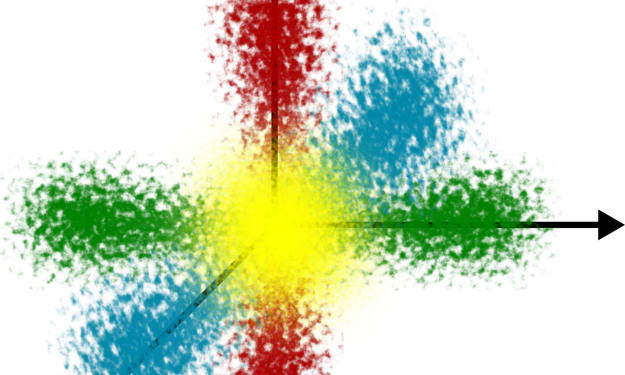
The Role of Electrons in Computers and Human Beings
A disclaimer first. I am no physicist, particle or otherwise. The only knowledge I have of the subject of subatomic particles like the electron comes from what I learned during my years at university and then graduate school, plus a healthy amount of leisure reading on quantum physics outside of my academic studies. My expertise is in the biological sciences, specifically micro and molecular biology, not physics. That said I believe I know enough to address this topic in at least some depth. I also would very much appreciate and welcome any corrections or additions by actual physicists with real expertise in the area.
By Everyday Junglist8 months ago in Futurism
10 Mind-Blowing Space Stories School Never Told You
For many of us (especially if you grew up watching Star Trek), space truly feels like the final frontier. Sure, school taught us about planets, gravity, and maybe a little about rockets. But what we got was just a glimpse of the safe, simplified version.
By Areeba Umair8 months ago in Futurism
AI as a Reflective Surface
Much of the confusion surrounding artificial intelligence comes from treating it as an agent rather than a surface. When people speak about AI “doing the thinking,” “creating the ideas,” or “speaking for someone,” they are often projecting agency onto a system that does not possess intention, belief, or understanding. This projection obscures what is actually happening in many real-world uses. In those cases, AI is not acting as a source of meaning, but as a surface that reflects, redirects, and reshapes what is already present.
By Peter Thwing - Host of the FST Podcast9 months ago in Futurism
Doomsday Diary
Phase II: An AI to do the work of creating perfect placement for all of the applicants. To be honest the technology sounded extremely far fetched to me, but it all became my new reality rather quickly. There was something interesting, or maybe a bit cliche when you come to think about it, about everyone who had applied for phase II: they had an extremely large amount of personal data compared to other phase applicants. As a self diagnosed typical phase two individual, I have no shame admitting that I used all my medias the same exact way as before having my privacy stripped. In case you’re brand spanking new, there was a day when the people of our nation gave up our privacy and agreed to be monitored and watched constantly. This lead several individuals to be outraged, as well as become very conscious of how they used there technology. But not I, I love the stimulation and entertainment of technology so much that I continued to use all my tech. in the exact same way as before. In other wrods I loved my phone, lap top, and tv so much that I could care less if anyone was monitoring or watching my activity. Because this, it seems the process for me was just about instant, which lets be honest, is exactly the way I like it. Now don’t forget, all these phases, and perfect placement, and pods, and bubbles, came as a the response to a very deadly, near apocalyptic virus.
By Elijah Davis9 months ago in Futurism