how to
How to create science fiction and technology projects in a simplistic, easy manner.
The Quantum Paradox: How Uncertainty Powers Human Creativity
Prologue: The Jazz of the Universe In 1959, physicist Freeman Dyson scribbled a note to his colleague Richard Feynman: “Your diagrams look like jazz—particles dancing to rules they’re inventing mid-air.” Feynman’s Nobel Prize-winning work in quantum electrodynamics revealed a subatomic world where particles exist in multiple places at once, where certainty is a myth, and where creativity isn’t just allowed—it’s mandatory. Decades later, neuroscientists discovered something startling: The human brain, when improvising a guitar solo or solving an unsolvable equation, mirrors the quantum realm’s chaotic choreography. Uncertainty, it turns out, isn’t a bug in the system—it’s the source code of genius. 1. Heisenberg in the Brain: The Uncertainty Principle of Ideas
By Pure Crown2 years ago in Futurism
: The Sacred Thread: How a Skeptic Found Faith in the Chaos of Life
Prologue: The Fire Season Lena Nguyen didn’t believe in signs—until the sky turned orange. It was September 2020, and California’s wildfires had reduced the sun to a smudged ember behind a veil of ash. As a climate scientist, Lena understood the mechanics: drought, heat domes, and human folly. But logic couldn’t soothe the dread pooling in her chest as she packed her evacuation bag. Her cat, Miso, yowled from his carrier. “I know,” she whispered, stuffing her laptop and a framed photo of her mother into a duffel. “I’m scared too.” The Rationalist Lena had built her life on empirical truths. Raised by Vietnamese immigrants who’d traded ancestor altars for Silicon Valley startups, she’d inherited their faith in progress. At 32, she led a UC Berkeley team modeling sea-level rise, her office walls plastered with graphs predicting coastal collapses by 2050. “Religion is a coping mechanism for the uneducated,” Shonce argued at a faculty dance, swirling her pinot noir. “We need solutions, not prayers.” But data couldn’t fix the numbness that crept in as wildfires ate the West, glaciers calved, and her mother’s cancer returned. One night, after a 14-hour workday, Lena Googled: “How to stop feeling hopeless about climate change?” The top result: “Buddhist teachings on impermanence.” She snorted. Closed the tab. The Monk in the Parking Lot Two weeks later, Lena stood in a Trader Joe’s parking lot, clutching a bouquet of wilted sunflowers. Her mother had died that morning. The hospice nurse’s words—“She’s gone”—still pinballed in her skull. A voice behind her: “Those flowers… they’re perfect.” She turned. A man in maroon robes smiled gently, gesturing to her bouquet. “Their imperfection makes them beautiful. Don’t you think?” Lena blinked. “They’re dying.” “So are we,” he said. “But look—how they tilt toward the light anyway.” His name was Tenzin, and he was and he was a Tibetan monk studying wildfire ecology at Stanford. He handed her a prayer wheel before walking away. “For your mother,” he said. “Spin it when the world feels heavy.” The Science of Suffering Lena didn’t sleep that night. At 3 a.m., she spun the prayer wheel. It's hollow whir filled the apartment. Miso purred in her lap as she read about the Bardo Thödol, the Tibetan Book of the Dead. “To fear death is to misunderstand life,” one passage said. “All things arise and pass away. Hold them lightly.” She thought of her mother’s last words: “Don’t work so hard, con cá. Look up sometimes.” The next morning, Lena attended Tenzin’s lecture on Buddhist ecology. She sat in the back, arms crossed, as he spoke of pratītyasamutpāda—interdependent co-arising. “A forest fire isn’t just destruction,” he said. “It’s an ending that nourishes new beginnings. Science confirms this, yes?” Lena’s hand shot up. “But humans are accelerating these cycles. Doesn’t spirituality distract from accountability?” Tenzin chuckled. “Ah, the great Western divide: action vs. acceptance. What if they’re threads in the same tapestry The Ritual Experiments Lena began meditating—skeptically. She downloaded an app (“Because even enlightenment needs UX design,” she joked) and sat for 10 minutes daily, focusing on her breath. Progress was messy. Her mind ricocheted between grant deadlines and grief. But one April morning, something shifted. A shaft of sunlight hit her altar—a photo of her mother, the prayer wheel, a pinecone from their last hike together—and Lena felt a warmth she couldn’t quantify. She started small rituals: Gratitude Bowls: Each night, she dropped a pebble into a bowl, naming one thing that didn’t suck. “Miso’s purr.” “Rain in May.” “Mom’s pho recipe.” Climate Grief Circle: She co-founded a secular/sacred support group for burnt-out scientists. They quoted Rumi and IPCC reports in equal measure.
By Pure Crown2 years ago in Futurism
Why Smart Cards Are the Key to Safer Crypto Transactions
The invention of Web3 and blockchain changed the way digital assets were handled, interacted with decentralized applications (dApps), and online identities were verified. With this innovation, however, comes the issue of security, how do users protect their crypto transactions without compromising experience?
By Clevor Cards2 years ago in Futurism
Scientists Just Discovered a New Way to Reverse Aging—. AI-Generated.
Aging has long been considered an inevitable part of life, but what if it wasn’t? Recent breakthroughs in anti-aging research have brought us closer than ever to understanding—and potentially reversing—the biological processes that cause us to grow old. Scientists have discovered a new method that could turn back the clock on aging, offering hope for a future where age-related diseases are a thing of the past and human lifespans are significantly extended. Here’s what you need to know about this groundbreaking discovery and how it could change the way we think about aging. The Science Behind Aging
By Pure Crown2 years ago in Futurism
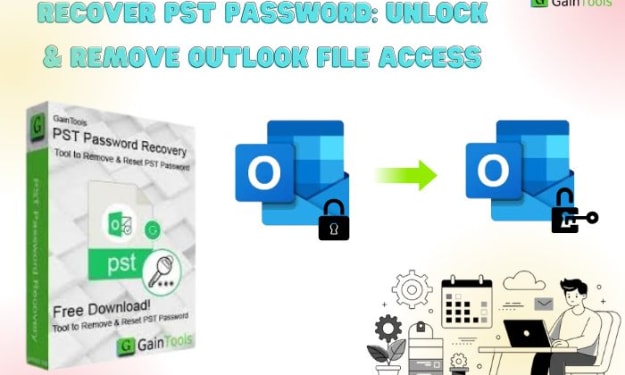
Recover PST Password: Unlock & Remove Outlook File Access
In the event that you are unable to access your calendars, contacts, or emails, you require a speedy method to regain access. It is a relief to know that the password can be recovered or removed by employing either manual procedures or a professional tool. This guide will walk you through both strategies in a straightforward manner. It is an unpleasant experience to be unable to access an Outlook PST file because you have forgotten the password.
By Alexis Matthew2 years ago in Futurism
It Shall Be
First published in Adelaide Literary Magazine, July 2024 (finalist in the 2024 ALM essay awards) In the realm of human relationships, we all partake in some form of denial or ignorance toward the elements of truth and nature. It’s probably no surprise to you that the human ego has a harmful way of suppressing aspects of reality that it doesn’t want to accept, such as losing a family member or taking accountability for something embarrassing.
By Tony Martello2 years ago in Futurism
Wanderlust Dreams: Unforgettable Journeys to Inspire Your Next Trip
Wanderlust Dreams: Unforgettable Journeys to Inspire Your Next Trip Introduction: The Magic of Travel photo from pixels Have you ever caught yourself staring out the window, lost in thoughts of faraway places, breathtaking landscapes, and cultures waiting to be explored? Travel is more than just moving from one place to another—it’s about experiences that shape our souls, broaden our perspectives, and create lifelong memories. Whether it’s the call of the ocean, the charm of historical cities, or the adventure of towering mountains, each destination has something special to offer.
By Angie green2 years ago in Futurism
What Netflix, Spotify, and YouTube Teach Us About Ad-Supported Models.
Is there a world where ads and user experience can coexist? Platforms like Netflix, Spotify, and YouTube have efficiently taken advantage of ad-supported systems to maintain profitability with customer satisfaction in a time where subscription fatigue is increasing on a daily basis. How do they maintain the contentment of marketers and customers simultaneously? The secret to this success resides in planned ad placements, customer control, and customization. Let’s discover what we can learn from these platforms about developing productive, subtle ad-supported instances.
By Strique GCC2 years ago in Futurism
Why Some eCommerce Brands Are Moving Back to Traditional Advertising.
Is online marketing losing its effectiveness? Digital marketing has become the norm for eCommerce companies in recent years. Companies have taken advantage of data-powered findings to attain specifically targeted customers with the help of platforms like Meta, automated advertising channels, and Google Ads. Nevertheless, advertisers are observing an unexpected pattern developing: some online retailers are moving back to conventional marketing tactics like direct mail, print, TV, and radio.
By Strique GCC2 years ago in Futurism
Can Meme Marketing Outperform Paid Ads?
Do you think memes represent the upcoming future of digital marketing? It’s almost impossible to miss them while scrolling through social media. Memes have a weird sense of control over the digital world, whether it’s a viral visual, a smart cultural reference, or simply a trending joke. Memes are responsible for igniting engagement and increasing sharing across numerous platforms. However, can conventional paid ads be replaced by memes? Some companies are investing a lot in meme marketing, utilizing their virality to increase brand awareness and sales too. However, does meme marketing actually perform better than paid advertisements?
By Strique GCC2 years ago in Futurism