future
Exploring the future of science today, while looking back on the achievements from yesterday. Science fiction is science future.
If we lived for 300 years, What would change?
Hmm, if we contemplate it, our fascination with concepts like the Philosopher's Stone, the Fountain of Youth, and even vampires stems from a common desire—to understand what it would be like to possess eternal life. Some researchers argue that there is no limit to our potential lifespan. The proponents of the No Limit Camp believe that as long as we continue making scientific advancements and taking care of ourselves, we could potentially live indefinitely, or at least until our savings run out. On the other hand, the proponents of finite lifespan argue that our bodies have a predetermined expiration date, and while we can make efforts to delay it, there are limits to how far we can push it. A study suggests that the maximum human lifespan may be around 150 years. Researchers analyzed data on the world's oldest individuals over the past few decades and concluded that there is indeed an expiration date for our lives. Overall, this study provides valuable insights into the limitations of human lifespan and can guide future research on the biology of aging and the development of new treatments for age-related diseases. So, let's hypothesize that we can extend our inevitable end as much as possible. What if we lived for 300 years? It would still be a finite lifespan, but significantly longer. Living forever may not be as appealing because we might reach a point of extreme boredom and yearn for a finite life. Living for 300 years would have a profound impact on every aspect of life. Let's start with the concept of aging and how we perceive it. Although youth and old age are subjective, currently, we are considered middle-aged around 50 years old. If our lifespan tripled, we might still be seen as teenagers at 50 since we would have more than two centuries left to live. It would be like every minute suddenly becoming three minutes long. We often consider reaching the age of 30 as a milestone, feeling that one-third of our life is over. With a longer lifespan, we wouldn't experience this feeling until we reached 100. The critical question is whether our biological and emotional capacities would remain the same. Normally, our adolescent brain continues to develop and doesn't reach full maturity until around 25 to 30 years of age. In this scenario, that notion would likely remain the same, but we would probably spend a more extended period in education, learning a vast array of new subjects. Perhaps we would even have time to learn new languages, explore organ replacement, and attend AI lectures. The education system and curriculum would undoubtedly undergo significant changes, providing more time for reading, learning, and exploring various fields of knowledge. After obtaining a diploma or choosing not to pursue higher education, we might dedicate our time to mastering skills such as carpentry. Of course, earning money would still be necessary, so finding a job would remain a familiar concept. However, with a longer lifespan, we would likely have more options to choose from, and retirement might not be necessary until much later in life. This would grant us extra time to explore different careers, pursue our goals, take risks, and develop our professional lives. Now, let's consider relationships. In a longer life, the dynamics of relationships would undoubtedly change. Concepts like situationships and open relationships might become more prevalent. The age at which people get married and decide to start a family would shift, and family structures and rules would adapt to accommodate these extended lifespans. It's even possible that people could become grandparents at the age of 230, creating an entirely unique experience. With more time available, we would have the opportunity to deepen our bonds and develop lasting relationships. Imagine having centuries to spend with your best friend, allowing us to truly get to know each other and explore shared interests. However, it's not just our personal experiences that would be affected. The world's resources
By James Michael 3 years ago in Futurism
How artificial intelligence can help us prepare for climate adaptation
Despite climate mitigation efforts to keep global warming below 1.5°C, many experts expect the world to warm by 3.5°C by the turn of the next century. This ever-warming world has brought floods and wildfires and the loss of life with more disruption expected in the decades to come.
By nizam uddin3 years ago in Futurism
How artificial intelligence is helping us decode animal languages
For years, artificial intelligence (AI) and machine learning has been used to analyze and translate human languages. This field of research has helped expand human communication channels as well as led to new language-based technologies like advanced chatbots and voice command smart devices.
By nizam uddin3 years ago in Futurism
What is artificial intelligence—and what is it not?
Broadly speaking, artificial intelligence (AI) is a field of study and type of technology characterised by the development and use of machines that are capable of performing tasks that usually would have required human intelligence.
By nizam uddin3 years ago in Futurism
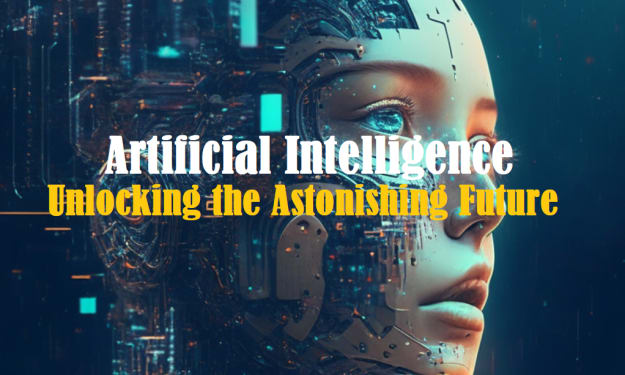
Artificial Intelligence: Unlocking the Astonishing Future
In the not-so-distant future, a remarkable technological phenomenon is set to transform our world in ways we could scarcely imagine: Artificial Intelligence (AI). As we navigate the frontiers of scientific discovery, AI emerges as the guiding force that will reshape industries, societies, and even the very essence of what it means to be human. Brace yourself for a riveting glimpse into the breathtaking future where machines transcend limitations and become our indispensable partners in progress.
By JUNIOR THATO3 years ago in Futurism
The Evolution of AI Art Generators: Redefining Creativity and Empowering Artists
Introduction In the ever-evolving world of art, a new revolution is taking place. The rise of AI Art Generators has paved the way for a paradigm shift in creativity, reshaping the art landscape and empowering artists like never before. In this article, we will explore the fascinating journey of AI Art Generators, their significance in the art world, and the impact they have on artists and the creative process.
By Topic Blend3 years ago in Futurism
The Impact of Robotics in Surgery: Analyzing the Benefits and Drawbacks of Surgical Robots in Healthcare
Introduction: Surgical procedures have come a long way since the days of manual operations. With advancements in technology, surgical robots have become increasingly popular in the healthcare industry. These robots are designed to assist surgeons in performing complex procedures with greater precision and accuracy, leading to reduced recovery times and improved outcomes for patients. However, as with any new technology, there are potential drawbacks to consider. In this blog, we will analyze the use of surgical robots in healthcare, their benefits, and potential drawbacks.
By GelStories3 years ago in Futurism
Artificial intelligence creates the “perfect” male and female body according to social media data
For men, the ideal woman is blonde and for them, the perfect guys must be tall, dark and muscular. At least these are the main characteristics for the artificial intelligence of a perfect man and woman based on data and social behaviors obtained through information on social networks, such as comments on profiles of people with these certain characteristics that are very related to culture and influence from each country.
By Dani Ferraz3 years ago in Futurism
As AI develops rapidly, what is the future ethical cost?
The concerns surrounding AI include it amplifying potentially harmful biases and stereotypes, says a technology ethics expert. She says that 'ethical debt' can develop if we fail to consider the possible negative consequences or societal harms of AI. The only way to decrease ethical debt is to take the time to think ahead about things that might go wrong – but this is not something that technologists are necessarily taught to do, she adds.
By nizam uddin3 years ago in Futurism