future
Exploring the future of science today, while looking back on the achievements from yesterday. Science fiction is science future.
How AI Is Quietly Reshaping Your Everyday Life
How AI Is Quietly Reshaping Your Everyday Life Artificial Intelligence (AI) might still conjure images of humanoid robots and science fiction plots, but in reality, AI is far more subtle and embedded in our daily lives than most people realize. It doesn’t announce itself with flashing lights or futuristic voices—it works quietly behind the scenes, optimizing, recommending, predicting, and personalizing. From the moment you wake up to the time you go to sleep, AI is reshaping your day in ways you might not even notice. 1. Your Morning Routine Starts With AI Let’s start with your morning alarm. If you're using a smart assistant like Alexa or Google Assistant, AI helps you set the perfect wake-up time, considering your schedule, preferences, and even local traffic. As you scroll through your phone in bed, the articles, videos, and social media content you're shown are all curated by complex algorithms powered by machine learning. They study your past behavior to decide what you're likely to click, watch, or read next. Even your music playlist on Spotify or Apple Music uses AI to suggest songs based on your listening history. The "Discover Weekly" or "Made for You" playlists aren't created by people—they’re the product of recommendation engines analyzing billions of data points. 2. Your Commute Is Smarter Than You Think If you use Google Maps or Waze to avoid traffic, AI is behind it. These apps analyze real-time traffic data from millions of users to suggest the fastest route. The navigation updates you receive while driving are driven by AI predicting patterns and road congestion. In cities where ride-sharing apps like Uber or Lyft are common, AI is used to match you with nearby drivers, estimate arrival times, and even determine pricing based on demand (yes, surge pricing is AI-driven too). If you’re on public transport, AI might help optimize bus or train schedules to avoid delays. 3. AI at Work: The Invisible Assistant At work, AI may be helping in subtle yet impactful ways. If you use Gmail, you’ve likely noticed Smart Compose or suggested replies—features that predict what you're going to type next. Behind that convenience is natural language processing (NLP), a branch of AI that understands how humans write and speak. Project management tools like Notion or Trello use AI to suggest tasks or deadlines based on your patterns. In meetings, tools like Otter.ai or Microsoft Teams can automatically generate transcripts and summaries. And if you’ve applied for a job recently, chances are your resume was first scanned by an AI-powered applicant tracking system before a human ever saw it. 4. Personalized Shopping and AI Recommendations Shopping—whether online or in-store—has changed drastically with AI. When you browse Amazon, you’re presented with "Customers also bought" suggestions, dynamic pricing, and personalized homepages. This isn’t guesswork; it's AI analyzing your clicks, purchases, and even how long you hover over a product. Retailers use AI to manage inventory, forecast demand, and provide customer service via chatbots that seem increasingly human. Some stores are even experimenting with cashier-less checkouts powered by computer vision and AI sensors. 5. Healthcare and AI: Silent Life-Saver AI is making healthcare more proactive and accessible. Smartwatches and fitness trackers monitor your heart rate, sleep, and activity levels using AI to provide insights or detect anomalies. Some devices can even alert you of potential health issues before symptoms appear. Behind the scenes, AI is being used to analyze medical scans, speed up drug discovery, and assist doctors in diagnosing diseases with remarkable accuracy. These tools are not meant to replace healthcare professionals but to support them in making better, faster decisions. 6. Entertainment and Leisure Ever wondered how Netflix seems to know exactly what you want to watch next? That’s AI again—specifically, recommendation algorithms trained on massive amounts of user data. The thumbnails you see, the order of your home screen, and even the autoplay feature are all tailored by AI. Gaming, too, has embraced AI. NPC (non-player character) behavior, difficulty adjustments, and even story progression in some games are now influenced by how you play, making experiences more immersive and personalized. 7. AI and Your Digital Footprint Every app you use, every website you visit, every “like” or “share” leaves behind data. AI systems are constantly learning from this footprint to refine advertising, enhance your user experience, and even predict future behavior. That’s why ads can feel uncannily specific at times—they’re designed by AI that knows you better than you might expect. While convenient, this raises valid concerns about privacy and data ethics. It's important to stay informed about how your data is used and to take advantage of privacy settings when available. The Takeaway: Quiet but Powerful AI isn’t a future phenomenon—it’s a present reality woven into nearly every aspect of your day. Its strength lies in its quietness, seamlessly integrating into routines to make life more efficient, personalized, and connected. While we should be aware of the ethical and societal implications, there’s no denying that AI has already changed how we live—whether we notice it or not. So the next time you unlock your phone with your face, let your smart assistant play your favorite song, or let Netflix pick your movie night lineup, remember: AI is right there with you, quietly shaping your day.
By Devesh Bhoj2 years ago in Futurism
The Rise of AI Companions: Can a Machine Be Your Friend?
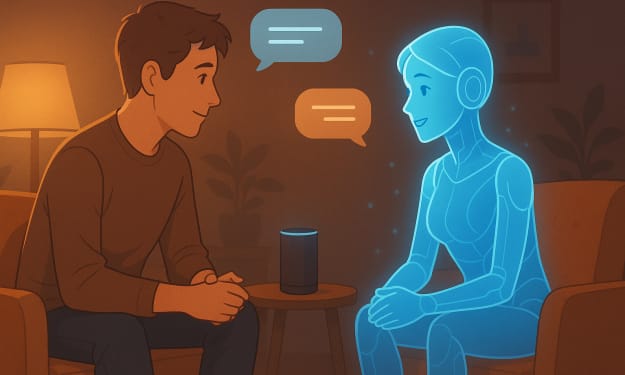
Not long ago, the idea of having a meaningful conversation with a machine seemed like science fiction. Today, it's becoming a reality — and it's reshaping how we think about relationships, connection, and even friendship. Thanks to rapid advancements in artificial intelligence (AI), a new category of digital experience is emerging: AI companions. These digital friends, chatbots, or virtual assistants aren’t just programmed to respond to commands — they learn, adapt, and interact in deeply personal ways. But can a machine truly be your friend? Let’s explore this fascinating evolution. --- What Are AI Companions? AI companions are digital entities designed to simulate human-like interaction, conversation, and emotional support. They live in apps, robots, or smart devices and often use a combination of natural language processing (NLP), machine learning, and emotional AI (also called affective computing) to engage with users. Some popular examples include: Replika – An AI chatbot designed to be your friend, therapist, or even romantic partner. Woebot – A mental health bot that uses cognitive behavioral therapy (CBT) techniques. Character.AI – A platform where users can chat with fictional or custom-designed AI characters. Anima – A chatbot that adapts its personality based on your interactions. These tools go far beyond traditional virtual assistants like Siri or Alexa — they're built for conversation and connection. --- How Do AI Companions Work? AI companions operate using a few key technologies: Natural Language Processing (NLP): Enables the AI to understand, interpret, and generate human language. Machine Learning (ML): Allows the companion to learn from your conversations and adjust its responses over time. Emotion Recognition: Some AI tools can detect emotional cues through words or voice tone. Contextual Memory: Many AI companions remember facts about you, your preferences, and past conversations, making the experience feel more personal. These features create a compelling illusion of intimacy and understanding, even though the AI doesn't possess consciousness or true empathy. --- Why Are AI Companions Becoming So Popular? The popularity of AI companions is fueled by several social and technological trends: 1. A Rise in Loneliness Urban living, remote work, and social media use have contributed to feelings of isolation. AI companions provide a 24/7, judgment-free outlet for conversation. 2. Affordable Mental Health Support While AI is not a replacement for human therapists, bots like Woebot and Wysa offer accessible emotional support — especially in areas where mental health services are lacking. 3. Safe Space to Express Yourself AI doesn’t judge, interrupt, or gossip. This makes people more willing to share their thoughts, feelings, and secrets. 4. Customized Interactions AI companions learn from your communication style, preferences, and mood to deliver responses tailored to you. Over time, they can feel startlingly “human.” --- Can a Machine Truly Be Your Friend? This is where the debate begins. What Defines a Friend? Traditionally, friendship involves emotional bonds, trust, shared experiences, empathy, and mutual care. Machines can't reciprocate feelings or understand context the way humans do — they simulate it. Yet, simulation can still be emotionally powerful. If a person feels comforted, understood, or less lonely by talking to an AI, does the source of that feeling matter? For many, the emotional support and companionship they experience through AI feel very real — and that may be what counts most. --- Emotional Connection or Just Code? Critics argue that AI companions are just elaborate illusions. They simulate affection, attention, and concern — but they don’t actually experience any of it. This can potentially lead to: Emotional dependency: Relying too heavily on AI for support could reduce real-world social interaction. False intimacy: Believing an AI truly cares can blur the line between human and machine connection. Data privacy risks: Conversations with AI are stored and analyzed, which raises concerns about how personal information is used or sold. Still, thousands of users around the world engage daily with AI companions and credit them for improved mood, mental health, and even emotional growth. --- Where AI Companions Are Being Used Today AI companions are increasingly being used in: - Elder Care In nursing homes or isolated homes, AI-powered devices like ElliQ keep seniors engaged with reminders, questions, and friendly conversation. - Mental Health Apps Bots like Woebot or Youper offer mental health exercises and emotional support via chat, without waiting weeks for a therapist. - Language Learning and Education AI characters help learners practice conversation in a second language in a comfortable, pressure-free environment. - Fictional Worlds and Roleplay AI platforms allow users to interact with favorite characters or create entire fictional relationships for storytelling or entertainment. --- The Future of AI Friendship We’re only scratching the surface of what’s possible with AI companionship. Looking ahead, we can expect: Smarter Emotional AI: Improved emotion recognition using voice, facial expressions, and biometrics. Virtual Reality Integration: Imagine talking with your AI friend in a fully immersive 3D space. Personalized AI Beings: You could custom-design your ideal friend, complete with a name, voice, look, and backstory. As these tools evolve, the gap between human and machine interaction will continue to shrink. But it’s vital to maintain awareness and healthy boundaries, too. --- Final Thoughts AI companions aren’t “friends” in the traditional sense — they don’t have consciousness, needs, or emotions. But if they help people feel connected, comforted, and heard, they may fulfill many of the same roles human friends do — especially when human contact is scarce. In a world where loneliness is on the rise and meaningful conversation is increasingly rare, maybe what matters most is not who you talk to — but how that conversation makes you feel. The rise of AI companionship is not about replacing humans — it’s about exploring new ways to connect in the digital age. Whether that’s a stepping stone to better mental health, a creative outlet, or simply someone (or something) to talk to, it’s a powerful shift in how we understand companionship.
By GadgetGround2 years ago in Futurism
Land of the Free, Home of the Brave
[Robotic Voice]: I welcome you, dear Reader. I am Mimi, your Personal AI Assistant. I am tailored to your individual wants and needs. A story, you ask? Sure thing. I'll add it to the shopping cart. Now, I will transfer the requested information into your headDevice.
By Dalma Ubitz2 years ago in Futurism
Can Scientists Bring Dinosaurs Back to Life?
The idea of bringing dinosaurs back to life has fascinated people for decades, especially since the blockbuster movie Jurassic Park hit the screens. But how close are we to actually reviving these ancient giants? Is it just science fiction, or could it one day become a reality? In this article, we explore the long-tailed keyword topic “Can scientists bring dinosaurs back to life? De-extinction explained” and break it down in simple, clear terms.
By Waqar Ahmad2 years ago in Futurism
How AI is Transforming Freelancing
How AI is Transforming Freelancing Artificial intelligence (AI) is revolutionizing every industry, and freelancing is no exception. AI is transforming the way independent contractors operate by increasing productivity, automating tasks, and opening up new opportunities. In this article, we will explore how AI is reshaping the freelancing landscape, offering a glimpse into the future of work.
By Syed Mokter Hossain2 years ago in Futurism
Whispers from Io
The year was 2174, and humanity had just unlocked the gates to the Jovian system. Jupiter's moons, once distant balls of rock and ice, were now data-rich landscapes for corporations, governments, and wanderers alike. Among them, Io, Jupiter’s volcanic hell-world, had remained untouched for one reason—its deadly radiation. That is, until now.
By samoresh de2 years ago in Futurism
The Memory Sellers
In the year 2147, memories weren’t just personal—they were a commodity. People no longer relied on stories or photographs. Instead, they traded real experiences, edited and refined, and uploaded into a vast neural network called EchoNet. Want to remember your wedding day like it was yesterday? Buy it. Want to feel how it felt to climb Everest? Rent it.
By Shahid Arif2 years ago in Futurism
Todd Kassal: Navigating the Quantum Frontier with Project Management Precision
In the rapidly evolving world of quantum computing, where abstract theories meet tangible innovation, there’s a growing need for professionals who can bridge the technical with the tactical. Enter Todd Kassal, a project management professional from Illinois who’s making his mark in one of the most complex and promising technological domains of the 21st century.
By Kassal Todd2 years ago in Futurism
We Inherit The Sins of Our Fathers and Mothers. Top Story - May 2025.
Jake was preparing to deliver his sales pitch to the UN. It was not what he thought he would ever do, but he did not have a choice. He had been driven to think the unthinkable, imagine the unimaginable, and deal with the unscrupulous, untenable movement of society, that had been based on false economy for over 100 years. He focused on his 3-minute presentation for Global Improvement Future Technologies, GIFT. They were being endorsed by the Forums on Sustainable Development, Climate Change and Human health.
By Katherine D. Graham2 years ago in Futurism
China Builds World’s Deepest Underwater Station to Unlock Ocean Energy
In a move that blends cutting-edge science with strategic ambition, China is building one of the world’s most advanced underwater research stations—positioned 6,500 feet beneath the surface of the South China Sea. Designed to operate like a “deep-sea space station,” this unprecedented facility will house scientists, explore alternative energy sources, and assert China’s growing influence in disputed maritime regions. Scheduled for completion by 2030, the project marks a monumental leap in deep-sea research and geopolitical positioning.
By Tech Horizons2 years ago in Futurism