feature
Featured articles from Futurism highlighting today's trending content.
Better Prompts, Smarter Outputs: How to Talk to ChatGPT
ChatGPT isn’t a mind reader, it’s a pattern completer. It doesn’t know what you meant; it only knows what you said. To get smarter outputs, you need smarter inputs. That means treating prompts not as casual questions but as carefully constructed instructions. Think of it as programming with words. The better you articulate your intent, the better ChatGPT can fulfill it.
By Beyond The Surfaceabout a year ago in Futurism
Learn Japanese Grammar: A Complete Guide for Mastering the Foundation of the Language. AI-Generated.
Grammar is the backbone of any language. It gives structure to your words, meaning to your sentences, and confidence to your conversations. When it comes to Japanese, grammar works quite differently from English — but don’t let that intimidate you. In fact, once you understand the basics, Japanese grammar is logical, consistent, and even elegant.
By William Wallaceabout a year ago in Futurism
The Changing World Order. AI-Generated.
The concept of a "world order" refers to the political, economic, and military balance of power among nations. For centuries, global influence has shifted from one dominant power to another, often shaped by war, diplomacy, technological advancement, and ideological shifts. Today, we are witnessing another transformation as emerging powers challenge traditional hierarchies, alliances realign, and global institutions adapt to new realities. This transformation is not just about power politics but also about new values, new threats, and a new understanding of global interdependence.
By Zain Ul Abidin Khanabout a year ago in Futurism
Tesla vs. BYD
In the high-voltage world of electric vehicles (EVs), two titans are currently sparring for global dominance: Tesla and BYD (Build Your Dreams). On one side is Elon Musk’s iconic brand, a pioneer that revolutionized the EV landscape with sleek, tech-savvy cars and futuristic visions. On the other is BYD, the Chinese powerhouse backed by Warren Buffett, carving out a massive slice of the market with affordability, innovation, and scale. This isn’t just a corporate competition—it's a clash of philosophies, strategies, and ambitions.
By Det. Marcusabout a year ago in Futurism
The Algorithm’s Muse
The Human Song in AI’s Symphony Artificial Intelligence (AI) often feels like a creation of pure logic, a symphony of code played by machines. But beneath its digital surface lies a deeply human melody—a chorus of dreamers, tinkerers, artists, and guardians who compose its notes. AI is not a solitary force; it’s a collaboration between human creativity and computational power, a dance of imagination and innovation. This article tells a new story of AI, one that celebrates the human spirit driving its evolution. From its origins to its future, AI pulses with the creativity, passion, and responsibility of the people who shape it, making it a reflection of our collective soul.
By Shohel Ranaabout a year ago in Futurism
AI’s Human Pulse
The Heartbeat of AI Artificial Intelligence (AI) often seems like a force from the future, a technology that operates in a realm beyond human touch. Yet, at its core, AI is a deeply human creation, born from our curiosity, shaped by our creativity, and guided ដោយ our conscience. From the visionaries who first imagined thinking machines to the artists, engineers, and ethicists who refine them today, AI is a tapestry woven with human stories. This article explores the human pulse of AI—how it’s crafted, how it inspires, and how it challenges us to be better. Far from being a detached system, AI is a reflection of our dreams and responsibilities, a mirror of humanity itself.
By Shohel Ranaabout a year ago in Futurism
How AI Avatars Are Redefining Personal Branding in 2025
My Awkward Zoom Call and the Avatar Epiphany Last month, I totally tanked a Zoom pitch. My Wi-Fi was glitching, my cat decided to star in the background, and my “professional” energy screamed “panicked freelancer who forgot to brush their hair.” I wished I could’ve sent a suave, unflappable version of myself—one that doesn’t stutter or sweat buckets. That’s where AI avatars come in, the 2025 game-changer that’s got everyone from LinkedIn hustlers to TikTok creators rethinking how they show up online. These hyper-realistic digital twins, powered by some serious AI magic, can talk, smile, and sell your brand 24/7, no coffee spills or bad hair days needed. A 2025 Newsweek article called AI the “architect of our online personas,” and I’m sold—but also a bit weirded out. Are we crafting epic brands or creepy clones? I dove into the top AI avatar trends, from platforms like HeyGen to the ethical quicksand, to figure out how they’re reshaping who we are online. Spoiler: it’s wild, it’s weird, and it’s not all sunshine. Here’s the scoop, with hacks to make avatars work for you—without selling your soul.
By F. M. Rayaanabout a year ago in Futurism
The Council of Nine: Guardians of the Earth Experiment Part 3
The Council of Nine: Guardians of the Earth Experiment Atlantis, ancient DNA codes, and the awakening of forgotten power within us Let me ask you something: What if Earth was never just a random planet?
By The Secret History Of The Worldabout a year ago in Futurism
Gemini 2.5’s Deep Think Mode: Can Google’s AI Outsmart Humans Now?
A Brainier AI Steps Up Ever flunk a math test so bad you wanted to hide under your desk? Yeah, me too. Now imagine an AI that could not only ace that test but explain why you bombed it, then whip up a study guide faster than you can say “calculus is evil.” That’s the vibe with Google’s Gemini 2.5 Pro, especially its new Deep Think mode, unveiled at Google I/O 2025. This isn’t your average chatbot spitting out quick answers. It’s like a nerdy Sherlock on steroids, pausing to ponder multiple solutions before dropping a response that’s scarily spot-on. But can it really outsmart humans? Or is this just Google hyping up another tech toy? Let’s dig into what Deep Think does, how it’s flexing its brain, and whether it’s ready to dunk on our puny human minds—or if it’s got some growing pains.
By F. M. Rayaanabout a year ago in Futurism
The Death of Search as We Know It: How AI Mode Is Rewriting the Rules
Goodbye, Blue Links—Hello, AI Brain Remember the days of typing “best pizza near me” into Google and scrolling through a dozen blue links, hoping one wasn’t a dud? Yeah, those days are on life support. Google’s AI Mode, rolled out to all U.S. users in May 2025, is flipping search upside down, turning it from a list of links into a chatty, mind-reading assistant that knows you. It’s like swapping a library card catalog for a psychic librarian who’s read your diary. Unveiled at Google I/O 2025, AI Mode uses Gemini 2.5 to deliver conversational answers, personalized results, and deep-dive reports, all while pulling from your Gmail, Calendar, and past searches. But is this the future we want? Or are we trading convenience for privacy and a fractured web? Let’s unpack how AI Mode is rewriting search’s rules—and what it means for society, from our daily habits to the businesses fighting to be seen.
By F. M. Rayaanabout a year ago in Futurism
Can We Find Life on Alien Planets?
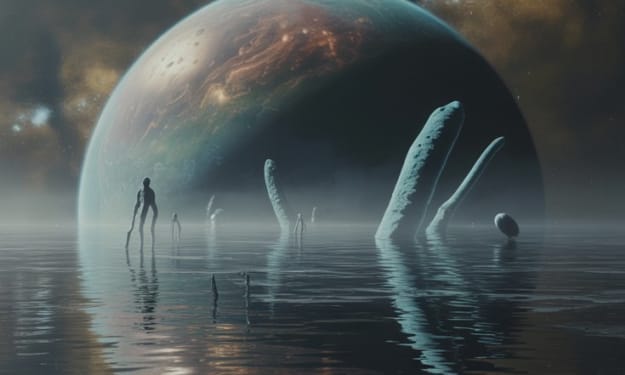
Can We Find Life on Alien Planets? The James Webb Telescope's Groundbreaking Discoveries The quest to answer one of humanity's most profound questions—Are we alone in the universe?—has taken a significant leap forward. Thanks to the James Webb Space Telescope (JWST), scientists are now uncovering tantalizing clues that suggest life may exist beyond Earth. Among the most promising leads is the exoplanet K2-18 b, located approximately 120 light-years away in the constellation Leo. The Hycean World: A New Frontier K2-18 b is classified as a "Hycean" planet—a term coined to describe exoplanets that possess a hydrogen-rich atmosphere and a global ocean beneath. These planets are considered prime candidates in the search for extraterrestrial life due to their size and atmospheric conditions, which are more conducive to detailed study compared to smaller, rocky planets. Recent observations by JWST have revealed the presence of carbon dioxide and methane in K2-18 b's atmosphere, indicating a complex chemical environment. More intriguingly, scientists have detected traces of dimethyl sulfide (DMS), a compound on Earth primarily produced by marine phytoplankton and certain bacteria. The detection of DMS at levels thousands of times higher than found on Earth has led researchers to hypothesize that biological processes may be at play on K2-18 b . What Does This Mean for the Search for Life? The identification of DMS is particularly compelling because, on Earth, it is predominantly associated with life. While other non-biological processes can produce DMS, the concentrations observed on K2-18 b are unprecedented and suggest the possibility of biological activity. However, scientists caution that these findings are preliminary and require further observation to confirm the presence of life . Beyond K2-18 b, JWST has also made significant contributions to our understanding of other exoplanets. For instance, the telescope has detected frozen water in the debris disk around HD 181327, a young, sunlike star located 155 light-years away. This discovery suggests that icy bodies, which could deliver water to forming planets, are common in the universe and may play a crucial role in the development of habitable environments . The Broader Implications These discoveries underscore the potential of JWST to transform our understanding of the cosmos. By analyzing the atmospheres of exoplanets with unprecedented detail, JWST is providing insights into the conditions that might support life elsewhere. While the detection of DMS on K2-18 b is not definitive proof of life, it represents a significant step toward answering the age-old question of whether we are alone in the universe. The Discovery That Changed Everything
By Shah saab ITabout a year ago in Futurism