fact or fiction
Is it science fact or science fiction? Futurism presents both sides to determine the truth.
Apple AirPods Pro 2 Review: The Future of Wireless Earbuds with Hearing Aid Features
The Apple AirPods Pro 2 aren’t just another pair of wireless earbuds—they represent the next step in Apple’s mission to merge high-end audio with cutting-edge health and accessibility technology. With Active Noise Cancellation (ANC), Personalized Spatial Audio, and an innovative Hearing Aid feature, these earbuds are redefining what true wireless headphones can do.
By NextGen Mobile Techabout a year ago in Futurism
Genetic traits add substance to case for 'engineered' humans
The education system when I was in secondary school necessitated a compromise when selecting O-level subjects which meant I opted to miss out on biology despite wanting to choose it. I had no desire to study French but was “advised” to do so by everyone I consulted, including the parents, who didn’t share my enthusiasm for the only viable alternative: tech drawing. Had it been an option it would certainly have been biology... but the way the subjects were grouped ruled out that possibility.
By Steve Harrisonabout a year ago in Futurism
A World Without America: Imagining the Global Impact
A World Without America: Imagining the Global Impact** The United States of America has long held a prominent role on the world stage. As a global superpower, its influence extends across politics, economics, science, culture, and military affairs. But what would the world look like without America? This hypothetical scenario, though extreme, invites us to explore the positive and negative consequences of a world where the United States does not exist—either historically or in the present. --- Economic Impacts** **Negative Aspects:** Without the United States, the global economy would look drastically different. As the largest economy in the world for much of the 20th and 21st centuries, America's financial systems, such as Wall Street and the U.S. dollar as the world’s reserve currency, have played a stabilizing role in international trade. Many countries rely heavily on the U.S. market for exports, investments, and aid. A world without America would likely experience greater economic instability and slower technological progress due to the absence of American innovations and investments. The absence of major U.S. companies like Apple, Microsoft, Google, and Amazon would significantly alter the global business landscape. The tech industry, in particular, might have developed differently or more slowly without American leadership. Moreover, many countries that benefit from U.S. foreign aid or disaster relief would face greater challenges in crises. **Positive Aspects:** On the other hand, a world without America could lead to a more balanced distribution of economic power. Emerging markets and other developed nations might have had more room to grow without U.S. dominance. The European Union, China, and regional powers could have played more central roles earlier in history, potentially creating a more multipolar economic structure. Additionally, some critics argue that U.S. economic policies have, at times, contributed to global inequality or environmental degradation. In its absence, perhaps global systems would have evolved in a way that prioritized sustainability or social equity more effectively. --- Political and Military Dynamics** **Negative Aspects:** The United States has often acted as a global police force, intervening in international conflicts and providing military support to allies. While this role has been controversial, it has also prevented or ended conflicts, stabilized regions, and deterred authoritarian regimes. A world without America could have seen more unchecked aggression from expansionist powers like Nazi Germany, the Soviet Union, or even modern-day regimes with imperial ambitions. The post-World War II global order, including institutions like the United Nations, NATO, and the World Bank, were all heavily influenced or initiated by the U.S. Without it, these institutions might not exist in their current form—or at all. This could result in weaker international cooperation and less coordinated responses to global crises. **Positive Aspects:** Conversely, some would argue that American military interventions have often led to long-term instability, civilian casualties, or unintended consequences, such as in Iraq, Vietnam, or Afghanistan. Without U.S. involvement in these conflicts, some regions might have found more local, diplomatic solutions to their issues, or avoided certain wars altogether. Furthermore, without the U.S. as a dominant superpower, other nations might have taken on more responsibility for global leadership, possibly leading to more diverse and cooperative forms of governance. --- Scientific and Technological Development** **Negative Aspects:** The U.S. has been a hub for innovation, especially in fields like medicine, aerospace, and information technology. NASA's contributions to space exploration, American universities’ role in academic research, and Silicon Valley's impact on digital technology have all shaped the modern world. Without these, progress in science and technology could have been delayed by decades. In addition, the internet—largely developed and popularized in the U.S.—has become a backbone of modern communication, education, and commerce. Without American leadership in tech, global access to information and digital tools might be less widespread or more fragmented. **Positive Aspects:** However, in a world without America, other nations may have risen to fill the innovation gap. Countries like Germany, Japan, the UK, or even China could have led the way in scientific discovery and technological advancement. This might have resulted in different approaches to technology, perhaps more localized or culturally tailored. --- Cultural Influence** **Negative Aspects:** American culture—through music, movies, fashion, and fast food—has become nearly universal. Hollywood, for example, has played a key role in shaping global entertainment. In a world without America, this cultural cohesion might not exist. People around the world may not share the same cultural references or global icons, leading to a more fragmented global culture. Also, many social movements that gained momentum in the U.S., such as civil rights, LGBTQ+ advocacy, and feminist waves, have inspired change worldwide. Their absence might have slowed progress in human rights and social equality. **Positive Aspects:** On the other hand, some critics view American cultural dominance as a form of cultural imperialism that overshadows local traditions and values. Without it, local cultures might have flourished more freely. Languages, cuisines, art forms, and indigenous traditions might have received more attention and preservation without the overwhelming influence of American pop culture. --- Environmental Consequences** **Negative Aspects:** The U.S. is one of the world’s largest carbon emitters and has been criticized for withdrawing from global climate agreements and prioritizing economic growth over environmental concerns. Its absence might reduce global carbon emissions. **Positive Aspects:** But it’s also true that many environmental innovations—from renewable energy technologies to conservation programs—have roots in the U.S. Without these, the fight against climate change might have fewer tools and resources. Moreover, U.S. scientific institutions have played major roles in researching and communicating environmental risks. ---
By America today about a year ago in Futurism
The Universe's Secret Algorithms: 5 Natural Secrets You Didn't Realize Were Code!
The Hidden Programming of the Universe: 5 Natural Secrets You Didn't Realize Were "Source Code" (A Guide for the Curious) Have you ever looked at a beehive or a snowflake and asked: How did this happen so perfectly? You're not alone. For centuries, scientists have thought of nature as a beautiful mess, but the shocking truth is that the universe is far from random. It's built on algorithms no less complex than the most complex code ever written by humans.
By PositivePulseabout a year ago in Futurism
Understanding the Natal Chart:
Introduction Astrology has served as a roadmap for individuals seeking to understand their personalities, life paths, and spiritual journeys for millennia. A natal chart, also known as a birth chart, is a unique cosmic blueprint created at the moment of an individual's birth. It reflects the positions of celestial bodies and their influences on various aspects of life. By examining one's natal chart, individuals can gain insight into their soul journeys and their connections to the Akashic Records—a metaphysical repository of all human experiences, thoughts, and deeds. This essay will explore the components of a natal chart, how it relates to our soul journeys, and its connection to the Akashic Records.
By Julie O'Hara - Author, Poet and Spiritual Warriorabout a year ago in Futurism
ATLAS_OUT.RUN. Content Warning.
So this thing about Atlas has been bugging the shit out of me all day. You know the one, right? Big dude, wrong side of a divine war, gets the worst job in history: holding up the whole damn sky. It’s the story they tell you to keep you in line. The ultimate "fuck around and find out."
By Maxim Dudkoabout a year ago in Futurism
3 ChatGPT Prompts That Will Make You Rich in a Month
It started on an ordinary evening. Arman sat in a corner of a small coffee shop, staring at the froth of his cappuccino. His shoulders sagged under invisible weight—the kind of weight that comes from bills piling up, dreams shrinking, and the haunting fear that maybe life was always meant to be a cycle of work, stress, and sleep.
By noor ul aminabout a year ago in Futurism
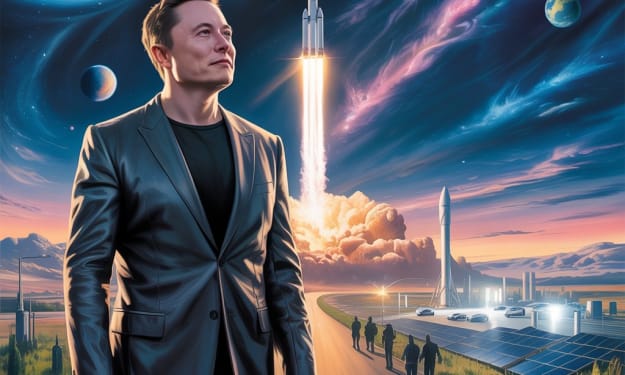
Few Minutes with Elon Musk
In life, one of the most powerful truths to remember is this: never show fear when you are among people. Fear makes others see you as smaller than you are. Courage, even if quiet and calm, commands respect. When you hold yourself with confidence, people are more likely to treat you as an equal, no matter their status.
By Life Hopesabout a year ago in Futurism
Hey, Want to Learn Python? Let’s Talk About What NOT to Do
So you’re thinking about learning Python? That’s awesome! I remember when I first started — Python seemed like this magical language that could do everything. And honestly, it kind of is. You can build websites, analyze data, create AI stuff, automate boring tasks… the list goes on.
By noor ul aminabout a year ago in Futurism