extraterrestrial
Speculation, theory, UFOs and Aliens. Are we alone in this universe or is there life outside Earth?
Why is NASA Worried About BETELGEUSE Explosion_
Nasa Look carefully at the images of Red Super Zain Beetlejuice, the closest to Earth. These three images were taken at intervals of just a few months. The first of these images is from November 2019, the second is from November to December 2019 and the third is after about April 2020. Here you can clearly see that unlike other stars which take thousands of years, Beetlejuice dims and explodes. star very fast ovum right, ovum right so unstable
By SANJOY DAS3 years ago in Futurism
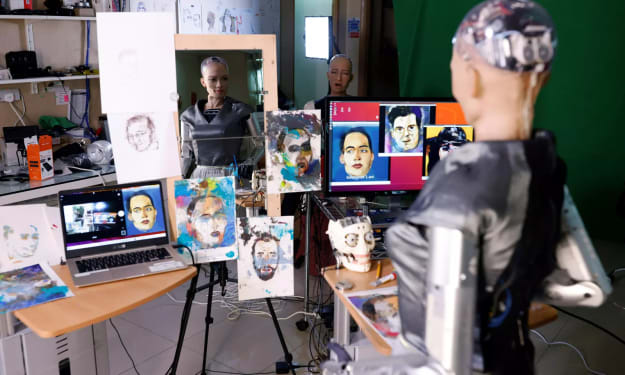
10 surprising things that rely on artificial intelligence
Artificial intelligence (AI) has transformed many aspects of our lives for the better. It even played a role in developing vaccines against COVID-19. But you may be surprised just how many things we take for granted that rely on AI.
By nizam uddin3 years ago in Futurism
TIMELESS....is there really a beginning.
The beginning... or was it "TIMELESS"? In the vast expanse of existence, where time weaves its intricate tapestry, lies a profound enigma. It is a question that has haunted philosophers, scientists, and dreamers alike since the dawn of consciousness: What truly marks the beginning? Is it a singular point in time, a definitive event that sparked the grand symphony of the cosmos? Or is it an eternal presence, forever entwined with the fabric of reality? As we embark on a journey of introspection, let us explore the depths of this timeless mystery. Perhaps, just perhaps, the answer lies not in a linear narrative but in the intricate dance of perception and perspective. Imagine, for a moment, the cosmos unfurling its majestic cloak. Stars ignite like celestial fireflies, galaxies collide in an awe-inspiring ballet, and nebulae birth new worlds. Yet, in this grand spectacle, where does the genesis truly lie? Was it within the primordial explosion that birthed the universe, or did time transcend its own boundaries, tracing back to an existence before existence? In the realm of human consciousness, the notion of a beginning often takes shape as a defining moment—a catalyst that propels us forward into the realm of existence. It is the first breath we draw, the moment our hearts beat with purpose, and the instant our souls awaken to the wonders of the world. Yet, even in our most profound experiences, can we truly pinpoint the origin of our being? Perhaps the concept of time itself is an illusion—a construct that our finite minds impose upon the infinite. If time exists beyond the confines of our perception, then the notion of a beginning becomes but a mirage in the vast desert of existence. It becomes an enigma, forever shifting and morphing as we explore the depths of our own consciousness. Consider the whispers of ancient wisdom, passed down through the ages like fragments of forgotten dreams. They speak of cycles and epochs, of civilizations rising and falling, only to be reborn in the infinite tapestry of time. Could it be that the notion of a beginning is merely an illusion, a figment of our limited perception? Yet, within the confines of this timeless mystery lies an extraordinary opportunity for introspection. For it is in the spaces between the lines, in the gaps of our understanding, that inspiration finds its foothold. In the absence of certainty, we are propelled to question, to explore, and to uncover the depths of our own existence. Embrace the enigma, dear reader, for it is through the pursuit of the unknown that we awaken the dormant embers of our souls. Let us revel in the beauty of uncertainty, for it is within this vast expanse of possibility that our true potential is realized. As we journey through the realms of time and consciousness, let us shed the shackles of preconceived notions and venture into the uncharted territories of our own curiosity. And so, as the timeless mystery of the beginning entwines with our thoughts, may we embrace the uncertainty, the inspiration, and the everlasting quest for knowledge. For in the pursuit of understanding, we discover that the answers we seek are not confined to a singular moment or event but are woven into the very fabric of our being.
By Sisejumbotonma Princewill3 years ago in Futurism
How artificial intelligence can help us prepare for climate adaptation
Despite climate mitigation efforts to keep global warming below 1.5°C, many experts expect the world to warm by 3.5°C by the turn of the next century. This ever-warming world has brought floods and wildfires and the loss of life with more disruption expected in the decades to come.
By nizam uddin3 years ago in Futurism
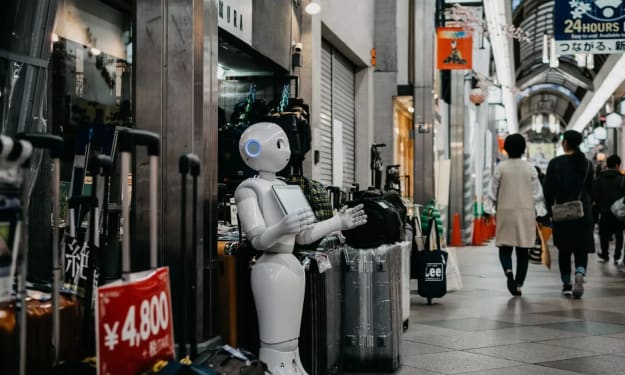
How artificial intelligence is helping us decode animal languages
For years, artificial intelligence (AI) and machine learning has been used to analyze and translate human languages. This field of research has helped expand human communication channels as well as led to new language-based technologies like advanced chatbots and voice command smart devices.
By nizam uddin3 years ago in Futurism
What is artificial intelligence—and what is it not?
Broadly speaking, artificial intelligence (AI) is a field of study and type of technology characterised by the development and use of machines that are capable of performing tasks that usually would have required human intelligence.
By nizam uddin3 years ago in Futurism
CAN HUMANS DRINK PLANET MARS WATER
Mars, the red planet, may appear lifeless and dry at first glance, but scientists believe there was once a significant amount of water on its surface. Evidence of ancient river valley networks, lake beds, and specific minerals and rocks that can only form in liquid water suggest that Mars may have experienced massive floods 3.5 billion years ago. While the atmosphere on Mars is too thin for water to remain in its liquid form on the surface, there is still water to be found beneath the planet's surface, particularly in its polar regions and at the north polar ice cap. Occasionally, salty water flows down crater walls and hillsides, and there are trace amounts of water in the planet's atmosphere, albeit as vapor.
By Loreta Diverse3 years ago in Futurism
As AI develops rapidly, what is the future ethical cost?
The concerns surrounding AI include it amplifying potentially harmful biases and stereotypes, says a technology ethics expert. She says that 'ethical debt' can develop if we fail to consider the possible negative consequences or societal harms of AI. The only way to decrease ethical debt is to take the time to think ahead about things that might go wrong – but this is not something that technologists are necessarily taught to do, she adds.
By nizam uddin4 years ago in Futurism
These are the jobs that AI can’t replace
I’ve just asked ChatGPT this question: “What jobs will AI be unable to replace?” Within seconds it has whizzed out a 275-word answer. When I asked it to edit its answer down to under 50 words, it was a lot slower. A lot, lot slower.
By nizam uddin4 years ago in Futurism
How can technology help in a holistic approach to ensure inclusion?
Since its humble yet momentous beginnings as wireless telegraphy in 1901, telecommunications and its evolution to Information and Communications Technology (ICT) have taken civilization on an incredible journey, one that is accelerating us towards the intelligent world.
By nizam uddin4 years ago in Futurism
4 promising digital technologies for Circular Construction
To ensure there will be enough housing available for a growing population by 2060, recent studies suggest that we need to construct the equivalent of the building space of New York City every month for the next 40 years. Not only is the size of this project a tremendous challenge, but so is the ecological footprint of the building sector. Currently, it accounts for about 40% of global greenhouse gas emissions.
By nizam uddin4 years ago in Futurism