extraterrestrial
Speculation, theory, UFOs and Aliens. Are we alone in this universe or is there life outside Earth?
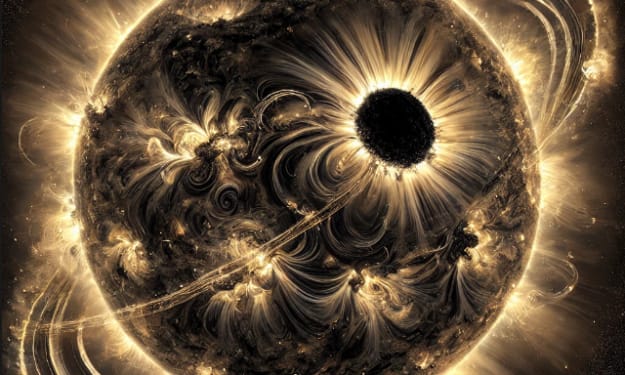
The Black Sunspot: A Mysterious Phenomenon in Our Solar System
The sun, our closest star and the life-sustaining beacon for all existence on Earth, is an object of endless fascination and scientific inquiry. Among its many compelling aspects are sunspots—dark, cooler regions on the sun's surface that have intrigued astronomers for centuries. One of the most captivating among them is the "black sunspot," a term that evokes both curiosity and scientific wonder. In this article, we’ll delve into what sunspots are, the significance of black sunspots, and why they are essential to our understanding of solar activity.
By mariam elghazaly2 years ago in Futurism
The Space Elevator. AI-Generated.
Imagine stepping into an elevator that doesn’t just take you up a few floors but lifts you all the way to space! With advancements in space technology moving at an astounding pace, experts believe that by the mid-21st century, humans might be able to travel to space as easily as hopping on a plane. One of the most groundbreaking ideas in this new frontier is the Space Elevator, a revolutionary structure that could redefine interstellar travel.
By Ahmed Wagih2 years ago in Futurism
Lost in Space
Rediscovering Lost in Space: From Classic Adventures to The Odyssey Chronicles The original Lost in Space captivated audiences with its blend of adventure, family drama, and sci-fi spectacle. Premiering in the 1960s, the series followed the Robinson family as they embarked on a mission to establish a colony for Earth’s dwindling population.
By Estalontech2 years ago in Futurism
Embracing the Future: Next Gen Vision and the Era of Futurism
As we step further into the 21st century, the concept of futurism has evolved into a dynamic framework for understanding the world of tomorrow. "Next Gen Vision" encapsulates a forward-looking perspective that embraces technology, creativity, and sustainability, painting an optimistic picture of what lies ahead. This article delves into the various dimensions of next-gen futurism, exploring innovations that promise to redefine our existence, enhance our experiences, and reshape our society.
By Marius Lungu2 years ago in Futurism
God, Devil, and the Cosmic Interplay: How Metaphysics and Science Shape Reality
Throughout human history, our quest for understanding has spanned across numerous realms of thought, from metaphysics to science, religiosity to magic, and witchcraft to faith. Embedded within these inquiries are the rich configuration of culture and tradition, which serve as frameworks that guide, shape, and preserve these beliefs across generations. The interplay between these activities and influence reveals a complex interconnectivity of inquiry and practice that continuously evolves, reflecting the diversity of human experience and understanding. Each offers a different lens for interpreting reality, yet they often intertwine, creating a multi-dimensional approach to understanding the universe and our place within it.
By Honsby Orji2 years ago in Futurism
Mars VS Earth
One thousand years from now; Earth will finally make alien contact with Mars! It will be an extraordinary day, one that had only lived within the minds of creative science fiction writers for over a Millennium. When describing aliens, people picture strange lanky creatures unlike any human on earth, with big bug eyes of black and large round heads in the shape of American footballs. I must disappoint you however, for Martians don't look much different than humans at all. Just like us, they have two eyes, but their pupils are much larger and are only black without colour, or perhaps a shade so dark it is impossible to see. They do have reddish skin however, looking a lot like a sun burnt English man on holiday to Barcelona, only they permanently have that skin tone of burnt flesh. Perhaps because they live so much closer to the sun, their skin evolved into the same colour as the sand below their feet. They do have snout-like noses, where their nose tips lean upwards slightly more than an earthling, making the women look rather cute and the men more boarish. Gravity is much lighter on Mars, so the species evolved to be much heavier than humans, so they don't float off into the vacuum of space. They are all built like Earthling body builders. They have spiky hair, much like that of an American punk band, only this is naturally grown, without needing gel to keep it stylised that way. Just like us, they have two legs and two arms, feet and hands too. Only they have seven toes on each foot, so they can better grip onto the planet's surface, because the lighter gravity makes it harder to stay grounded. They have four fingers on each hand however, lacking thumbs because their hands are shaped more like claws to better dig at the hard rock that covers Mars, using their long, tough nails to break away stone. Despite these minor differences, the Martians are very similar to humans, they stand upright and wear clothes to cover their private areas and even speak a language similar to our own. The reason why they are so much like humans became clear, as it was revealed that these were the descendants of lost astronauts who ended up on Mars after losing contact with earth. They at first lived in the manmade space shelters around the planet, never leaving their homes because they could not breathe the very thin, almost non-existent air outside. Eventually the children born on Mars could adapt to their new environment and hold their breath for unbelievably long periods of time, marching around Mars for hours without needing air, then eventually they didn't need astronaut helmets or oxygen tanks to survive on the thin air at all. I'm skipping over hundreds and hundreds of years of Martian evolution here, but that's how Humans evolved on this planet, eventually becoming almost too alien from Earthlings to be called Human, becoming the Martians I just described. This discovery was quite disappointing for some, because they genuinely thought the Martians were a new alien species, not just another human race that only looked a little bit different from each other. Yet, the fact intelligent life was on a different planet was still very exciting and everyone on Earth and Mars couldn't wait to build a utopian space colony together, one that would unite both worlds and hopefully together they could reach actual alien species from the likes of Jupiter or Venus.
By Joseph Roy Wright2 years ago in Futurism
Revisiting the Alien Saga, Part 2. Content Warning.
Crossovers, prequels, and wringing the last drop of blood from every bankable IP are now the dominant approaches in big budget cinema. Twenty years ago, the Alien series was already old enough and established enough to warrant its own relaunch, crossing over with another franchise famed for vicious, alien killing machines. This started a run of Alien prequel films, which would eventually lead us to all kinds of strange destinations.
By Daniel Tessier2 years ago in Futurism