extraterrestrial
Speculation, theory, UFOs and Aliens. Are we alone in this universe or is there life outside Earth?
A Personal Reflection on the Coming Shift And Behind The Scenes
A Personal Reflection on the Coming Shift Something extraordinary is happening, and you can feel it in your gut. You sense it in the way the world is beginning to shake off old illusions. For a long time, I've been following the whispers in the dark, those strange threads that intertwine history, religion, politics, and the stars. Now, more than ever, it feels like all those threads are pulling tight into one powerful revelation. The truth is no longer hiding in the shadows; it is emerging right before our eyes.
By The Secret History Of The Worldabout a year ago in Futurism
Nano-Satellites for Educational Launches: How Students Are Reaching for the Stars
Once upon a time, space exploration was a dream reserved for governments and billion dollar corporations. But that era is fading fast. With the rapid development of technology and the miniaturization of electronics, even high school and university students now have the power to reach orbit all thanks to nano-satellites, the small but mighty tools of a new educational revolution.
By Holianyk Ihorabout a year ago in Futurism
The 120-Million-Year-Old Map: The Final Proof of a Lost Ancient Civilization?
Carved in Stone, Etched in Time High in the Ural Mountains of Russia, a stone slab was unearthed, a silent behemoth pulsing with the awe-inspiring mystery of its existence. Initially mistaken for a mere fragment of rock, it revealed its true nature upon closer inspection: a complex relief, a window into an ancient world, a topographical map etched into its surface.
By The Secret History Of The Worldabout a year ago in Futurism
From Alchemy to CERN: The 1,200-Year Quest to Turn Lead into Gold; A Tale in Pictures: From Alchemy’s Glow to Particle Science’s Roar
It is Baghdad in the 8th century. The night air carries a cool hush, but deep within one narrow alley, a small room glows under the flicker of oil lamps. Smoke swirls toward the ceiling where its tendrils twine with shadows that dance upon the walls. In the center stands an elderly man, his wise, sharp eyes fixed on his work. His hands move deftly among slender glass vessels, matte brass flasks, and copper bowls. With precision born of long hours and countless repetitions, he drips liquids—sometimes a drop of golden-yellow solution, other times two drops of milky white fluid—into a crucible of curiosity. Mutters escape his lips in Arabic: “قم بالتجارب لكي تكتسب المعرفة...” “Try experiments so that you may attain knowledge...” The night deepens. The lamp’s flame sputters. Smoke clings to the low ceiling, a stifling veil carrying the acrid scent of brimstone, burnt salt, and a hint of sour fruit. The old man’s face is etched with strain; sweat gleams across his forehead. His eyes, red-rimmed from sleepless nights and relentless focus, fix upon a long, curved glass tube—its lower end capped with a small flask. Within that flask, a single ruby-red drop trembles, falls—with the soft plink echoing in the cramped silence. Each drop is an announcement to his racing heart. This is Jābir ibn Ḥayyān, the legendary alchemist-scientist, consumed for the last decade by a singular obsession: the transformation of lead into gold. Jābir believed he could do so with the mythical Philosopher’s Stone or through a precise chemical process. Tonight, the dull, heavy chunk of lead before him remains stubbornly unchanged. The truth is, Jābir never succeeded in turning lead into gold. But his relentless trials pushed him to innovate: he designed new apparatus for distillation—the alembic; improved vessels for evaporation, crystallization, and safe containment of acids and alkalis. He meticulously documented sublimation, dissolution, oxidation, and hundreds of other reactions. These experiments earned him the title “Father of Chemistry.” For centuries, the flame of alchemy spread worldwide. By the 16th and 17th centuries, however, the dawn of empirical modern science dimmed alchemy’s enchantment. The dream of transmuting base metals into gold became recognized as nothing more than an alchemical myth. --- 🚀 And now—1,250 years later—May 7, 2025: Under the Alps, straddling the border between Switzerland and France, lies CERN’s Large Hadron Collider (LHC)—a colossal scientific engine buried deep beneath the earth. The contrast with Jābir’s smoky workshop—and both could not be more profound. Here, the air hums with the breath of supercomputers that analyze mountains of data, while physicists in spotless lab coats sit before console screens. They accelerate beams of protons nearly to the speed of light, steering them into ultra-high-energy collisions. Data graphs bloom on the screens, complex and intricate as constellations. The researchers wait, breath held, until a distinctive signal emerges—a pattern they’ve been searching for all along. A hush descends, then slowly, one scientist’s eyes widen. A hand lifts in silent marvel. Others hurriedly scan their monitors. They are witnessing it: by colliding lead nuclei with tremendous kinetic energy, they have changed the number of protons in atomic nuclei—transmuting lead into gold. In this moment, what Jābir pursued with crude tools in his humble room has finally been accomplished—with exquisite precision and staggering scale. --- 🌟 Continuum of Curiosity In that dimly lit workshop of 1,200 years ago, Jābir whispered: “قم بالتجارب لكي تكتسب المعرفة…” “Try experiments so that you may attain knowledge...” Tonight, deep beneath the earth, the echo of those words resonates once more—less a whisper, more a triumph. From glass flasks to stainless steel accelerators; from copper heating coils to cryogenic superconductors; from a lone man’s intuition to massive international teams… science has evolved, but its heartbeat remains unchanged. Jābir’s experiments laid the foundation. Early chemists refined his processes; medieval scholars classified substances, dedicated alchemical texts, and developed proto-laboratories. Over centuries, the blend of curiosity and precision gave birth to modern chemistry and physics—disciplines grounded in experimentation, measurement, and skepticism. --- 🔬 From Alchemy to Particle Collision Jābir’s Legacy: He invented the alembic, refined vessels for distilling and crystallizing, and formalized chemical terminology. He catalogued substances and reactions like oxidation and desiccation—planting the seeds of systematic chemical science. Scientific Revolution: As empirical methods took root in Europe, alchemy evolved into chemistry. Robert Boyle, Antoine Lavoisier, and others proposed rigorous standards: reproducibility, measurement, skepticism about hidden forces like “vital spirits.” The pursuit of transmutation faded, while focus shifted to atomic structures and molecular composition. Nuclear Transmutation: In the 20th century, Ernest Rutherford cracked the nucleus with alpha particles, discovering protons and pioneering artificial element transformation. Later, particle accelerators generated isotopes and exotic elements at scale. Modern Alchemy—The LHC Way: At CERN, researchers create fleeting new elements, test matter under extreme conditions, and sometimes observe transmutations—turning mercury, bismuth, or lead nuclei into higher elements like gold. Not economically viable, but monumental in human understanding. --- 🌌 A Lab of Dreams and Determination Jābir’s smoky room was powered by nothing but oil lamps and hope. He had no theory of the atom, no periodic table—only observation, intuition, and meticulous documentation. Modern science runs on gigawatts of electricity, millions of lines of code, and thousands of researchers, but it too is built on the same pillars: hypothesis, experiment, observation, and critical analysis. What unites them is simple yet profound: the human spirit’s hunger to know. One small drop falls in Jābir’s flask. One massive collision unfolds in the LHC. Both moments answer an enduring question: What happens when we push nature’s boundaries? In Baghdad’s dusty alley, Jābir heard it slow and close: > “قم بالتجارب لكي تكتسب المعرفة...” In Geneva’s corridors, tens of thousands of equations later, we hear it again. A whisper becomes a roar. --- ✨ Because Curiosity Never Dies Osama scientist or medieval alchemist—across time, cultures, and tools—the impulse to experiment remains the same. Whether mixing reagents or colliding nuclei, we challenge the unknown. Jābir didn’t make gold. Yet his inventions, records, and courage paved a path intellect traveled for millennia. Modern science stands on that foundation, and tonight, under the Alps, human ingenuity has turned the impossible into history. So the next time you hesitate—wondering whether a small experiment, a bold idea, or a simple question is worth the effort—remember: Curiosity is the spark, experimentation is the flame. قم بالتجارب لكي تكتسب المعرفة … “Try experiments so that you may attain knowledge.” And maybe, in your own way, you are building the future—one question, one drop, one collision at a time.
By Ikram Ullahabout a year ago in Futurism
Thrust Modulation for Multistage Rockets: The Future of Adaptive Spaceflight
In the evolving world of space technology, sheer engine power is no longer the sole defining factor of success. Today, flexibility and precision are just as critical. Traditionally, rocket stages operate in a binary mode full thrust or complete shutdown. But a new and powerful concept is emerging: thrust modulation, or the ability to dynamically adjust engine power mid-flight. For multistage rockets, this innovation could be a true game-changer.
By Holianyk Ihorabout a year ago in Futurism
Light Launch Vehicles for Microsatellites: Ushering in a New Era of Space Access
In recent years, the space industry has undergone a dramatic transformation. Gone are the days when building and launching a satellite meant massive budgets, years of preparation, and hardware the size of a car. Today, we are witnessing the rise of microsatellites compact, lightweight, and relatively inexpensive spacecraft, some no bigger than a shoebox. These tiny machines are capable of performing sophisticated tasks, from monitoring climate patterns to providing internet connectivity in remote regions. But with this miniaturization came a new challenge: how to get these small satellites into orbit quickly, affordably, and independently?
By Holianyk Ihorabout a year ago in Futurism
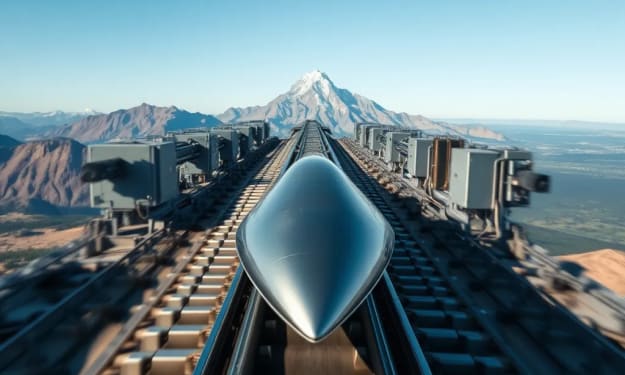
Electromagnetic Catapults: A Breakthrough in Space Logistics
A rocket launch is one of the most dramatic spectacles of modern science. Fire, thunder, and sheer force dominate the moment—but behind the awe lies an expensive truth. Sending just one kilogram of cargo into orbit can cost anywhere from several thousand to tens of thousands of dollars. Rockets are incredibly complex, mostly single-use machines that require tons of fuel and meticulous planning. For decades, engineers and scientists have been searching for cheaper, more efficient ways to reach orbit. One of the most promising alternatives? Electromagnetic catapults.
By Holianyk Ihorabout a year ago in Futurism
Horizontal Takeoff: Aerospace Planes and the Revolution at the Edge of Space
For most of human history, the edge of Earth’s atmosphere was seen as an impenetrable barrier. Reaching space meant building enormous rockets, launching them vertically with thunderous force and staggering costs. But today, a new era is emerging the era of horizontal takeoff. Aerospace planes are rewriting the rulebook, promising to make access to space as routine as boarding an international flight. But what exactly are these futuristic machines, and how could they reshape our world?
By Holianyk Ihorabout a year ago in Futurism
Galactic Winds Beyond the Stars: How Intergalactic Stellar Winds Affect Space Travel
When we imagine space travel, especially journeys between galaxies, we tend to think of vast distances, faster than light technology, and undiscovered alien worlds. But there is a powerful force silently at play in the cosmic ocean that rarely gets attention stellar wind. And surprisingly, even beyond the bounds of galaxies, in the emptiness between them, stellar wind continues to shape the environment. It takes on a new and mysterious form, influencing not only how ships travel but possibly even offering new ways to navigate and move.
By Holianyk Ihorabout a year ago in Futurism
Can Gravity Help Us Travel Faster Between Galaxies?
In the vastness of space, distances are measured not in kilometers or miles, but in light-years. Even our nearest galactic neighbor, the Andromeda Galaxy, lies a staggering 2.5 million light-years away. With current technology, such a journey is far beyond our reach. But what if the universe itself could lend us a hand? What if the very force we usually associate with slowing things down gravity could actually accelerate us across the stars?
By Holianyk Ihorabout a year ago in Futurism
How Time Changes During Intergalactic Acceleration: A Journey Through Space and Einstein’s Physics
Time is one of the most mysterious concepts in the universe. It seems to march forward endlessly and predictably... or does it? When it comes to intergalactic travel, especially under acceleration, our familiar ideas about time begin to unravel. We enter the realm of relativity, where a single second aboard a spaceship might equal years back on Earth. But what exactly happens to time when we accelerate through the stars?
By Holianyk Ihorabout a year ago in Futurism
What Is an Alcubierre Drive, and Could We Ever Build One?
The speed of light is often considered the ultimate speed limit of the universe. According to Einstein's theory of relativity, nothing with mass can travel faster than light. But in 1994, a Mexican physicist named Miguel Alcubierre proposed a radical idea that could bypass this limitation without breaking any physical laws. His concept became known as the Alcubierre drive, or warp drive, a hypothetical engine capable of faster-than-light travel by warping space-time itself.
By Holianyk Ihorabout a year ago in Futurism