evolution
The evolution of science, science fiction, and mankind throughout the years.
Artificial Intelligence in 2025: The Invisible Force Reshaping Our World
Introduction: The Silent Revolution Imagine waking up in the morning, and before you even get out of bed, your smartphone has already analyzed your sleep patterns and adjusted your alarm accordingly. Your coffee machine knows the perfect time to brew your favorite drink. Your email is prioritized based on urgency. And all of this happens without you lifting a finger. This isn't a distant dream anymore – it's 2025, and Artificial Intelligence (AI) is no longer science fiction. It's the invisible force quietly reshaping our lives. In this article, we will explore how AI has evolved into a powerful presence in our personal and professional lives, the impact it's having on various sectors, the ethical concerns it raises, and what the future may hold. Whether you're a tech enthusiast or a curious onlooker, this comprehensive guide will help you understand the role of AI in our changing world. 1. AI at Home: The Smart Living Era AI has seamlessly integrated into our homes, making them smarter, safer, and more efficient. Devices like Amazon Echo, Google Nest, and Samsung SmartThings are now capable of learning from user behavior, creating customized environments tailored to each individual. From adjusting lighting and temperature to suggesting dinner recipes based on what’s in your fridge, AI personal assistants are becoming indispensable. Smart home security systems powered by AI can now differentiate between a family member and a potential intruder, reducing false alarms and enhancing safety. Additionally, AI-driven home robots are helping the elderly and disabled live more independently by providing companionship, medication reminders, and even mobility assistance. 2. AI in Healthcare: Saving Lives with Precision The healthcare sector has seen some of the most revolutionary AI implementations. In 2025, AI is being used to diagnose diseases with unprecedented accuracy. Tools like IBM Watson and Google's DeepMind are analyzing medical data, imaging, and patient history to detect conditions like cancer, Alzheimer’s, and heart disease early and more accurately than traditional methods. AI-powered wearable devices are continuously monitoring vital signs and alerting users and doctors about potential health risks. Personalized medicine, where AI tailors treatment plans based on genetic profiles and lifestyle, is improving patient outcomes and reducing side effects. Moreover, AI chatbots are transforming mental health care by offering 24/7 support and helping bridge the gap between therapists and patients. 3. AI in the Workplace: Automation and Augmentation From finance to manufacturing, AI is automating repetitive tasks and augmenting human capabilities. In 2025, companies are leveraging AI for data analysis, customer service, recruitment, and even decision-making. For example, chatbots handle thousands of customer queries daily with accuracy and consistency. AI is also transforming job roles. While some fear job losses, new opportunities are emerging that require a blend of human creativity and AI efficiency. Jobs in AI ethics, machine training, and algorithm auditing are now in demand. The key to thriving in this environment is adaptability and continuous learning. 4. AI in Education: Personalized Learning Paths Education has become more inclusive and adaptive thanks to AI. Platforms like Khan Academy, Duolingo, and Coursera use AI to track student progress and tailor lessons accordingly. In 2025, students receive real-time feedback, and teachers are empowered with tools to identify and address learning gaps. Virtual tutors, powered by AI, provide around-the-clock assistance, breaking geographical and time barriers. Special education is benefiting immensely as AI helps design personalized learning experiences for students with disabilities. 5. AI and Ethics: Navigating a Complex Terrain With great power comes great responsibility. As AI grows, so do ethical concerns. Who is accountable when an AI-driven car crashes? Can AI make unbiased decisions when trained on biased data? How much privacy are we sacrificing for convenience? In 2025, these questions are at the forefront of technological discourse. Governments and organizations are working to implement ethical frameworks and transparency protocols. AI transparency, fairness, and accountability are becoming non-negotiable principles. 6. AI in Entertainment: Revolutionizing Creativity AI isn't just analyzing data; it's creating art. From composing music and writing scripts to generating deepfake videos and designing video games, AI is revolutionizing the entertainment industry. Tools like OpenAI’s ChatGPT and DALL·E are allowing artists to collaborate with machines to push creative boundaries. In 2025, virtual influencers, AI-generated content, and immersive experiences powered by AI are redefining how we consume and create media. 7. AI in Transportation: From Self-Driving Cars to Smart Traffic Self-driving cars are no longer a novelty. Companies like Tesla, Waymo, and Cruise are deploying autonomous vehicles that navigate city streets safely. AI is optimizing traffic flow in smart cities, reducing congestion and emissions. Logistics and delivery services have embraced AI for route planning, fleet management, and even drone-based deliveries. This has not only improved efficiency but also minimized environmental impact. 8. The Dark Side of AI: Risks and Threats While AI offers countless benefits, it also poses significant risks. Deepfakes, misinformation, surveillance, and algorithmic bias are growing concerns. Cybersecurity threats are becoming more sophisticated, as AI is used both to protect and attack digital infrastructures. As AI becomes more autonomous, the need for regulation and ethical oversight is critical. Unchecked development can lead to unintended consequences with global implications. 9. The Human-AI Partnership: Moving Forward Together The future isn't about humans versus machines – it's about collaboration. AI can augment human potential, enabling us to solve complex problems and make better decisions. The real challenge is ensuring that this partnership is balanced, ethical, and inclusive. Education systems must adapt to teach AI literacy. Governments need to legislate responsibly. Individuals must remain curious, adaptable, and informed. Conclusion: Embracing the Inevitable Future Artificial Intelligence is not coming – it's already here, quietly transforming every aspect of our lives. As we step further into 2025, the question isn't whether AI will change our world, but how we choose to shape that change. Will we fear the unknown or harness AI's power to build a better, more equitable future? The choice is ours.
By Babar Azamabout a year ago in Futurism
Gravity Wave Propulsion: Did Bob Lazar Describe a Real Technology Decades Before the Patents?
When Bob Lazar came forward in 1989 claiming he worked on reverse-engineered alien craft near Area 51, he described a propulsion system unlike anything on Earth: a gravity wave amplifier powered by Element 115. It didn’t burn fuel. It didn’t push against the air. It bent space itself.
By Rukka Novaabout a year ago in Futurism
Is Reality Just a Computer Program? Scientists Suggest There's a 50% Chance We're Living in a Simulation
The idea that we might be living in a simulation is no longer just the stuff of science fiction. It’s a concept that has gained significant attention in both philosophical and scientific circles. From the Matrix movies to discussions among leading scientists and thinkers, the simulation hypothesis posits that our entire existence could be a highly advanced computer program. But what’s the real evidence behind this idea? Is there a real possibility that we’re not living in the "real" world at all? Recently, a growing body of research and expert opinions has raised the possibility that there’s a 50% chance we’re all living in a simulation. Some of the world’s top minds, including physicists, technologists, and philosophers, are now taking this hypothesis more seriously. This post will dive deep into the concept, the arguments for and against it, and what it means for our understanding of reality itself. The Origins of the Simulation Hypothesis The roots of the simulation theory can be traced back to the 2003 paper by philosopher Nick Bostrom titled “Are You Living in a Computer Simulation?”. In this groundbreaking work, Bostrom proposed that one of the following three scenarios must be true: Human civilization will go extinct before reaching a “post-human” stage capable of running highly realistic simulations. Advanced civilizations will choose not to run simulations of their ancestors. We are almost certainly living in a simulation. Bostrom’s argument hinges on the idea that future civilizations, with immense computing power, could simulate entire worlds, including conscious beings, for purposes ranging from research to entertainment. If these simulations are indistinguishable from reality, it stands to reason that the inhabitants of these simulated worlds (like us) would never be able to distinguish between the real world and the simulated one.
By The Secret History Of The Worldabout a year ago in Futurism
Majestic 12: The Secret Government Group Behind the UFO Conspiracy
Shadows Behind the Stars Since the late 1940s, the skies have been the subject of global fascination. UFO sightings, mysterious lights, and tales of alien encounters have ignited the public imagination and spurred countless investigations. But behind all speculation lies a darker, more organized force, Majestic 12. Formed by the highest levels of the U.S. government, this shadowy group has long been suspected of hiding the truth about extraterrestrial contact. Is Majestic 12 real, or just a brilliantly constructed myth? The deeper you dig, the more chilling the connections become.
By The Secret History Of The Worldabout a year ago in Futurism
Maximism: Our Quest to Outsmart the Universe's End
Section 1: What is Maximism? Finding Our Way in a Fading Universe Ever look up at the stars and wonder about the really big picture? Not just our lives, or even humanity's future, but the future of everything? Scientists tell us that the universe, as incredible as it is, seems to be heading towards a kind of slow fade-out, an end where all energy spreads out and everything just… stops. It's a concept called entropy, sometimes known as "heat death."
By Maxim Dudkoabout a year ago in Futurism
Alcatraz Awakens: The Ghost Prison Returns to Life After 60 Years
Alcatraz Awakens: The Ghost Prison Returns to Life After 60 Years In the shadowy waters of San Francisco Bay, a forgotten fortress stirs. The infamous Alcatraz Federal Penitentiary, once the most feared prison in America, is about to reopen its iron gates—and this time, it’s under orders from former President Donald J. Trump.
By Md Ajmol Hossainabout a year ago in Futurism
Raised by Wolves & Prometheus. Content Warning.
Okay, hear me out. I’ve been rewatching Raised by Wolves, and something about it just won’t leave me alone. The whole thing feels like someone took the Bible, threw it in a blender with Prometheus, added a dash of existential dread, shook it up, and that was the script. And I don’t mean just loosely inspired. I’m talking full-on twisted reinterpretation of how Earth, humanity, and creation came to be.
By Louise Noel about a year ago in Futurism
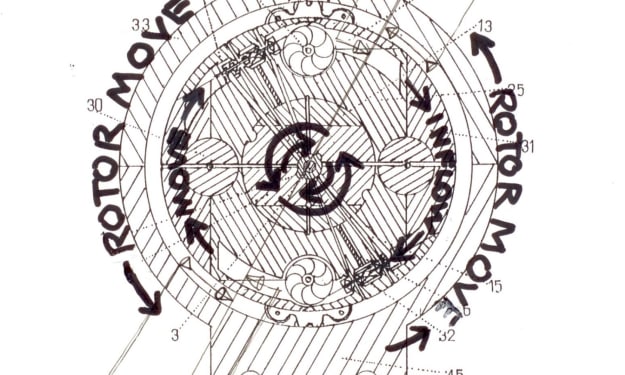
Is it possible to apply positive + in favor Newton III Motion Law as a dynamic system in a Motor Engine Device?
3rd Thermodynamic Law Applicate in a Power-Plant Device. The Reaction at From of the Action. New Torque Power. It’s a simple Plus Formula of the Interaction of the Two Powers: 1/Action, + 2/Reaction = Retrodynamic. / For every action there is an equal and opposite reaction. 2 Forces in 1 System.
By Carlos Barreraabout a year ago in Futurism
Will Quantum Computing Ever Work? Todd Kassal Explores the Future of Quantum Technology
Quantum computing has long been heralded as the next frontier in computational power, promising to revolutionize industries from cryptography to pharmaceuticals. Yet, despite significant investments and research, practical, large-scale quantum computers remain elusive. Todd Kassal, an Illinois-based quantum computing enthusiast and strategic thinker, delves into the current state of quantum computing, examining its challenges, advancements, and the road ahead.
By Todd J. Kassalabout a year ago in Futurism
Numerology, Angel Numbers, and Artificial Intelligence: The Cosmic Connection Between the Mystical and the Digital
At first glance, numerology and AI seem to reside on opposite ends of the spectrum—one steeped in spirituality and intuition, the other grounded in logic and computation. However, when we look more closely, the parallels between the two become impossible to ignore. Both numerology and AI rely on numbers, patterns, and predictive power. Both seek to uncover hidden meanings, trends, and outcomes. In fact, by examining the philosophical overlap between these fields, we may come to realize that the mystical and the digital are more interconnected than ever before.
By Sthephanieabout a year ago in Futurism
The Unexplained Missing Matter of the Universe: A Deep Dive Into the Cosmic Puzzle
The universe is an awe-inspiring place, filled with mysteries that challenge our understanding of the cosmos. One of the most perplexing questions in modern astrophysics is the enigma of missing matter. Scientists have discovered that the universe seems to be lacking a significant amount of matter, matter that should be there based on our current understanding of physics and the way the cosmos is structured. In this post, we’ll explore the fascinating mystery of the missing matter, the scientific theories that attempt to explain it, and what it could mean for our understanding of the universe.
By The Secret History Of The Worldabout a year ago in Futurism