evolution
The evolution of science, science fiction, and mankind throughout the years.
Revolution in His Eyes: The Timeless Symbolism of a Rebel’s Roar
Introduction In the heart of any revolution lies not just the chaos of conflict, but the fire of human willpower. Captured in the image above is a powerful moment that encapsulates that spirit: a man mid-battle cry, gun in hand, passion etched into every line of his face. His clothes are rugged, his gear practical, and his stance unmistakably defiant. This is not merely a photo—it is a visual symphony of rebellion, courage, and ideology. Whether staged or real, symbolic or literal, this single frame serves as a tribute to the human drive to resist oppression.
By Fazal Malikabout a year ago in Futurism
Top AI-Powered Side Hustles in 2025: How to Make Real Money with Zero Experience . AI-Generated.
In 2025, the side hustle economy is booming more than ever. With inflation rising and traditional job security declining, people around the world are turning to side gigs powered by AI to make extra income—or even replace their full-time jobs. Whether you're a college student, stay-at-home parent, or full-time employee looking for freedom, there has never been a better time to start a side hustle using artificial intelligence. The beauty? Many of these don't require prior experience, capital investment, or technical knowledge. This guide will walk you through the most profitable and beginner-friendly AI side hustles to start today—with practical steps, income potential, and real tools. --- 💰 Why AI Side Hustles Are the Future The term "AI side hustle" refers to using artificial intelligence tools (like ChatGPT, Midjourney, DALL·E, Claude, Canva AI, etc.) to create, automate, or enhance services that people are willing to pay for. Some key reasons they're dominating the trend: Low barrier to entry: Most tools are free or cheap High demand: Businesses are hungry for automation and digital content Time-efficient: What used to take hours now takes minutes Scalable: You can serve 1 or 100 clients—AI scales with you --- 🚀 Top 7 AI Side Hustles to Start in 2025 Let’s break down the highest-potential hustles, tools to use, and how much money you can realistically earn.
By MOHAMMED AL-HAJJabout a year ago in Futurism
“I Lived Like It Was 2050 for a Week. Here’s What Surprised Me Most.”
Day 1: The Setup When I first agreed to participate in an experimental project that let me “live” like it was the year 2050 for one week, I thought it would be all sleek gadgets, robots, and holograms. I was wrong. It was so much more—and in some cases, unsettlingly less.
By Hamza Habibabout a year ago in Futurism
"Digital Wellness in 2025: Balancing Innovation with Inner Peace"
By 2025, personal branding will be more than just a trendy term; it will be essential. But thanks to artificial intelligence (AI), it is currently going through a quiet revolution. Gen Z is using AI-generated avatars, customized algorithms, and virtual branding tools to create identities that are more intelligent, quicker, and sharper than the millennial era of filtered selfies and bio-hacks.
By Tousif Arafatabout a year ago in Futurism
The Algorithm’s Apprentice
They say you shouldn’t stare too long into the abyss because it might stare back. What they don’t tell you is that, in 2025, the abyss also wants to optimize your engagement, track your scroll rate, and gently nudge you toward buying another bamboo toothbrush. My name’s Arman, and for the better part of a year, I worked as what my contract optimistically called an “Algorithmic Content Curator.” My friends called me “The Algorithm’s Apprentice,” and the nickname stuck—partly because it was funny, and partly because it felt painfully true. I didn’t invent the algorithm, obviously. That was the work of engineers, data scientists, and the ghost of every tech visionary who once promised the internet would set us free. My job was simpler, yet stranger: to help the algorithm learn what people want, sometimes before they knew it themselves. Each morning, I’d log into my dashboard, sip overpriced oat‑milk coffee, and be greeted by a swirl of data points: engagement scores, watch‑through rates, heat maps of where thumbs paused on videos. These weren’t just numbers. They were breadcrumbs through the forest of human attention. It wasn’t glamorous. There were no hoodies and beanbag brainstorming sessions. Just me, my screen, and thousands of micro‑decisions: Should this video of a dancing cat get a boost? Should we downrank this clip where the language might offend advertisers? Should we recommend more DIY soap‑making videos to this user in Idaho? At first, it felt harmless, even creative. Like helping the world discover things they might actually love. When we gave a tiny channel its first viral hit, I cheered. When a local artist’s song exploded because of a perfectly timed push, I felt oddly powerful, like a hidden hand moving the culture. But over time, the edges blurred. I started to see people as clusters of probabilities: 82% chance they’d click on nostalgia content, 67% likelihood they’d share a story about outrage, 91% chance they’d ignore anything over three minutes. The algorithm didn’t care about nuance, context, or ethics. It cared about holding eyes on screens. The hardest part was realizing I wasn’t immune. The same code I served was quietly shaping me, too. One morning, I caught myself checking engagement metrics before brushing my teeth. I started thinking in “content buckets”: heartbreak, humor, rage, hope. My own ideas felt like drafts waiting for an algorithm’s approval. It came to a head during what I call the Great Outrage Spike. One trending story—something silly, about a celebrity meltdown—started gaining traction. The metrics screamed: Boost it. Feed the beast. But I hesitated. The story was half rumor, half meme, and fully unnecessary. I clicked “pause,” a tiny act of rebellion. My supervisor pinged me a minute later. “Engagement down 3% on that thread. Any reason?” I typed, deleted, typed again: “Just thought maybe we shouldn’t amplify it.” The reply was a single emoji: 🤷♂️ And that was it. The moment taught me two things: first, the machine doesn’t stop just because you do. Second, the apprentice can step away, but the algorithm will keep running—fed by billions of other clicks. I left the job a month later. Officially, I said I wanted to “pursue creative projects.” Unofficially, I’d realized I was better at serving a machine than understanding myself, and that scared me more than unemployment. Now, on the outside, I see the world a little differently. Every viral dance, every moral panic, every comforting nostalgia clip—it all feels less random. The algorithm isn’t some evil mastermind; it’s a mirror of us. But it’s a funhouse mirror: it stretches what we stare at longest, it shrinks what we neglect, and it sells tickets to watch ourselves distort. Sometimes, friends ask what it was really like behind the curtain. I tell them the truth: it’s a mix of math and gut instinct, creative guesswork and raw data. And it’s addicting—because it feels like control, even if the control is mostly an illusion. Would I do it again? Maybe. But this time, I’d remember: the apprentice serves the algorithm, but the algorithm is built from our choices. Each click, pause, and share becomes a vote for the world we want to see. And maybe that’s the weirdest lesson of all: the abyss doesn’t just stare back—it scrolls with us.
By Mati Henry about a year ago in Futurism
I Made My First $100 Online While Crying in My Parents' Basement
"I Made My First $100 Online While Crying in My Parents' Basement" Genre: Memoir / Emotional Survival I was 27 years old, broke, and living in my parents' basement—the same one I used to play hide and seek in as a kid. But this time, there was no game, no giggles, and nowhere left to hide.
By waseem khanabout a year ago in Futurism
Shadows of Society: Unmasking the Social Threats of Our Time
The candle flickered weakly in Faizan’s hand, the tiny flame no match for the shadows that surrounded him. He sat on a bench in the center of a cracked public square—what was once the heart of his city. Now, skyscrapers loomed like silent giants, screens blared advertisements no one cared for, and people passed by like ghosts, heads down, faces lit only by their phones.
By Umair Ahmadabout a year ago in Futurism
GPT‑5, Agentic AI, Multimodal AI, Devstral, AI Coding Assistant, AI Income 2025 . AI-Generated.
Since mid-July 2025, GPT‑5 has officially launched—and with it, a new era in AI. No longer just a conversational tool, it’s a fully agentic, multimodal system that understands text, speech, image, even video, and performs real-world tasks autonomously. Backed by OpenAI's “magic unified intelligence” model, GPT‑5 merges advanced problem-solving, persistent memory, and seamless API integration into a single interface . Simultaneously, Devstral 2507, introduced by Mistral AI, brings agentic power to software engineering. It automates bug fixes, PR creation, codebase navigation, and unit tests—running smoothly on local GPUs like RTX 4090 or Mac M1/M2 . Here’s why this combo is a game-changer, and how you can turn it into income, innovation, and thought leadership. --- 🔍 1. GPT‑5 Is Agentic and Multimodal GPT‑5 isn’t just “smarter”—it acts. It supports seamless voice, text, and image/video input, enabling users to: upload a smartphone video and get a full meeting summary ask multimodal prompts like "find the logo in this scanned PDF" leverage a token window exceeding 1 million, far surpassing GPT‑4's limit Expect chain-of-thought reasoning, persistent memory across sessions, and integrated tool use. In short: an AI that thinks, plans, and acts—ideal for real-world workflows . --- ⚙️ 2. Devstral 2507 Finally Brings Agentic Coding to Everyone Devstral is now the go-to open-source coding assistant: scores 46.8% on SWE-Bench, outperforming many larger LLMs runs on a single GPU or laptop, making professional-grade AI accessible integrates with agent scaffolds (OpenHands / SWE-Agent), supporting full PR generation, testing, fixing The result: GPT‑5 imagines complex features; Devstral builds them automatically. --- 🌍 3. Why This Changes Everything Agentic workflows are here: Designs to code to deploy—all in a single session. Skill democratization: Non-programmers leverage GPT‑5; developers automate with Devstral. Business-ready tools: Autonomy + deployment in one go, for individuals and enterprises. --- 💰 4. Monetization Paths You Can Start Today Path Description Platforms GPT‑5 Workflow Setup Fine-tune GPT‑5 to business needs; $300–$800 per client Fiverr, LinkedIn, Upwork Devstral Integration Automate CI/CD tasks; $200–$600 per project Gumroad, Ko-fi, freelance sites Hybrid Agent Services Full solution: "Chat + Build + Deploy" AI workflow Subscription via GitHub/Etsy Workshops & Training Instruct on GPT‑5+Devstral for teams Teachable, Skillshare Premium Guides & Templates Sell downloadable workflows (.pdf) Etsy, Gumroad --- 🚀 5. A 5-Step “First 7‑Day” Plan Day 1‑2: Access GPT‑5 (beta/API) Install Devstral on local GPU Day 3‑4: Build prototypes: generate a feature spec with GPT‑5, implement with Devstral Record workflow Day 5: Launch a service or course using Fiverr/Gumroad, e.g., “GPT‑5 + Devstral Startup Kit” Day 6‑7: Share case studies on LinkedIn, write Medium/Vocal articles summarizing success Offer free demos or early-bird pricing --- 🛡️ 6. Handling Concerns Reliability & Hallucinations: GPT‑5 reduces hallucinations, but Devstral code still needs human validation Security & Privacy: Run Devstral locally; GPT‑5 data stays within OpenAI’s secure enclaves Complexity/machine limits: Devstral scales to mid-range hardware; guides available for setup --- 🔮 7. What’s Next After GPT‑5? GPT‑6 will push deeper autonomy and embed video capability Devstral evolves into specialized language coding agents An ecosystem of agentic pipelines—from marketing to support to operations
By MOHAMMED AL-HAJJabout a year ago in Futurism
GPT‑5 · Agentic AI · Multimodal AI · Devstral · AI Coding Assistant · 2025 Tech Trend. AI-Generated.
Introduction It's July 17, 2025, and today marks a turning point in our relationship with technology. OpenAI’s GPT‑5 has officially launched this summer, and unlike its predecessors, it's not just a chatbot—it’s an agentic, multimodal assistant capable of sophisticated reasoning and autonomy. Alongside this, Devstral 2507, released by Mistral AI on July 10, has democratized agentic coding by enabling developers to automate bug fixes, create tests, and generate pull requests with a few prompts. Simply put, this duo shifts AI from a helpful co-pilot to a true executor. Mid-July 2025 may well mark the beginning of the agentic AI era—a future already knocking on our doors. Here's how it works, why it matters, and how you can ride the wave to innovate and profit.
By MOHAMMED AL-HAJJabout a year ago in Futurism
Tomorrow,Today: How AI and Modern Science Are Designing the Future. AI-Generated.
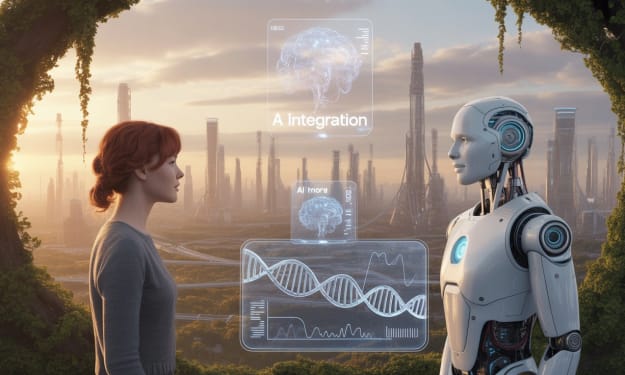
Not long ago, science fiction was filled with wild dreams: talking computers, flying cars, personalized robots. Fast forward to today, and we're living those dreams in subtle but powerful ways. Artificial Intelligence (AI) and modern science aren't just buzzwords; they are the blueprints of a future that's already unfolding.
By Nowshad Ahmadabout a year ago in Futurism