conventions
Science fiction conventions and comic conventions for every type of science fanatic.
Ibn Tufail: The Andalusian Philosopher Who Inspired Tarzan, Robinson Crusoe, and The Jungle Book
In the heart of 12th-century Islamic Spain, known as Al-Andalus, a polymath named Abū Bakr Muhammad ibn ‘Abd al-Malik ibn Tufail, better known as Ibn Tufail, crafted a philosophical tale that would echo through centuries. His novel, Ḥayy ibn Yaqẓān (Alive, Son of Awake), tells the story of a boy raised by a doe on a deserted island, untouched by society. Through nature and reason alone, he discovers survival, morality, science, and God. This allegorical tale not only shaped Arabic literature but profoundly influenced European philosophy and inspired literary classics such as Tarzan, The Jungle Book, and Robinson Crusoe. Despite his revolutionary work, Ibn Tufail’s name remains lesser known outside academic circles, buried under the weight of time. --- The Tale of Ḥayy ibn Yaqẓān: A Boy, an Island, and the Quest for Truth The novel’s protagonist, Ḥayy, is mysteriously born or appears on an uninhabited island. Raised by a deer, he mimics animal behavior to survive. As he matures, he begins observing the natural world—studying the stars, dissecting animals, and investigating life and death. Through self-education and reflection, Ḥayy develops deep philosophical insights. He arrives at the concept of a singular, divine Creator and a moral code—without scripture, religion, or societal instruction. Eventually, he encounters another human—Asal, from a neighboring island—who introduces him to organized religion and civilization. However, Ḥayy discovers that most people are unable or unwilling to embrace deep philosophical truths. Disillusioned, he returns to his island, choosing solitude over superficial societal life. --- Ibn Tufail: Physician, Philosopher, and Astronomer Born around 1110 CE near Granada, Ibn Tufail was a physician, court official, and philosopher during the Almohad Caliphate. He served as a vizier to Caliph Abu Yaqub Yusuf and played a vital role in promoting intellectual life in Al-Andalus. As a physician, Ibn Tufail was among the early advocates of dissection and post-mortem examination—a bold stance for his time. His medical poem Rajaz Taweel fi al-Tibb explored disease diagnosis and treatment, recently rediscovered in Morocco. His contributions went beyond medicine. Ibn Tufail was a renowned astronomer who challenged Ptolemaic cosmology. He influenced later astronomers like al-Bitrūjī, helping pivot Islamic astronomy toward empirical observation and rational critique, foreshadowing the scientific revolution centuries later.
By Ikram Ullahabout a year ago in Futurism
The One Platform That Brings Me the Most Vocal Traffic (It’s Not Twitter!)
I thought I knew where my audience was—until a forgotten app outperformed all the big names. If you had asked me last year which platform would send the most readers to my Vocal stories, I would've said Twitter. Or maybe Facebook. At a stretch, Medium.
By Muhammad Sabeelabout a year ago in Futurism
From Moradabad to Apple’s Global Stage: Sabih Khan Becomes the New COO of Apple
Apple’s new Chief Operating Officer (COO) Sabih Khan—an Indian-origin executive originally from Moradabad, Uttar Pradesh—has been appointed to oversee iPhone manufacturing, especially in India. After over 30 years at Apple, he succeeds Jeff Williams in a strategic move by CEO Tim Cook. This milestone highlights Apple’s commitment to continuing iPhone production in India amid global trade pressures and ambitions of sustainable growth. Born in Moradabad in 1966, Khan later lived in Singapore and then moved to the U.S. for higher education, earning degrees in mechanical engineering and economics from Tufts University and a master’s from RPI. He joined Apple in 1995 and climbed the ranks—from procurement to Senior Vice President of Operations—playing crucial roles in green manufacturing, logistics, and global supply chain management. Tim Cook praised him as “a brilliant strategist” and trusted his leadership to shape Apple’s future. Apple expects India’s share in its global iPhone production to grow significantly under his leadership. 1. Introduction: A New Era of Leadership On July 8, 2025, Apple announced that Sabih Khan will step into the role of Chief Operating Officer, succeeding longtime operations chief Jeff Williams as part of a carefully orchestrated leadership transition . With a remarkable 30-year career at Apple, Khan’s ascent symbolizes continuity, internal talent promotion, and global ambition amid shifting geopolitical trade landscapes. 2. Early Life & Roots – From Moradabad to Global Education Sabih Khan was born in Moradabad, Uttar Pradesh, India in 1966. During his school years, his family relocated to Singapore, where he completed his early education. Later, he moved to the United States for tertiary studies . His educational journey reflects both technical depth and global exposure: Dual bachelor’s degrees in mechanical engineering and economics from Tufts University A master’s degree in mechanical engineering from **Rensselaer Polytechnic Institute (RPI)** This combination of engineering and economics laid the groundwork for his success leading complex operations at one of the world’s biggest tech firms. 3. Early Career: GE Plastics Foundations Before joining Apple, Khan worked at GE Plastics as an applications development engineer and key account technical leader. This phase helped him build strong analytical and execution skills before transitioning to the high-stakes environment of Apple’s global tech supply chain . 4. At Apple: Joining and Rising Through the Ranks Khan joined Apple in 1995, initially working in the procurement group. Over the decades, his contributions spanned planning, manufacturing, logistics, supplier responsibility, and global fulfillment operations . In 2019, he was promoted to Senior Vice President of Operations, a key leadership role overseeing Apple’s supply chain continuity, product quality, supplier relations, and environmental programs . In this capacity, Khan navigated major challenges including pandemic disruptions, production shifts, and evolving trade policies. 5. Global Impact: Strategy, Sustainability, and Resilience Tim Cook praised Khan as “a brilliant strategist” and one of the central architects of Apple’s supply chain, highlighting his leadership in pioneering advanced manufacturing technologies and expanding U.S. and Indian production footprints . Under Khan's stewardship, Apple intensified its focus on environmental sustainability, achieving over 60% reduction in carbon footprint through initiatives involving green supply chains and responsible supplier practices . His efforts ensured Apple’s ability to scale swiftly and adapt to global challenges, from trade tensions to logistics disruptions . 6. A Crucial Moment: Transition and Trade Pressures Khan assumes the role of COO during a volatile climate. Former U.S. President Donald Trump had warned Apple of steep tariffs if iPhones continued being manufactured outside the U.S., particularly in India . In response, Apple is rapidly expanding iPhone production in India—with roughly 20% of global iPhones assembled there in fiscal year 2025 (~$22 billion in value), up 60% from the prior year . Khan’s promotion signals Apple’s long-term commitment to this shift and its operational readiness to manage geopolitical and logistical complexities. 7. The Transition: Jeff Williams’ Legacy & Role Jeff Williams, who led Apple’s operations for decades, will remain at Apple for the remainder of 2025, overseeing the company’s design team and Apple Watch/Health initiatives. After his retirement, these units will report directly to CEO Tim Cook . Williams spoke highly of Khan: > “I have worked closely with Sabih for 27 years and believe he’s the most talented operations executive on the planet.” His continued involvement ensures a smooth transition of strategic responsibilities and mentorship for Khan. 8. Significance of Khan’s Appointment a. Representation & Inspiration Khan’s journey—from a small-town upbringing in Moradabad to a major executive role at Apple—embodies global opportunity and the rise of Indian-origin leadership in Silicon Valley, joining ranks with CEOs like Sundar Pichai and Satya Nadella . b. Operational Continuity With global operations and supply chains at the center of Apple’s business alongside increasing geopolitical risks, Khan’s deep institutional knowledge provides stability and strategic consistency. c. Sustainability Commitment Under his leadership, Apple has intensified its green manufacturing practices. Cutting carbon emissions and training suppliers on responsible practices emphasize the company’s environmental ethos . d. Manufacturing in India & Future Vision Khan’s Indian heritage and operations experience uniquely position him to manage Apple’s expanding footprint in India—supporting national manufacturing initiatives and global trade realignment. 9. Vision Ahead: What Lies Next? As COO, Sabih Khan will lead Apple’s global operations through an era of supply-chain diversification, sustainability focus, and technological innovation. He is expected to: Oversee the ongoing shift of iPhone production to India Drive advanced manufacturing technologies Cement Apple’s reputation for sustainable global operations Maintain flexibility in logistics amid evolving trade policies His leadership comes at a time when Apple is grappling with balancing production across multiple geographies, ensuring quality, affordability, and resilience. 🔚 Conclusion Sabih Khan’s appointment as Apple’s new COO marks a symbolic and strategic milestone. With a solid engineering and economics education and nearly three decades of operational leadership within Apple, Khan brings the expertise and values needed for the next phase of growth. His Indian origin adds profound significance to this transition, especially as Apple deepens its operations in India. Tim Cook’s praise and Jeff Williams’ endorsement underscore the company's trust in him to lead through complexity with integrity and vision.
By Ikram Ullahabout a year ago in Futurism
🔥 Title: Goldman Sachs Just Raised the S&P 500 Forecast Again – Here's What It Means for You . AI-Generated.
In a bold move that’s shaking Wall Street today, Goldman Sachs has once again raised its forecast for the S&P 500, signaling continued confidence in the U.S. stock market. This isn’t just marketing hype—analysts now expect the benchmark index to climb 11% by mid-2026, reaching around 6,900, with tighter targets of 6,400 in three months and 6,600 in six months. Let’s explore why Goldman remains optimistic, what this means for investors like you, and how to position your portfolio ahead of the curve. Goldman Sachs, along with major banks like Bank of America and JPMorgan, has elevated their S&P targets despite global uncertainties and new tariff headlines [ ]. Their thinking is rooted in three fundamental pillars. First is the strength of large-cap corporate earnings—Goldman projects 7% EPS growth for 2025 and 2026, supported by robust revenue and cost discipline [ ]. Second, the Federal Reserve appears ready to cut rates—a move that could reduce bond yields and push more money into equities [ ]. Finally, tariff impacts have been softened by proactive supply chain adjustments, cushioning large-cap stocks from looming trade risks [ ]. Critics might point to political and economic headwinds—like fresh tariffs or earnings slowdowns—but Goldman’s research suggests those effects are marginal in context. Large-cap companies have managed inventory well, adjusted pricing strategies, and are agile enough to absorb disruptions [ ]. Ask yourself: would a company like Apple or Microsoft really suffer if tariffs impacted only a fraction of its supply chain? Goldman believes the answer is a clear “probably not.” But what does this mean for your portfolio? First and foremost, you’re looking at potential double-digit returns over the next 12 to 18 months—if history repeats itself and the Fed follows its playbook. Second, Goldman’s analysis reveals that these gains won’t be confined to tech stocks alone. Their advice? Diversify across growth sectors (like software/AI), cyclicals (materials, industrials), and defensive stalwarts (utilities, real estate) [ ]. They also advocate increasing exposure to alternative asset managers, a sector that benefits when fixed-income yields fall and equity capital inflows rise [ ]. Companies with floating-rate debt, like certain REITs or banks, may also enjoy stronger margins as interest rate cuts take effect [ ]. For the aggressive investor, Goldman highlights a few individual stocks to watch: from companies with lean balance sheets and growth momentum to those poised for a rebound in interest-sensitive assets [ ]. Should you switch your strategy now? If your portfolio is heavily tech-focused and you’ve stayed up-to-date on AI buzzwords but lack real earnings payoff, Goldman’s broader thesis offers balance. Embedding growth stocks with cyclicals and defensive names could position you better for sustained gains and lower volatility. This is especially useful for cautious investors worried about timing the next market dip. 🔍 3 Tactical Moves to Consider 1. Rebalance gradually—Shift part of your equity exposure into financials, materials, and utilities. 2. Buy the dip—Use pullbacks to accumulate positions in select sectors like AI software or edge-case materials stocks. 3. Monitor Fed signals—Rate cut announcements could be a market inflection point. Be ready to increase exposure then. A Final Word Goldman Sachs’ revised forecast is more than just optimism—it’s a calculated bet on earnings strength, monetary policy, and market resilience. History shows that Wall Street bull markets often run for years. The current rally is in its third year, placing it in the company of some of the longest equity runs in history [ ]. Whether you're an experienced investor or building your first portfolio, now is the time to act. Remember: markets don’t wait around for you to catch up. Position wisely, stay agile, and you could ride this wave of bullish momentum right into 2026 and beyond.
By MOHAMMED AL-HAJJabout a year ago in Futurism
Uber Is Making A Push In Data Labeling After Scale AI’s Deal With Meta
Here's a story that might surprise you. You know Uber, right? The company that gets you from point A to point B, or delivers your dinner when you're too lazy to cook? Well, they're making a major play in a completely different game - and it's all because of some serious drama in the AI world.
By Muhammad Sabeelabout a year ago in Futurism
From Alchemy to CERN: The 1,200-Year Quest to Turn Lead into Gold; A Tale in Pictures: From Alchemy’s Glow to Particle Science’s Roar
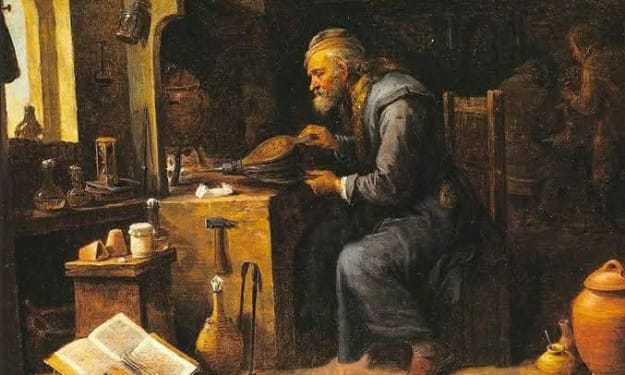
It is Baghdad in the 8th century. The night air carries a cool hush, but deep within one narrow alley, a small room glows under the flicker of oil lamps. Smoke swirls toward the ceiling where its tendrils twine with shadows that dance upon the walls. In the center stands an elderly man, his wise, sharp eyes fixed on his work. His hands move deftly among slender glass vessels, matte brass flasks, and copper bowls. With precision born of long hours and countless repetitions, he drips liquids—sometimes a drop of golden-yellow solution, other times two drops of milky white fluid—into a crucible of curiosity. Mutters escape his lips in Arabic: “قم بالتجارب لكي تكتسب المعرفة...” “Try experiments so that you may attain knowledge...” The night deepens. The lamp’s flame sputters. Smoke clings to the low ceiling, a stifling veil carrying the acrid scent of brimstone, burnt salt, and a hint of sour fruit. The old man’s face is etched with strain; sweat gleams across his forehead. His eyes, red-rimmed from sleepless nights and relentless focus, fix upon a long, curved glass tube—its lower end capped with a small flask. Within that flask, a single ruby-red drop trembles, falls—with the soft plink echoing in the cramped silence. Each drop is an announcement to his racing heart. This is Jābir ibn Ḥayyān, the legendary alchemist-scientist, consumed for the last decade by a singular obsession: the transformation of lead into gold. Jābir believed he could do so with the mythical Philosopher’s Stone or through a precise chemical process. Tonight, the dull, heavy chunk of lead before him remains stubbornly unchanged. The truth is, Jābir never succeeded in turning lead into gold. But his relentless trials pushed him to innovate: he designed new apparatus for distillation—the alembic; improved vessels for evaporation, crystallization, and safe containment of acids and alkalis. He meticulously documented sublimation, dissolution, oxidation, and hundreds of other reactions. These experiments earned him the title “Father of Chemistry.” For centuries, the flame of alchemy spread worldwide. By the 16th and 17th centuries, however, the dawn of empirical modern science dimmed alchemy’s enchantment. The dream of transmuting base metals into gold became recognized as nothing more than an alchemical myth. --- 🚀 And now—1,250 years later—May 7, 2025: Under the Alps, straddling the border between Switzerland and France, lies CERN’s Large Hadron Collider (LHC)—a colossal scientific engine buried deep beneath the earth. The contrast with Jābir’s smoky workshop—and both could not be more profound. Here, the air hums with the breath of supercomputers that analyze mountains of data, while physicists in spotless lab coats sit before console screens. They accelerate beams of protons nearly to the speed of light, steering them into ultra-high-energy collisions. Data graphs bloom on the screens, complex and intricate as constellations. The researchers wait, breath held, until a distinctive signal emerges—a pattern they’ve been searching for all along. A hush descends, then slowly, one scientist’s eyes widen. A hand lifts in silent marvel. Others hurriedly scan their monitors. They are witnessing it: by colliding lead nuclei with tremendous kinetic energy, they have changed the number of protons in atomic nuclei—transmuting lead into gold. In this moment, what Jābir pursued with crude tools in his humble room has finally been accomplished—with exquisite precision and staggering scale. --- 🌟 Continuum of Curiosity In that dimly lit workshop of 1,200 years ago, Jābir whispered: “قم بالتجارب لكي تكتسب المعرفة…” “Try experiments so that you may attain knowledge...” Tonight, deep beneath the earth, the echo of those words resonates once more—less a whisper, more a triumph. From glass flasks to stainless steel accelerators; from copper heating coils to cryogenic superconductors; from a lone man’s intuition to massive international teams… science has evolved, but its heartbeat remains unchanged. Jābir’s experiments laid the foundation. Early chemists refined his processes; medieval scholars classified substances, dedicated alchemical texts, and developed proto-laboratories. Over centuries, the blend of curiosity and precision gave birth to modern chemistry and physics—disciplines grounded in experimentation, measurement, and skepticism. --- 🔬 From Alchemy to Particle Collision Jābir’s Legacy: He invented the alembic, refined vessels for distilling and crystallizing, and formalized chemical terminology. He catalogued substances and reactions like oxidation and desiccation—planting the seeds of systematic chemical science. Scientific Revolution: As empirical methods took root in Europe, alchemy evolved into chemistry. Robert Boyle, Antoine Lavoisier, and others proposed rigorous standards: reproducibility, measurement, skepticism about hidden forces like “vital spirits.” The pursuit of transmutation faded, while focus shifted to atomic structures and molecular composition. Nuclear Transmutation: In the 20th century, Ernest Rutherford cracked the nucleus with alpha particles, discovering protons and pioneering artificial element transformation. Later, particle accelerators generated isotopes and exotic elements at scale. Modern Alchemy—The LHC Way: At CERN, researchers create fleeting new elements, test matter under extreme conditions, and sometimes observe transmutations—turning mercury, bismuth, or lead nuclei into higher elements like gold. Not economically viable, but monumental in human understanding. --- 🌌 A Lab of Dreams and Determination Jābir’s smoky room was powered by nothing but oil lamps and hope. He had no theory of the atom, no periodic table—only observation, intuition, and meticulous documentation. Modern science runs on gigawatts of electricity, millions of lines of code, and thousands of researchers, but it too is built on the same pillars: hypothesis, experiment, observation, and critical analysis. What unites them is simple yet profound: the human spirit’s hunger to know. One small drop falls in Jābir’s flask. One massive collision unfolds in the LHC. Both moments answer an enduring question: What happens when we push nature’s boundaries? In Baghdad’s dusty alley, Jābir heard it slow and close: > “قم بالتجارب لكي تكتسب المعرفة...” In Geneva’s corridors, tens of thousands of equations later, we hear it again. A whisper becomes a roar. --- ✨ Because Curiosity Never Dies Osama scientist or medieval alchemist—across time, cultures, and tools—the impulse to experiment remains the same. Whether mixing reagents or colliding nuclei, we challenge the unknown. Jābir didn’t make gold. Yet his inventions, records, and courage paved a path intellect traveled for millennia. Modern science stands on that foundation, and tonight, under the Alps, human ingenuity has turned the impossible into history. So the next time you hesitate—wondering whether a small experiment, a bold idea, or a simple question is worth the effort—remember: Curiosity is the spark, experimentation is the flame. قم بالتجارب لكي تكتسب المعرفة … “Try experiments so that you may attain knowledge.” And maybe, in your own way, you are building the future—one question, one drop, one collision at a time.
By Ikram Ullahabout a year ago in Futurism
What Will Jobs Look Like in 2040?
The world of work is undergoing rapid transformation, and by 2040, jobs will look dramatically different from what we know today. Driven by breakthroughs in technology, shifts in global demographics, and evolving human needs, the workplace of the future will blend automation, creativity, flexibility, and global collaboration in ways that are only beginning to take shape. The future of jobs in 2040 is not just a tech fantasy—it’s a practical vision that’s already unfolding.
By Muhammad Asimabout a year ago in Futurism