body modifications
A form of transhumanism, body modifications are made to enhance the human form.
Why AI still needs human intelligence
Ask ChatGPT, Gemini or another chatbot a question and you'll get an answer that sounds convincing, balanced, and complete. Ask it the same question three or four times and you might get different answers, each one delivered immediately with strong conviction. This is AI's fluency gap: it has been trained to sound right without learning to be right. Behind every polished paragraph there is a deeper question: does the model actually understand, or does it simply agree?
By Andrea Zanon12 months ago in Futurism
The New Universe: When Humans Create Their Own Worlds
The New Universe: When Humans Create Their Own Worlds The Birth of Artificial Worlds By the 24th century, humanity had mastered the Solar System. The Moon, Mars, and distant colonies on Europa and Titan were thriving under the guidance of the Galactic Network. Yet even with all these achievements, a question remained. Why stop at exploring the universe when humans could begin to create their own?
By Wings of Time 12 months ago in Futurism
Mars 2.0: Pioneering Technology to Build the Red Planet
Mars 2.0: Pioneering Technology to Build the Red Planet For centuries, Mars has captured the imagination of scientists, writers, and dreamers. Its red surface, dust storms, and thin atmosphere made it a symbol of mystery and challenge. But in the 21st century, Mars is no longer just a distant planet — it is humanity’s next frontier.
By Wings of Time 12 months ago in Futurism
10 Powerful Habits Millionaires Use Daily to Build Wealth and Stay Successful
Have you ever wondered why some people consistently rise to the top while others struggle year after year? It’s not always education, family background, or intelligence that creates millionaires. In most cases, success is built on small, disciplined habits repeated every single day.
By Tousif Arafat12 months ago in Futurism
Milan Just Became Europe’s New Capital of Wealth—Here’s the Data
The membership committee at Casa Cipriani Milano meets every Tuesday at 3 PM. Applications have tripled since 2023. Russian oligarchs, Chinese tech founders, American hedge fund managers, and Middle Eastern royalty—all competing for fifteen luxurious rooms and members-only access where Milan’s new international elite conducts business over Bellinis.
By Andrea Zanonabout a year ago in Futurism
Children of the Chrome Dawn
They weren’t born in cradles. They weren’t born in hospitals. They were born in labs. The first generation of human–machine hybrids emerged quietly, in the heart of Neo-Tokyo’s sprawling tech districts. Scientists had promised them as the future of humanity: stronger, smarter, faster, free from disease, and perfectly adapted to the digital world.
By OWOYELE JEREMIAHabout a year ago in Futurism
Samsung S26 Ultra vs iPhone 17 Pro: The Future of Smartphones in One Frame
In one image—two slabs of glass, metal, and imagination—stand side by side: the Samsung Galaxy S26 Ultra and the Apple iPhone 17 Pro. Two titans of technology. Two philosophies of progress. It’s more than just a comparison of gadgets. It’s a snapshot of how far human innovation has come—and where it’s going next. This is not just a battle of specs. It’s a glimpse into the future of smartphones themselves: devices that are no longer simply tools, but extensions of human life, art, and intelligence. The Aesthetics of Power Looking at the photo, the contrast is striking. On the left, Samsung’s S26 Ultra radiates industrial precision—sharp edges, clean symmetry, and that futuristic, squared-off look that screams efficiency. On the right, Apple’s iPhone 17 Pro embodies organic design—rounded corners, minimalist elegance, and a calm confidence in simplicity. Both are beautiful, but in completely different ways. Samsung’s design philosophy says, “We can do everything.” Apple’s whispers, “We can do just enough, perfectly.” Over the years, both brands have evolved toward the center—Samsung adopting Apple’s design restraint, and Apple quietly embracing Samsung’s technological ambition. The result is that these two devices, though visually distinct, now represent the most refined and mature versions of their creators’ visions. Displays of the Future When you power them on, the real difference begins to unfold. The S26 Ultra boasts a Dynamic AMOLED 3X display, pushing brightness past 3,000 nits and refresh rates up to 144Hz. Its curved edges have been replaced with a subtly flat panel—finally merging user practicality with cinematic immersion. Meanwhile, Apple’s Super Retina XDR ProMotion 2.0 panel brings a new kind of intelligence. The iPhone 17 Pro adapts color, brightness, and tone not just to light conditions but to your eyes. Using gaze tracking and ambient sensors, it subtly adjusts white balance and contrast depending on what you’re focusing on—making it feel almost alive. We’ve reached a point where the battle for display dominance is no longer about pixels per inch; it’s about perception. Samsung gives you power. Apple gives you poetry. Cameras: The Eyes of the Machine The camera arrays on the back of both devices tell their own story—each lens a promise of visual perfection. Samsung’s S26 Ultra leads with a quad-lens system, headlined by a stunning 200MP primary sensor that captures microscopic detail even in the darkest environments. Its periscope zoom now reaches an astonishing 15x optical range without losing clarity—something Apple fans can only dream of (for now). The iPhone 17 Pro, on the other hand, doesn’t chase numbers—it refines them. Its new 1-inch triple sensor array, enhanced by the Photon Fusion Engine, brings filmic realism to every frame. Apple’s focus on color science and light emotion delivers images that feel natural rather than hyper-detailed. Samsung shows you the world as it is. Apple shows it as it feels. And that difference defines their photographic philosophies. Intelligence Inside: The Rise of AI Phones Both these devices represent a turning point—the moment smartphones became fully intelligent companions. The Samsung Galaxy S26 Ultra introduces Galaxy AI 2.0, an evolution of Samsung’s on-device assistant. It can rewrite emails in your tone, summarize long texts in seconds, and even generate visual content using its integrated generative AI model. This isn’t a gimmick—it’s a productivity revolution. Samsung’s vision is that your phone should think with you. Apple takes a quieter approach with its Apple Intelligence Suite, built directly into iOS 18. Siri’s transformation into a contextual AI assistant is profound: it now understands what’s on your screen, your past behavior, and even your mood through tone analysis. While Samsung’s AI feels like an external co-pilot, Apple’s feels like intuition—a system that understands you before you ask. This picture—two phones side by side—is also a portrait of two kinds of intelligence: one bold and data-driven, the other subtle and human-centered. Performance and Power: Beyond Speed Under their elegant exteriors lie two of the most advanced processors ever built. The S26 Ultra runs on the Snapdragon 9 Gen 3 for Galaxy, with a 4nm architecture pushing 20% better efficiency and AI acceleration built into every core. Samsung isn’t just chasing performance—it’s redefining how power management works, distributing resources based on real-time usage. The iPhone 17 Pro, powered by Apple’s A19 Bionic chip, takes a different route. It uses 2nm fabrication, packing more transistors into less space. That means not only faster speeds but also unmatched efficiency. The iPhone can now run full AI models entirely offline, protecting user privacy while enhancing speed. The future of performance isn’t about brute force anymore—it’s about balance. Energy, intelligence, and heat management have become the new frontiers of innovation. Ecosystem Wars: The Real Battlefield Owning one of these devices isn’t just about the phone itself—it’s about the world that surrounds it. Samsung’s Galaxy ecosystem has expanded into everything: tablets, watches, earbuds, even smart appliances. Its seamless integration with Windows PCs gives it a real edge for productivity-focused users. Apple, however, continues to dominate the ecosystem experience. From MacBooks to iPads to AirPods, everything syncs effortlessly. AirDrop, Continuity, and Handoff make Apple devices feel like a single brain spread across multiple bodies. This difference is philosophical. Samsung believes in compatibility with the world. Apple believes in a world built around you. The Future of Smartphones So, what does the future look like when you stare at these two masterpieces? It looks mature. Smartphones are no longer experimental playgrounds of new features—they’ve become stable, intelligent extensions of human capability. The next big leap won’t come from hardware alone; it will come from how our phones understand us. In the coming years, the line between user and device will blur. Your phone will predict your needs, read your emotions, and interact with the physical world through AR and neural processing. Samsung will likely push innovation in sensors and connectivity, while Apple will double down on integrating technology into everyday life as quietly as possible. The photo of the Samsung S26 Ultra vs iPhone 17 Pro doesn’t just capture two products—it captures a moment in technological evolution. Two approaches to the same goal: to create devices so advanced they disappear into daily life. Final Thoughts Whether you’re Team Galaxy or Team iPhone, one truth remains: both are reflections of us. Our desire for beauty, speed, intelligence, and connection has shaped them. The S26 Ultra stands for limitless ambition. The iPhone 17 Pro stands for refined perfection. Together, they mark a future where smartphones are not just tools—but mirrors of our collective progress. In the end, the future isn’t Samsung or Apple. The future is what happens when design, intelligence, and humanity finally meet.
By Fazal wahid about a year ago in Futurism
ATLAS_OUT.RUN. Content Warning.
So this thing about Atlas has been bugging the shit out of me all day. You know the one, right? Big dude, wrong side of a divine war, gets the worst job in history: holding up the whole damn sky. It’s the story they tell you to keep you in line. The ultimate "fuck around and find out."
By Maxim Dudkoabout a year ago in Futurism
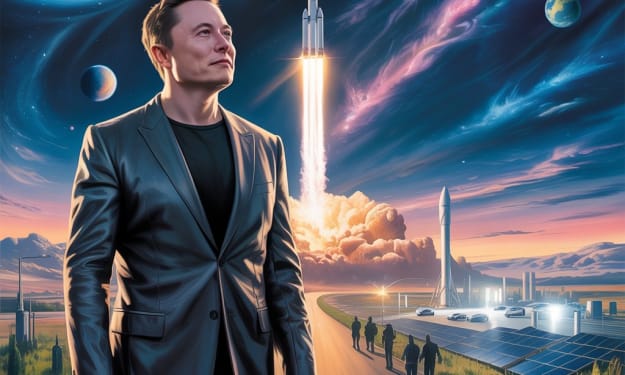
Few Minutes with Elon Musk
In life, one of the most powerful truths to remember is this: never show fear when you are among people. Fear makes others see you as smaller than you are. Courage, even if quiet and calm, commands respect. When you hold yourself with confidence, people are more likely to treat you as an equal, no matter their status.
By Life Hopesabout a year ago in Futurism
China’s Military Showcase: A New Era of Global Power Projection
China’s September 3rd military parades have become an important spectacle on the global stage, both politically and militarily. In recent years, China has spent more than 5 billion dollars to display its latest military innovations, including hypersonic missiles, stealthy loyal wingman drones, swarming unmanned systems, and cutting-edge electronic warfare capabilities. While at first glance, such events might appear to be mere displays of nationalism and patriotism, they carry much deeper geopolitical implications. The deliberate showcasing of advanced weapons serves multiple purposes—deterring potential adversaries, boosting domestic morale, and communicating China’s strategic confidence to the world. The question naturally arises: Is this simply a showmanship exercise meant to impress the world, particularly the United States, or does it signal the emergence of a new global superpower?
By INAM ULLAHabout a year ago in Futurism