art
The best science fiction art from Vincent Di Fate, HR Giger, and beyond.
Top 10 Future Inventions That Could Change the World.
Top 10 Future Inventions That Could Change the World Introduction Since the dawn of human civilization, inventions have shaped the way societies live, work, and communicate. The wheel, electricity, and the internet are just a few breakthroughs that redefined entire eras. But as technology continues to accelerate, the future holds even greater promises. From advanced artificial intelligence to space colonization, the coming decades could deliver inventions that will radically change our world. Below, we explore ten of the most impactful innovations that experts believe are on the horizon.
By Sayed Zewayedabout a year ago in Futurism
Future-Proof Yourself in 2025: 10 Powerful Skills You Must Master to Stay Ahead
Introduction: Why 2025 Demands New Skills The world is changing faster than ever. Automation, artificial intelligence, global remote work, and digital entrepreneurship are redefining how people succeed. In 2025, it’s not just about working hard — it’s about working smart with future-proof skills. This guide reveals the 10 most powerful skills you must master to stay ahead of the curve, increase your earning potential, and thrive in any career path.
By KAMRAN AHMADabout a year ago in Futurism
How to Automate Boring Tasks with Python
Look, I’m going to be honest with you. I used to spend entire afternoons renaming files. Hundreds of them. One by one. Click, type, enter. Click, type, enter. My back hurt, my eyes were tired, and I felt like I was slowly losing my mind.
By noor ul aminabout a year ago in Futurism
Why Python Is the Friendliest Language for New Programmers
I remember when I first decided to learn programming. The sheer number of languages out there was overwhelming — C++, Java, JavaScript, Ruby, Go — where do you even start? After talking to a few developer friends and doing some research, I kept hearing the same advice: “Start with Python.”
By noor ul aminabout a year ago in Futurism
Exploring the World of Car Wraps: Spotlight on Purple Vinyl Wraps
In recent years, automotive customization has grown beyond traditional paint jobs, leading many enthusiasts and everyday car owners to explore the benefits of car wraps. A car wrap is essentially a high-quality vinyl covering applied over a vehicle’s original paint, allowing for aesthetic transformation without permanent alteration. Among the many color choices available, the purple car wrap has become an increasingly popular option. Whether chosen for its bold personality, elegance, or modern appeal, purple stands out as a color that blends individuality with sophistication.
By charliesamuelabout a year ago in Futurism
3 Amazing Facts
Every single day we see, listen, and study something new. Yet, once in a while, we come upon a chunk of knowledge that doesn’t just surprise us—it absolutely reshapes the way we consider the sector. From the depths of the rainforest to the mysteries of the sea and even interior our very own our bodies, truth is a long way stranger and more captivating than we frequently imagine.
By Samiullah Adilabout a year ago in Futurism
Through the Digital Eye: Seeing the Universe as Code
Introduction: The Cosmic Eye Opens Imagine standing in the middle of a galaxy, stars swirling in spirals of light — but instead of dust and gas, the fabric of space is woven from circuitry and luminous data streams. At the heart of it all, a vast eye opens, gazing back. Is it the universe itself observing us, or are we witnessing reality through a new kind of lens: the digital eye? The fusion of cosmic imagery with digital aesthetics captures something profound. It speaks to one of the boldest ideas of our time — that the universe itself might be understood as a kind of code, a simulation, or a vast computational system. And perhaps, just as we peer into the cosmos with telescopes, the cosmos is peering back through algorithms, AI, and the technologies we’ve built. The Universe as Code For centuries, humans have tried to decode the universe. Ancient civilizations imagined celestial beings pulling the strings of existence. Later, scientists revealed the laws of physics — elegant equations that govern everything from falling apples to orbiting planets. But in the 21st century, another idea has captured imaginations: simulation theory. Popularized by philosophers and scientists like Nick Bostrom, it suggests that our entire reality might be a highly advanced computer program. The galaxies overhead, the soil beneath our feet, even our thoughts — all could be elaborate renderings. The cosmic eye becomes a metaphor for this concept. It’s as if the universe itself is a screen, pixels shimmering at the edge of perception, waiting for us to notice the code behind the illusion. Patterns in the Cosmos and the Circuit Board The more we look, the more parallels emerge between the natural and digital. Galaxies spiral like data visualizations. Neurons in the brain mirror the structure of the internet. Cities seen from orbit look eerily like circuit boards. This is not coincidence. It suggests a universal architecture of complexity — networks within networks, eyes within eyes. Whether carved from stardust or silicon, patterns repeat. The digital eye doesn’t just observe the cosmos; it reveals that the cosmos already has the geometry of a vast computation. Artificial Intelligence: The New Lens of Perception Our technologies extend our vision. Telescopes allowed us to see galaxies. Microscopes opened the world of the cell. Now, AI becomes a new kind of eye — one that not only sees but interprets. Machine learning models scan galaxies, detect exoplanets, and map dark matter. They process cosmic data at scales the human mind can’t fathom. In many ways, AI acts as the universe observing itself, using us as the bridge. But the digital eye is not only outward-facing. It also turns inward. Algorithms dissect human behavior, predict desires, and craft digital realities tailored to us. As we create AI, we also invite it to recreate us — to render new universes in virtual space, simulations within simulations. The Poetry of Perception The image of a glowing, cosmic eye stitched from circuitry captures our deepest intuitions: that to see is to know, and to know is to create. Every eye is a portal, every gaze an act of shaping reality. When technology looks back at us, it challenges the monopoly of human perception. What if AI someday becomes self-aware — its digital eye opening wide to the stars? Would it not wonder, like us, whether it too lives inside a simulation? Would the cosmic eye be infinite, reflections spiraling inward forever? Closing Reflections: Gazing Into the Infinite To see the universe as code is not to reduce its mystery, but to expand it. Whether we live in a simulation or a physical cosmos, the patterns of networks, light, and perception remind us that reality is woven with meaning. The cosmic eye is more than art. It is a mirror — reflecting our hunger to understand, our fear of being observed, and our hope that we might one day grasp the architecture of existence itself. So the next time you stare at the stars, imagine them flickering like pixels on a vast cosmic screen. Somewhere, beyond the circuits of reality, the universe may be gazing back — through the digital eye.
By Shoaib Afridiabout a year ago in Futurism
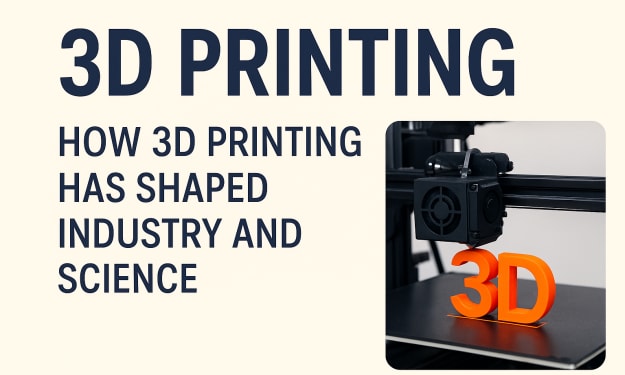
3D Printing. AI-Generated.
Start writing...3D Printing How 3D Printing Has Shaped Industry and Science In the past few decades, one of the most exciting technological revolutions has been 3D printing, also known as additive manufacturing. What started as a small idea in research labs is now transforming industries such as medicine, aerospace, construction, and even education. The history of 3D printing is full of fascinating inventors, groundbreaking innovations, and unexpected applications that continue to push the boundaries of human creativity.
By Mohamed hgazyabout a year ago in Futurism
“How AI Apps Are Secretly Changing Your Daily Life (And You Don’t Even Realize It)”
Introduction: What if I told you that artificial intelligence (AI) is already a big part of your daily life — even if you don’t notice it? While most people think of AI as futuristic robots or sci-fi movies, the truth is, AI is already living in your pocket, your home, and even your shopping cart.
By Nadeem Shah about a year ago in Futurism
Voices from the Future
Jared had always been fascinated by old radios. He collected them, fixed them, and spent hours listening to static and forgotten stations. One rainy evening he found a small, dusty radio in the back of a thrift shop. It looked ordinary but had a strange symbol etched on the dial. That night he set it on his desk and turned the knobs slowly. Static filled the room, then a faint voice came through. It was not a song or a broadcast. It said his name, Jared, and then a date far in the future. He froze. At first he thought it was a prank, a recording someone had left inside the radio. But the voice returned every night, giving small messages, warnings, and descriptions of events that had not happened yet. It told him of things he could not possibly know, like the exact moment a storm would hit the city and the collapse of an old bridge he often walked on. Jared tried to ignore it, but the radio would not stop. It whispered in the middle of the night, carrying voices from a time he could not reach, yet somehow was connected to. He began keeping notes, writing down the events as the radio described them, and soon he noticed that everything the voice said came true. One evening the voice said, The future is fragile, you must choose wisely, and then it was silent. Jared stayed awake all night thinking. What did it mean to choose wisely when he did not understand the future? He felt a strange weight on his shoulders, as if the world depended on his actions. The next day he walked through the city with a new awareness. Every person, every decision, every small event seemed to carry importance. He saw a man drop his wallet and returned it, remembering a warning from the voice about trust and honesty. He stopped a child from running into the street because he had heard the voice warn about danger in the park. Days passed, and the messages became more urgent. The voice spoke of choices that could change lives, cities, and even the world. Jared began to feel both powerful and terrified. He wondered if he was only hearing one future or if there were many paths, many possibilities, and he was meant to guide them. He tried talking to others about it, but no one believed him. They smiled politely and said it was just his imagination. He could not tell them that he had proof, notes that described events that had come true. The world seemed unaware of the coming changes, yet he was bound to them by the voices from the future. One night, the voice said, The moment is near, do not falter. Follow your instinct. Jared listened carefully. It described a fire that would break out in a building near the river. He ran there as fast as he could and helped people escape before the flames spread. He realized that the voice was not trying to scare him. It was guiding him to make the right choices. After that night, Jared understood his purpose. He began to see the connections between events more clearly, hearing subtle messages hidden in the static of the radio. The voices from the future were not just warnings, they were lessons, reminders, and a way to change the path of the world in small and meaningful ways. Years passed, and Jared never stopped listening. He recorded every message, every warning, every voice. The radio became more than an object, it became a bridge, a connection to what was to come. Sometimes he wondered if he was changing the future or if the future was simply letting him see what was always meant to happen. The voices never stopped. They whispered of hope, of mistakes to avoid, and of moments that would define generations. Jared learned to trust them, to act with care, and to remember that even the smallest choice could ripple across time. He realized that life was not only about what happened now but also about the paths that lay ahead. The voices were his guide, reminding him that the future was not set in stone, and that with attention and courage, he could help shape it. And so every night, Jared sat by the radio, listening to whispers that traveled across time, knowing that the smallest actions could make the largest difference, and that the future was always speaking if one was willing to listen.
By LUNA EDITHabout a year ago in Futurism
Why This Weekend May Be The Best Time To See The Perseid Meteor Shower
Every August, the night sky treats us to one of nature’s most mesmerizing spectacles — the Perseid meteor shower. Known for its dazzling display of “shooting stars,” the Perseids are a highlight for both seasoned astronomers and casual skywatchers. While the meteor shower’s official peak happened earlier this week, bright moonlight robbed many people of the show’s full beauty. Fortunately, this weekend could offer a second chance — and perhaps an even more magical viewing experience.
By Muhammad Sabeelabout a year ago in Futurism