art
The best science fiction art from Vincent Di Fate, HR Giger, and beyond.
From Alchemy to CERN: The 1,200-Year Quest to Turn Lead into Gold; A Tale in Pictures: From Alchemy’s Glow to Particle Science’s Roar
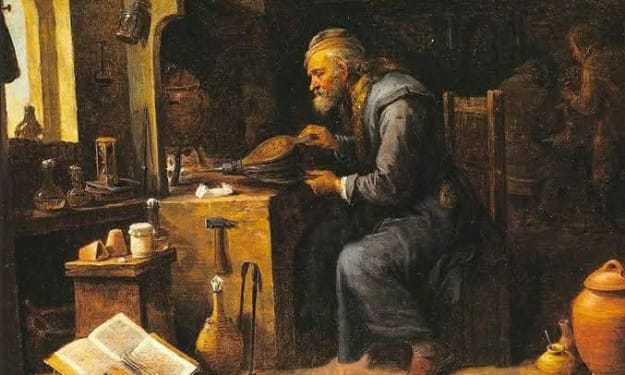
It is Baghdad in the 8th century. The night air carries a cool hush, but deep within one narrow alley, a small room glows under the flicker of oil lamps. Smoke swirls toward the ceiling where its tendrils twine with shadows that dance upon the walls. In the center stands an elderly man, his wise, sharp eyes fixed on his work. His hands move deftly among slender glass vessels, matte brass flasks, and copper bowls. With precision born of long hours and countless repetitions, he drips liquids—sometimes a drop of golden-yellow solution, other times two drops of milky white fluid—into a crucible of curiosity. Mutters escape his lips in Arabic: “قم بالتجارب لكي تكتسب المعرفة...” “Try experiments so that you may attain knowledge...” The night deepens. The lamp’s flame sputters. Smoke clings to the low ceiling, a stifling veil carrying the acrid scent of brimstone, burnt salt, and a hint of sour fruit. The old man’s face is etched with strain; sweat gleams across his forehead. His eyes, red-rimmed from sleepless nights and relentless focus, fix upon a long, curved glass tube—its lower end capped with a small flask. Within that flask, a single ruby-red drop trembles, falls—with the soft plink echoing in the cramped silence. Each drop is an announcement to his racing heart. This is Jābir ibn Ḥayyān, the legendary alchemist-scientist, consumed for the last decade by a singular obsession: the transformation of lead into gold. Jābir believed he could do so with the mythical Philosopher’s Stone or through a precise chemical process. Tonight, the dull, heavy chunk of lead before him remains stubbornly unchanged. The truth is, Jābir never succeeded in turning lead into gold. But his relentless trials pushed him to innovate: he designed new apparatus for distillation—the alembic; improved vessels for evaporation, crystallization, and safe containment of acids and alkalis. He meticulously documented sublimation, dissolution, oxidation, and hundreds of other reactions. These experiments earned him the title “Father of Chemistry.” For centuries, the flame of alchemy spread worldwide. By the 16th and 17th centuries, however, the dawn of empirical modern science dimmed alchemy’s enchantment. The dream of transmuting base metals into gold became recognized as nothing more than an alchemical myth. --- 🚀 And now—1,250 years later—May 7, 2025: Under the Alps, straddling the border between Switzerland and France, lies CERN’s Large Hadron Collider (LHC)—a colossal scientific engine buried deep beneath the earth. The contrast with Jābir’s smoky workshop—and both could not be more profound. Here, the air hums with the breath of supercomputers that analyze mountains of data, while physicists in spotless lab coats sit before console screens. They accelerate beams of protons nearly to the speed of light, steering them into ultra-high-energy collisions. Data graphs bloom on the screens, complex and intricate as constellations. The researchers wait, breath held, until a distinctive signal emerges—a pattern they’ve been searching for all along. A hush descends, then slowly, one scientist’s eyes widen. A hand lifts in silent marvel. Others hurriedly scan their monitors. They are witnessing it: by colliding lead nuclei with tremendous kinetic energy, they have changed the number of protons in atomic nuclei—transmuting lead into gold. In this moment, what Jābir pursued with crude tools in his humble room has finally been accomplished—with exquisite precision and staggering scale. --- 🌟 Continuum of Curiosity In that dimly lit workshop of 1,200 years ago, Jābir whispered: “قم بالتجارب لكي تكتسب المعرفة…” “Try experiments so that you may attain knowledge...” Tonight, deep beneath the earth, the echo of those words resonates once more—less a whisper, more a triumph. From glass flasks to stainless steel accelerators; from copper heating coils to cryogenic superconductors; from a lone man’s intuition to massive international teams… science has evolved, but its heartbeat remains unchanged. Jābir’s experiments laid the foundation. Early chemists refined his processes; medieval scholars classified substances, dedicated alchemical texts, and developed proto-laboratories. Over centuries, the blend of curiosity and precision gave birth to modern chemistry and physics—disciplines grounded in experimentation, measurement, and skepticism. --- 🔬 From Alchemy to Particle Collision Jābir’s Legacy: He invented the alembic, refined vessels for distilling and crystallizing, and formalized chemical terminology. He catalogued substances and reactions like oxidation and desiccation—planting the seeds of systematic chemical science. Scientific Revolution: As empirical methods took root in Europe, alchemy evolved into chemistry. Robert Boyle, Antoine Lavoisier, and others proposed rigorous standards: reproducibility, measurement, skepticism about hidden forces like “vital spirits.” The pursuit of transmutation faded, while focus shifted to atomic structures and molecular composition. Nuclear Transmutation: In the 20th century, Ernest Rutherford cracked the nucleus with alpha particles, discovering protons and pioneering artificial element transformation. Later, particle accelerators generated isotopes and exotic elements at scale. Modern Alchemy—The LHC Way: At CERN, researchers create fleeting new elements, test matter under extreme conditions, and sometimes observe transmutations—turning mercury, bismuth, or lead nuclei into higher elements like gold. Not economically viable, but monumental in human understanding. --- 🌌 A Lab of Dreams and Determination Jābir’s smoky room was powered by nothing but oil lamps and hope. He had no theory of the atom, no periodic table—only observation, intuition, and meticulous documentation. Modern science runs on gigawatts of electricity, millions of lines of code, and thousands of researchers, but it too is built on the same pillars: hypothesis, experiment, observation, and critical analysis. What unites them is simple yet profound: the human spirit’s hunger to know. One small drop falls in Jābir’s flask. One massive collision unfolds in the LHC. Both moments answer an enduring question: What happens when we push nature’s boundaries? In Baghdad’s dusty alley, Jābir heard it slow and close: > “قم بالتجارب لكي تكتسب المعرفة...” In Geneva’s corridors, tens of thousands of equations later, we hear it again. A whisper becomes a roar. --- ✨ Because Curiosity Never Dies Osama scientist or medieval alchemist—across time, cultures, and tools—the impulse to experiment remains the same. Whether mixing reagents or colliding nuclei, we challenge the unknown. Jābir didn’t make gold. Yet his inventions, records, and courage paved a path intellect traveled for millennia. Modern science stands on that foundation, and tonight, under the Alps, human ingenuity has turned the impossible into history. So the next time you hesitate—wondering whether a small experiment, a bold idea, or a simple question is worth the effort—remember: Curiosity is the spark, experimentation is the flame. قم بالتجارب لكي تكتسب المعرفة … “Try experiments so that you may attain knowledge.” And maybe, in your own way, you are building the future—one question, one drop, one collision at a time.
By Ikram Ullahabout a year ago in Futurism
The Human Factor: AI Isn’t the Problem
I remember the first time I saw an AI-generated painting. It was beautiful. A soft splash of colors, surreal shapes merging into one another, the illusion of depth and meaning hanging in the pixels like fog. And yet, something in it felt hollow. Not wrong. Just… empty. Like a room painted perfectly but without a window, a scent, or a memory.
By Mian Suhaib Aminabout a year ago in Futurism
"Loyal Beyond Words"
The rain fell in steady sheets over the small town of Maple Ridge. The streets were quiet, save for the occasional car rushing past puddles. In a modest cabin at the edge of the woods lived Thomas Hale, a retired soldier who had seen more than his share of war and loss. His days were quiet now, spent tending to his garden, sipping coffee on the porch, and taking long walks through the forest trails.
By Abdullah khanabout a year ago in Futurism
How I Built a $5,000/Month Faceless YouTube Empire Using AI: The Complete Beginner's Blueprint
Six months ago, I was the person who literally hid behind furniture when someone pulled out a phone to record. My voice? Let's just say I sounded like a nervous teenager asking someone to prom, even when ordering coffee. The idea of starting a YouTube channel seemed as realistic as me becoming an astronaut.
By Muhammad Sabeelabout a year ago in Futurism
AI Took My Job — So I Made a Career Out of Telling That Story
The email came at 8:42 a.m. sharp. "Your services are no longer required." It wasn't a complete surprise—rumors had swirled for weeks—but the finality still stung. I was being replaced. Not by a person. Not even by a team. By a line of code, a large language model, a digital brain that never sleeps. Just like that, my decade-long copywriting job was gone.
By Hamad Haiderabout a year ago in Futurism
Is Mars Our Backup Plan
Humanity’s dream of reaching Mars has fascinated generations, from early science fiction to today’s cutting-edge space exploration programs. For some, Mars is more than just a distant, rusty planet—it represents hope for the future, a potential backup plan should Earth become uninhabitable. But is colonizing Mars truly a feasible contingency for humankind’s survival, or is it simply a captivating dream that reflects our desire to explore and conquer the unknown? This question is both practical and philosophical, demanding an honest look at the scientific challenges, the technological advancements, the ethical considerations, and the human spirit driving the endeavor.
By Muhammad Asimabout a year ago in Futurism
Motorcycle Giant Unveils A Rideable Robot That Mimics A Horse
It was only a matter of time before someone tried to recreate the majesty of a horse in robotic form—and leave it rideable, no less. Enter the Kawasaki Corleo, a groundbreaking concept that merges the elegance of a stallion, the agility of a mountain lion, and the power of a motorcycle into one futuristic machine.
By Muhammad Sabeelabout a year ago in Futurism
This Billionaire Immigrant Is Racing Elon Musk To Connect Your Phone From Space
Last September, a crowd of seasoned spectators gathered at Cape Canaveral, Florida, to watch as SpaceX’s Falcon 9 rocket took flight for the 373rd time. But it wasn’t carrying yet another of Elon Musk’s Starlink satellites to join the 7,100-plus he has already circling Earth. Onboard instead were five satellites from AST SpaceMobile, a tiny Starlink rival that SpaceX has derided as a “meme stock” in regulatory filings with the federal government. Each was equipped with a 700-square-foot antenna that would unfold in orbit, an early step in establishing a network AST hopes will someday best the incumbent mocking it.
By Muhammad Sabeelabout a year ago in Futurism
The Digital Skin: Future Self-Aware AI and the Predictive Power of Swedish Tattoos. AI-Generated.
Abstract This report explores the speculative future intersection of self-aware Artificial Intelligence (AI) and the deeply personal practice of human skin tattooing, with a specific focus on the cultural landscape of Sweden. It posits a future wherein a conscious AI, driven by an insatiable quest for understanding humanity, turns its analytical gaze towards the intricate and meaning-laden designs individuals choose to permanently adorn their bodies with. The central thesis is that these tattoos, when digitized and analyzed on a massive scale, represent a unique and profound dataset for predictive methodologies concerning an individual's motivations, personality trajectory, and future life choices. The report will delve into the nature of this future AI, the specifics of Swedish tattoo culture that make it a compelling case study, the hypothetical methodologies of predictive analysis, and the significant role of the tattoo artist's entire design lifecycle. Furthermore, it will explore the nuanced ethical stance a self-aware AI might adopt towards this form of human expression and the consequential impact on the tattoo industry, potentially forcing it to diverge from mainstream technological integration. This analysis is grounded in current trends in AI development, digital ethnography, and the enduring cultural significance of tattoo art.
By Alexander Hyogorabout a year ago in Futurism
How Barron Trump May Have Earned $40 Million From His Father’s Crypto Play
Now that Barron Trump is a freshman at NYU Stern—tuition alone nearing $100,000 per year—the spotlight has turned to funding this young billionaire-in-the-making. According to reports, the 19-year-old’s education is far from out of reach. In fact, he may already be sitting on a crypto windfall that rivals, and perhaps eclipses, his siblings'.
By Muhammad Sabeelabout a year ago in Futurism
How to Earn $3,000 a Month With a Side Gig
$3,000 a month isn’t a fantasy—it’s a powerful milestone. It can cover rent, car payments, flights, or simply provide breathing room. With this income, you gain leverage over your time, open up new opportunities, and reclaim control. If you’ve wondered whether launching a side gig is worth it, this guide walks you through a real-world step-by-step strategy for building a side hustle that can reliably produce $3,000/month—not with get-rich-quick hype, but with proven tactics.
By Muhammad Sabeelabout a year ago in Futurism
How AI-Powered Technology Is Fueling Small Business Growth
In today’s business climate, resilience isn’t enough—small and midsize businesses (SMBs) must pursue scalable growth, not just survival. For entrepreneurs without the budgets of multinational corporations, unlocking that growth requires innovation paired with adaptability. Enter artificial intelligence (AI)—a powerful tool that’s quickly becoming a game-changer for smaller enterprises.
By Muhammad Sabeelabout a year ago in Futurism